

In the Russian Orthodox Church, the eagle rug is a small round rug that is put under the feet of a bishop during the divine service. It covers the ambon — a place in front of the altar.
Bishops, archbishops, and metropolitans traditionally belong to the episcopal rank. They head dioceses and metropolias, appoint and remove clergy, monitor the construction and development of churches, perform all church sacraments, and are considered the main teachers of the faith.
An episcopal divine service is a solemn event for any church and its parishioners. A special vestment is prepared for the priest: a mantle, an omophorion ribbon, a pastoral staff, and a high headdress — a miter.
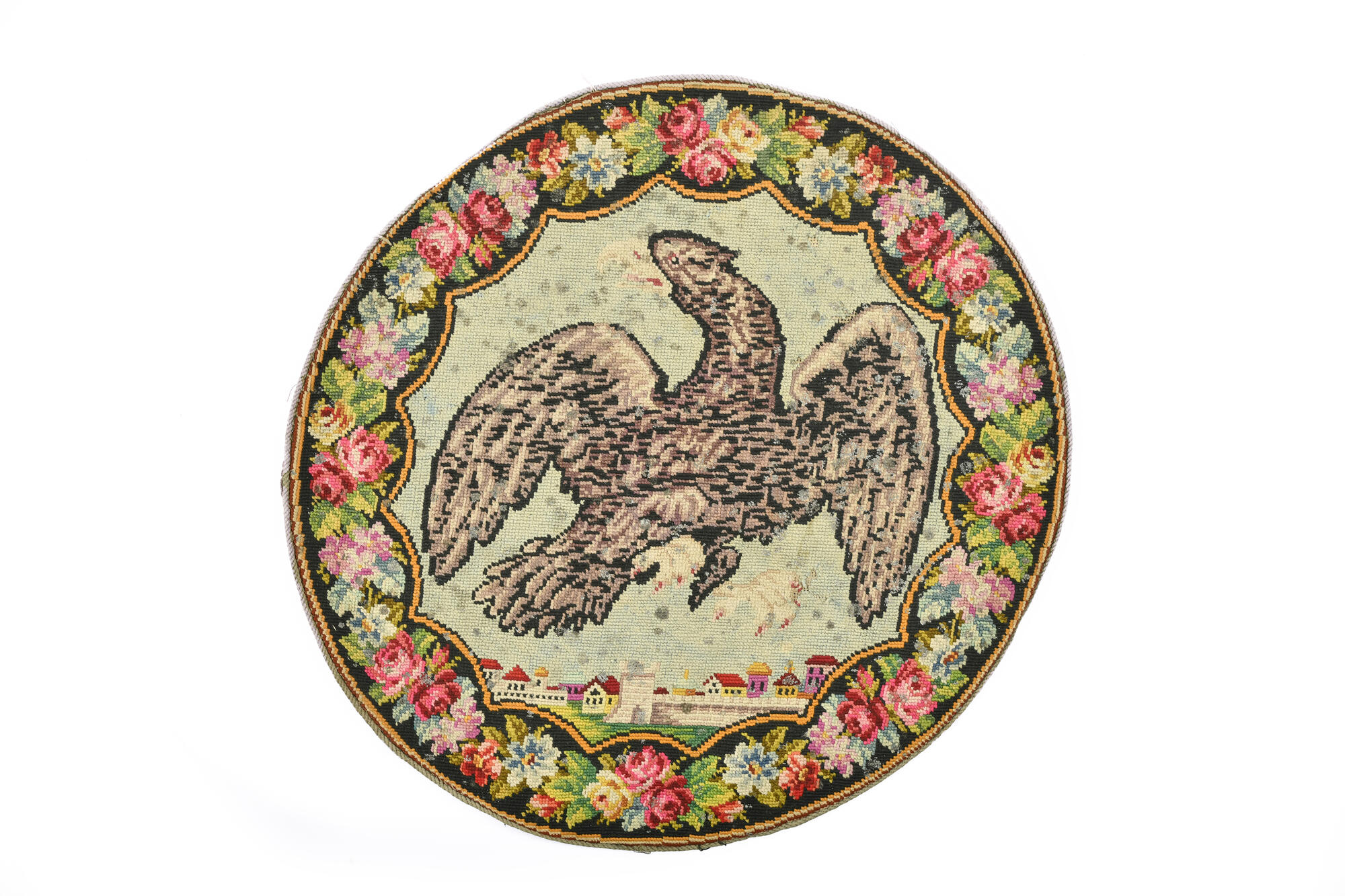
The name “eagle rug” comes from the traditional image that is placed on it: an eagle hovering over the city. This bird symbolizes spiritual purity, God’s patronage, and the bishop’s high rank. It was believed that the priest metaphorically rests on the eagle’s back and rises above the flock. No one but him has the right to set foot on an eagle rug. The round shape of the rug embodies infinity and universal equality in the eyes of the Lord.
The eagle rug from the Bishop’s House collection entered the funds from the Church of the Archangel Michael, according to legend. This church is one of the oldest in the city: it was built in 1759. The famous Russian writer, the author of “The Little Humpbacked Horse” Pyotr Ershov was married in it.
The front side of the rug is embroidered with worsted — colored woolen threads. The pattern is made in the half-cross technique or, as it was called in the old days, slanting stitch. There is a dark brown eagle with an open beak and wide-spread wings in the center, on a sky-blue background. Below it, one can see a cityscape — white buildings with red roofs.
There is a wide border with a floral ornament on a black background around the central field. It symbolizes the terra firma in the church tradition. The pattern consists of violets and pink buds; they are framed by wide green leaves. Along the edge, the rug is sewn with a dense cord, which prevents the fabric from crumbling and helps keep its shape.
Bishops, archbishops, and metropolitans traditionally belong to the episcopal rank. They head dioceses and metropolias, appoint and remove clergy, monitor the construction and development of churches, perform all church sacraments, and are considered the main teachers of the faith.
An episcopal divine service is a solemn event for any church and its parishioners. A special vestment is prepared for the priest: a mantle, an omophorion ribbon, a pastoral staff, and a high headdress — a miter.
The name “eagle rug” comes from the traditional image that is placed on it: an eagle hovering over the city. This bird symbolizes spiritual purity, God’s patronage, and the bishop’s high rank. It was believed that the priest metaphorically rests on the eagle’s back and rises above the flock. No one but him has the right to set foot on an eagle rug. The round shape of the rug embodies infinity and universal equality in the eyes of the Lord.
The eagle rug from the Bishop’s House collection entered the funds from the Church of the Archangel Michael, according to legend. This church is one of the oldest in the city: it was built in 1759. The famous Russian writer, the author of “The Little Humpbacked Horse” Pyotr Ershov was married in it.
The front side of the rug is embroidered with worsted — colored woolen threads. The pattern is made in the half-cross technique or, as it was called in the old days, slanting stitch. There is a dark brown eagle with an open beak and wide-spread wings in the center, on a sky-blue background. Below it, one can see a cityscape — white buildings with red roofs.
There is a wide border with a floral ornament on a black background around the central field. It symbolizes the terra firma in the church tradition. The pattern consists of violets and pink buds; they are framed by wide green leaves. Along the edge, the rug is sewn with a dense cord, which prevents the fabric from crumbling and helps keep its shape.