The exhibition of the Tanais Archaeological Museum-Reserve features ancient lamps found in the Northern Black Sea Region. These lamps provide insight into the region’s foreign economic relations.
Lamps were typically made of clay or metal. In the second half of the 2nd century BCE, they began to be produced using two molds (an upper and a lower one), with clay pressed manually inside them. Such lamps were filled with olive oil or cheaper oil mixtures which emitted smoke, deposited soot in the wick holes, and provided dim lighting. It is believed that Tanais lamps were filled with either olive oil, the city’s main import product, or melted animal fat.
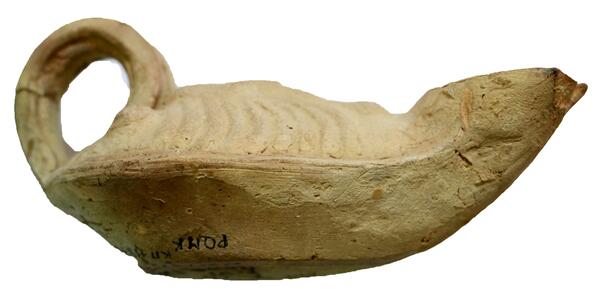
The oil lamp on display was discovered in 1978 in the basement of an estate in the center of the Tanais citadel. It is composed of two parts — an upper and a lower one — which were made separately using special molds and then joined together. At the bottom of the lamp there is an ovoid tray with a pointed end facing the spout. The shield is narrow and rounded, framed with a bead. The shoulders are very steep and decorated with a shell-like relief pattern with nine wavy grooves. The opening of the spout is rounded and rather wide, slightly raised upwards. The handle is loop-shaped and raised highly above the shield, with a groove running along its outside. There are also rounded attached elements on either side of the handle. There is also a relief bead running from the central hole towards the spout with a rounded convex element near the spout. The lamp is made of dense high-quality clay, orange in color with some inclusions.
Lamps in the Northern Black Sea Region were an essential element of daily life used by the representatives of all segments of society. They illuminated various rooms in city buildings. Cheaper clay lamps were used in service facilities, while more expensive bronze ones were reserved for the rooms of house owners and guest rooms. Additionally, there were molded lamps, made by the residents of Tanais and surrounding areas.