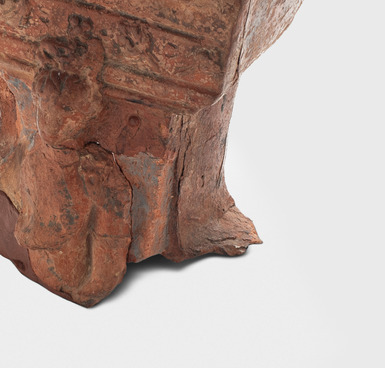
The exhibition of the Tanais Archaeological Museum-Reserve includes a terracotta figurine depicting the goddess Aphrodite.”
In the first centuries of the common era, this goddess was known on the Bosporus as Aphrodite Apaturia (the Deceitful). This local myth was described by the Greek historian Strabo in his work “Geography”. When Aphrodite was attacked by giants, the enemies of the Olympian gods, she called Heracles to her assistance. He concealed himself in a cavern. She then lured the giants one by one and surrendered them to Heracles to kill them. In this way, she deceived her enemies and received the nickname “Apaturia” (from the Greek “ἀπάτη” meaning “deception”). The cult of Aphrodite was highly developed on the Taman Peninsula. Researchers still cannot pinpoint the exact areas of its presence. Moreover, some researchers disagree with the established interpretation of the epithet “Apaturia” and have a different opinion. They argue that in almost all ancient Greek cities inhabited by the Ionians, including those on the Taman Peninsula, a special festival called Apaturia was celebrated annually. It symbolized the religious unity of various phratries, or clans. During this festival, newborn children and newly married women were registered in the lists of the phratries.
The standing figure of the goddess, found during
excavations at the Tanais necropolis, is placed on a profiled rounded base.
This is Aphrodite Apaturia, a small female figure wearing a high-girdled
chiton. She holds an apple in her right hand and a mirror in her left. Her hair
falls in large curls on both sides of her face, framing it and reaching her
shoulders. She has an elongated face with a large nose. She wears a calathus on
her head — a woven basket used to hold fruit or flowers — with a blanket thrown
on top. The chiton has a triangular neckline and a vertical fold down the
center. It descends and fits tightly around the legs, revealing the feet. Judging by the quality of its molding, the terracotta figurine likely came from
the Bosporan Kingdom. Terracotta figurines are not a common find in Tanais, but
they have been found in the settlement, necropolis, and even garbage layers.