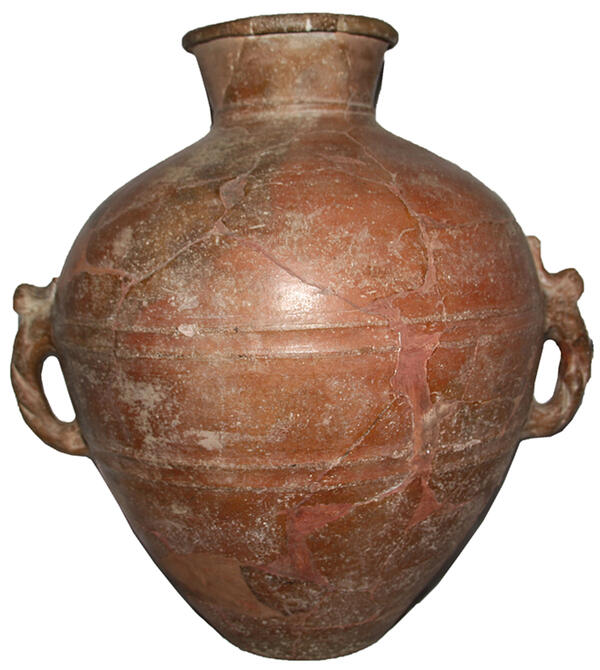
The exhibition of the Tanais Archaeological Museum-Reserve features a jug that was discovered in 1965 during excavations at one of the wealthy estates from the first half of the 3rd century CE.
The estate was large and had a spacious underground warehouse where the owners stored amphorae filled with grain, wine, and other goods for trading. The room where the jug was found served not only as a kitchen but also as a large bakery, supplying the entire neighborhood with bread. Vessels like this were produced in the Central Fore-Caucasus region. They were brought to Tanais along with the products from that area.
This is a large, wheel-thrown, gray clay jug with two vertical handles. The rim is turned outwards, forming a coil that is slightly trimmed from below. The neck is low, tapering towards the bottom, abruptly turning into a sphero-conical body. The lower part of the jug’s neck is decorated with a horizontal coil. Where the jug’s body meets the handles at the top and at the bottom, there are pairs of shallow, horizontally polished grooves. The bottom of the jug is concave. In the middle of the body, at its widest point, there is a symmetrical pair of vertical handles twisted from three round elements. These handles are small but quite massive. Their upper ends are attached to the body through holes in the sides, while the lower ends are simply glued onto the outside surface. At the top of each handle, there is a protruding, rounded image representing the head of an animal, with a long, bent “trunk” turning up, perpendicular to the jug’s body at its shoulder. On the sides of the head, there are small “eyes” attached to the surface. Another such element can be found on the trunk-shaped bend. The clay is brownish in color, with a rough texture and an abundant mixture of sand and dark particles. The polished surface is brown with a yellowish tint.
The products created by Alan potters during this time period are characterized by their unique firing techniques, shapes, and proportions of the vessels, as well as their zoomorphic and anthropomorphic decorative elements. Zoomorphic handles and spouts add a certain sophistication and mystique to the vessels. The handles are elegant, and the additional elements help to integrate the object seamlessly into any space and enhance their aesthetic value.