Font
Color
Graphics
Изображение точки

To see AR mode in action:

1. Install ARTEFACT app for iOS or Android;

2. Find the exhibition «Russians. Late 19th — Early 20th Century»

3. Push the «Augmented reality» button and point your phone's camera at the exhibit;

Скрыть точки интересаПоказать точки интереса
Показать в высоком качестве

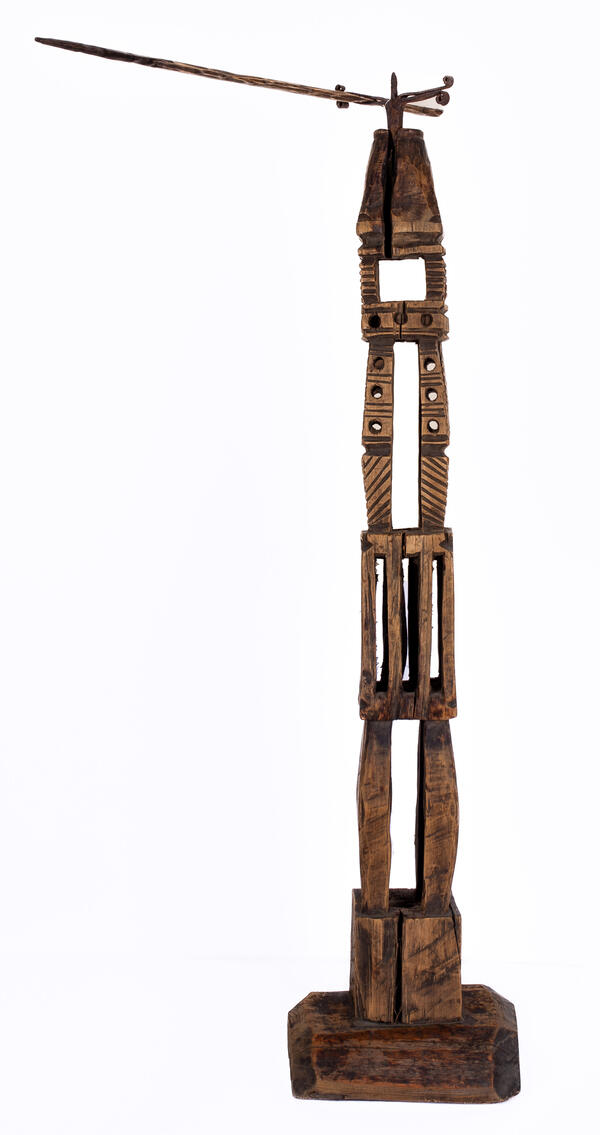
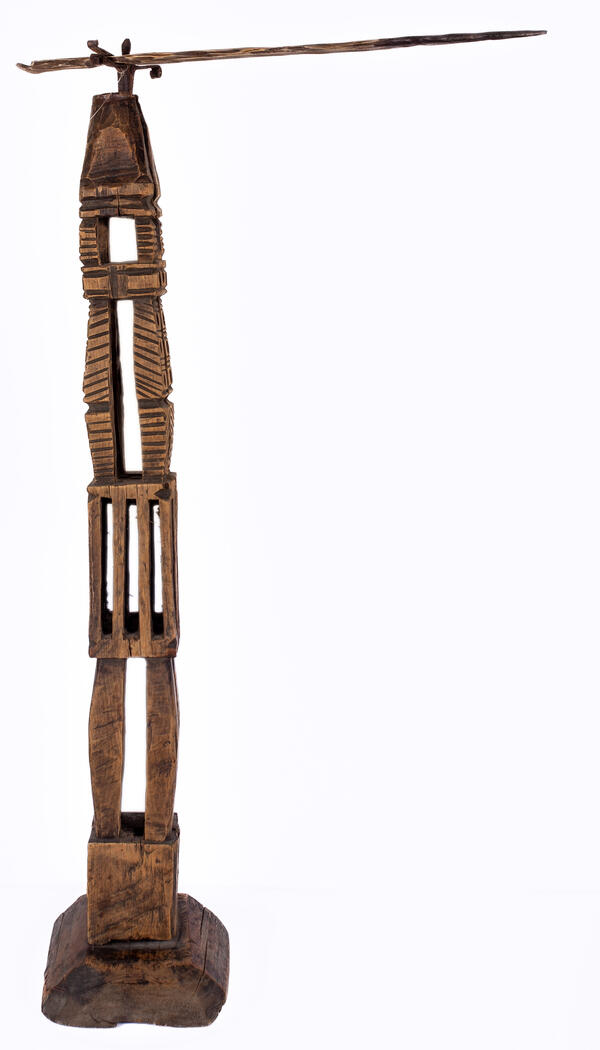
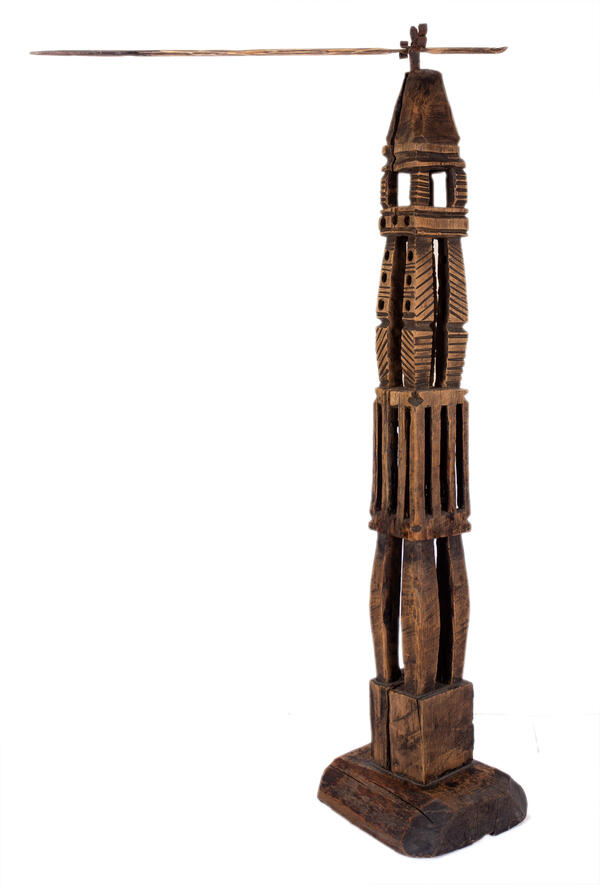
Rushlight holder

Creation period
the second half of the 19th century
Place of сreation
the Russian Empire, Vologda Governorate
Dimensions
89x20x22 cm
Technique
wood, metal; carving, chiseling, forging
3
Open in app
#1

A rushlight holder is one of the essential symbols of peasant life, a “derzhaltse” (fixture) for the burning sliver.

There were several types of rushlight holders: a high wooden or iron stand that had a stuck iron rod with branches for inserting a sliver; a wooden tub for water with a wooden pole on the edge, on which a forged iron fork was placed; an iron rod bent at right angles, one end of which had a fork and the other — a sharp tip for sticking it into a gap in the wall. To illuminate a larger space, the rushlight holder was made with several fork-holders.

The rushlight holder and the sliver, the main source of light in the house, were treated with respect, which is reflected in the riddles:
#2

What is the elder in the house?; If I put it up, it stands, if I put it down, it lies, it supports the house.

#3

“Troshka stands on one leg, crumbling the crumbs — about a rushlight holder with one sliver“; “Four Vasilisas tumbled down in one place.” — about a rushlight holder with several slivers.

To avoid fire, the light fixture was placed in a bucket of water or suspended over it.

Rushlight holders were not used all year round, but only in the fall and winter, spending long evenings doing handicrafts: weaving, basketwork, carving, and needlework.

From mid-August to mid-September, there was a rite of autumn kindling. According to a strong archaic tradition, men “rubbed” the need-fire, and women took it to their homes. This need-fire was supposed to kindle light at the first fall gatherings from this first need-fire. After the Annunciation (on the days of the spring equinox), the fire in the house was no longer lit.

The strong association with fire determined the “deterring” function of the rushlight holder and sliver, which can be seen in Christmas fortune-telling. On New Year’s Eve, the first fire was lit on the sliver, then the end of the sliver, “Vasiliev’s torch”, was used during divination, drawing with it “counter-sunwise”, and at the end of divination the same sliver was used to draw “sunwise”, that is, drawing a circle in the opposite direction — “following the sun”, “following God’s way”. Protective properties of the sliver were used in everyday practice: people opened the door of the stove to keep warm at night in winter, and a sliver was placed vertically at the mouth of the stove so that “the house spirit would not play a joke”; dishes with food were covered with two crossed slivers for the night to protect them from the house spirit.

But for that very house spirit, people would leave salt on a sliver under the oven. On the same stick they wrapped a piece of tow so that the midnight evil spirit could play with it without disturbing the baby. It was strictly forbidden to touch the baby with a dry sliver, “so as not to dry him out”. To harm the newlyweds, sorcerers traced their footsteps with a burning sliver.
#5
Rushlight holder
#4
read morehide
00:00
00:00
1x

Rushlight holder

Creation period
the second half of the 19th century
Place of сreation
the Russian Empire, Vologda Governorate
Dimensions
89x20x22 cm
Technique
wood, metal; carving, chiseling, forging
3
Point your smartphone camera to open in the app
Share
VkontakteOdnoklassnikiTelegram
Share on my website
Copy linkCopied
Copy
Open in app
To see AR mode in action:
  1. Install ARTEFACT app for 
  2. iOS or Android;
  3. Find and download the «Paintings in Details» exhibition
  4. Push the «Augmented reality» button and point your phone's camera at the painting;
  5. Watch what happens on your phone screen whilst you flip through the pictures.
 
We use Cookies
Cookies on the Artefact Website. We use cookies to ensure that we give you the best experience on our website. If you continue without changing your settings, we'll assume that you are happy to receive all cookies on the Artefact website. However, if you would like to, you can change your cookie settings at any time.
Learn more about useHide
Content is available only in Russian

X

Нашли опечатку?...

%title%%type%