Font
Color
Graphics
Изображение точки

To see AR mode in action:

1. Install ARTEFACT app for iOS or Android;

2. Find the exhibition «Russians. Late 19th — Early 20th Century»

3. Push the «Augmented reality» button and point your phone's camera at the exhibit;

Скрыть точки интересаПоказать точки интереса
Показать в высоком качестве

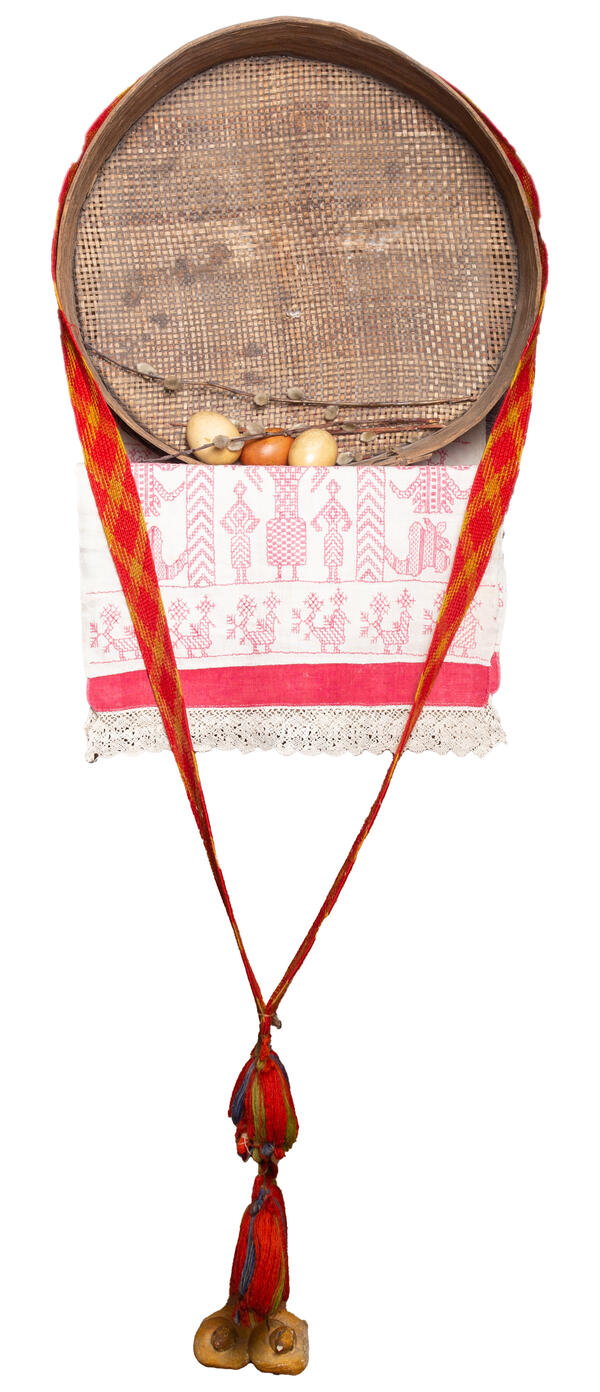
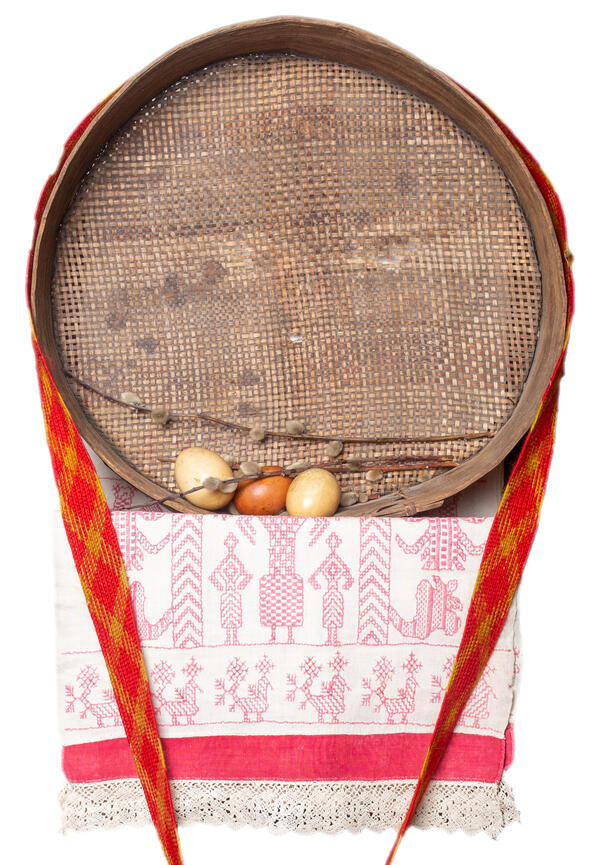
Sifter for sieving fine grains and flour

Creation period
the second half of the 19th century
Place of сreation
the Russian Empire
Dimensions
10,5x40 cm
Technique
wood; bending, network
2
Open in app
#1

A sifter is a household item that is functionally similar to a sieve, but due to its large, sparse mesh, it is suitable for coarser sifting. The bread baked from fine, airy flour sifted through a sieve was called sieved bread; whereas the bread from coarse flour was called sifted bread.

A sifter consists of a cylindrical bast drum (obechaika) and a mesh screen made of bast fiber or wire (a fine-meshed sieve in the old days was woven from thinner material — horsehair). A sifter was used for sifting cereals, flour and grain. Also, it could be used as a measure or container for storing food.

The ritual symbolism of the sifter is dominated by its perforated surface. This identifying characteristic is mentioned in the riddles:
#2

There are many holes, but nowhere to jump out; A new vessel, but it’s all riddled with holes.

#3

Depending on the context, the abundance of holes may have a positive or negative meaning. The negative symbolism of holes as a metaphor for meaningless, wasted effort, is reflected in Russian proverbs and sayings:

#4

To wet peas in a sifter is like to teach a fool to write; To carry water in a sifter.

#5

In wedding ceremonies, there were several ways to pinpoint the impurity of the bride. One of them was to put a cradle, in which a sifter or a leaky pot was placed, on the mother of a girl who had lost her innocence before marriage.

At the same time, the sifter had a strong association with the sky as the highest point of the world and the provider of life-giving moisture. The fact that the sifter was also synonymous with the sky as the topmost point, above which there is nothing, might explain the belief that a sifter put on a child’s head would stop his or her growth.

“The woven sieve is covered with a sifter”, says the cosmogonic riddle about the earth and the sky. At Christmas festivities, the sifter was used to create a “Nativity Star”: it was attached to a high pole, and an icon and a candle were placed inside it. In times of drought, women would pour a bucket of water over the sieve, thereby encouraging a real downpour.

Water “with earth from under the gateposts”, on which the gate leaves were hung, was passed through the mesh of the sifter and was revered as healing water. Sick children and cows after calving were washed with it, and on Holy Thursday, sheep were doused with it.

Despite its direct function — to let what is poured through itself — the image of the sifter embodied the idea of wealth, fertility, and good fortune. The sifter was used to collect presents for girls and women, who sang songs of praise at weddings. It was also a container for coins and grains, which were sprinkled on the young couple.
#7
Sifter for sieving fine grains and flour
#6
read morehide
00:00
00:00
1x

Sifter for sieving fine grains and flour

Creation period
the second half of the 19th century
Place of сreation
the Russian Empire
Dimensions
10,5x40 cm
Technique
wood; bending, network
2
Point your smartphone camera to open in the app
Share
VkontakteOdnoklassnikiTelegram
Share on my website
Copy linkCopied
Copy
Open in app
To see AR mode in action:
  1. Install ARTEFACT app for 
  2. iOS or Android;
  3. Find and download the «Paintings in Details» exhibition
  4. Push the «Augmented reality» button and point your phone's camera at the painting;
  5. Watch what happens on your phone screen whilst you flip through the pictures.
 
We use Cookies
Cookies on the Artefact Website. We use cookies to ensure that we give you the best experience on our website. If you continue without changing your settings, we'll assume that you are happy to receive all cookies on the Artefact website. However, if you would like to, you can change your cookie settings at any time.
Learn more about useHide
Content is available only in Russian

X

Нашли опечатку?...

%title%%type%