In traditional peasant communities, people resorted to the services of professional craftsmen and craftswomen only when they needed items that required serious skills and, as a rule, artistic taste to make. Everyday items were usually made by the people themselves using a standard set of tools: an ax, knives, a saw, an awl, a plane and a bow drill. The latter was used for drilling holes in bone, wood or even iron workpieces for harnesses, sled runners and other things.
Such a drill consisted of a metal tip, a wooden handle, and a leather strap tied to a bow, hence the name, “bow drill”.
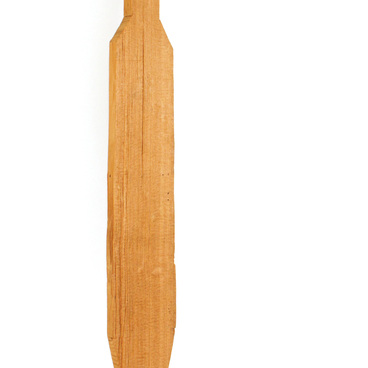
The bow of the drill presented in the exposition is a solid, roughly processed slightly curved stick that is thin on one end and thick on the other. The middle part of the bow is slightly rounded; the top part is flattened on two sides. The drill shaft features a handle on one side, and a slot into which the tip of the forged blade is inserted on the other.
When using this drill, the bow is moved back and forth with the right hand, which forces the strap to wind on the shaft, thus making the metal tip turn and cut into the surface of the workpiece.
Alder, birch, spruce wood were used to make the spool, and larch was used for the shaft. The tip could be made from a pitchfork tooth, rakes for collecting hay and other improvised metal “fragments” of a suitable shape and size.
Depending on the task, drills were made of different diameters and lengths. If the size of holes needed to be bigger than the tool could allow, several small holes were made close to each other and the walls between them were cut with a knife.
The bow drill presented in the exposition was used in the Khanty household in the 19th–20th centuries primarily for making sleds. It was also used in other household tasks, for example, for drilling holes for studs that regulate the thickness of the bottom and sides of the boat.
The exhibit was donated to the
museum by A.V. Pospelov, a resident of
Tobolsk.