The geologist Sergey Obruchev wrote in the book “On the Mountains and Tundras of Chukotka” that “Climbing into the polog [shelter for sleeping] with snow on your clothes, is an even bigger faux pas than entering a cultural house in dirty galoshes.”
A polog is the inner sleeping quarters of the yaranga tent. It is an insulated tent sewn from skins, which was heated and illuminated by a fat lamp. Unlike the cold outer part of the dwelling (chottagina, where clothes and pickled goods were stored), the polog was intended for maximum heat preservation and not ventilated. The skins became very damp overnight from human breathing and heat of their bodies, and it was unacceptable to bring additional moisture from snow and frost into the polog.
That is why in the winter months, housewives had to freeze the polog in the snow for one or two hours every morning, knock it out with beaters, and then dry it on a tree or right on the ground. At the entrance to the inner tent, it was necessary to thoroughly brush the snow off from clothes and shoes.
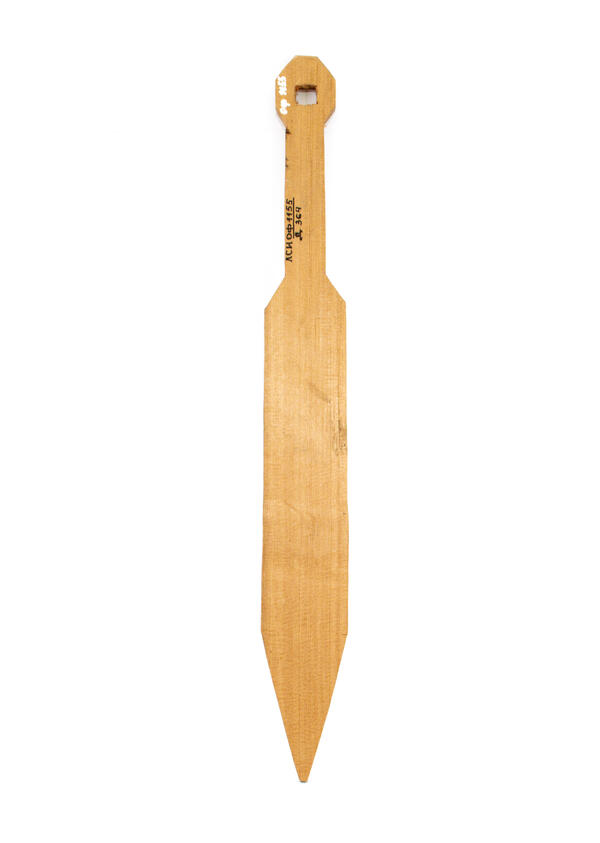
The snowbeater consists of a handle and a long pointed blade like that of a sword. Most often, these items were made of larch — a hard, durable material that does not absorb moisture and is resistant to rot. This tree is considered a symbol of longevity.
The “pommel” of the snowbeater has a hole which allows one to easily tie the snowbeater to the belt.
When using the tool, people would raise it high above their head and hit the spread clothes or skin with force, alternating hands. “Therefore, in the evening, ” wrote the ethnographer Vladimir Germanovich Bogoraz, “<…> the whole camp [for half an hour] was resounding with short blows of beaters hitting clothes.”
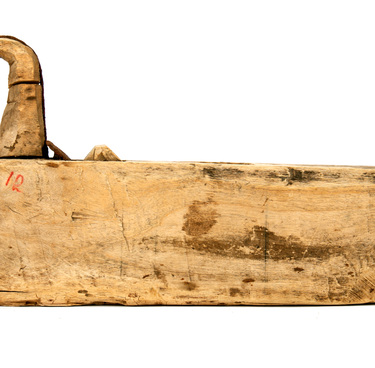
The sword-shaped snowbeater for clothes and the polog were considered feminine attributes. Men’s snowbeaters were made bigger with a curved blade and a handle. Such snowbraters were suitable not only for knocking out sled seats, but also for digging up snow when setting traps or evaluating pasture sites.
Usually the length of the snowbeater varied between 50 and 70 centimeters — depending on the height of the owner, the length of their arms and the optimal range of motion.
The exhibit was donated to the
museum by R.H. Rakhimov, a resident of
Tyumen.