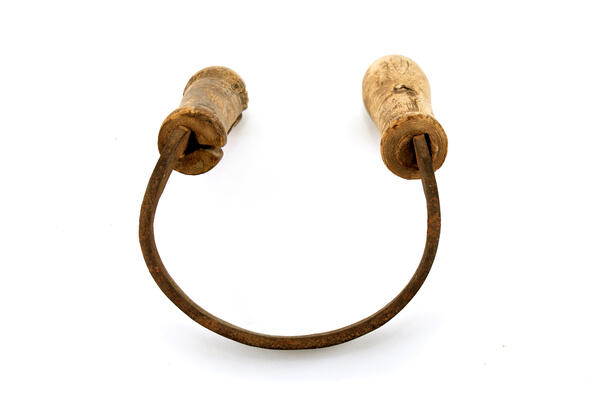
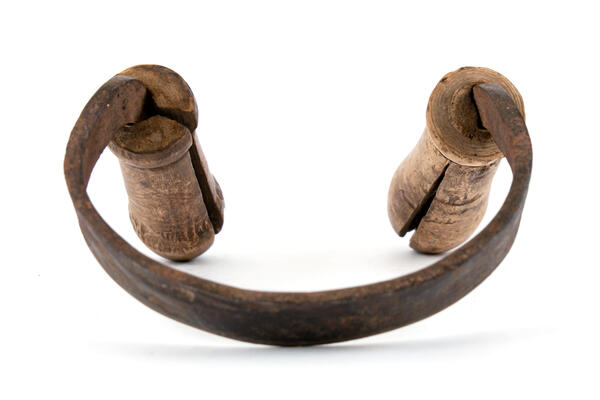
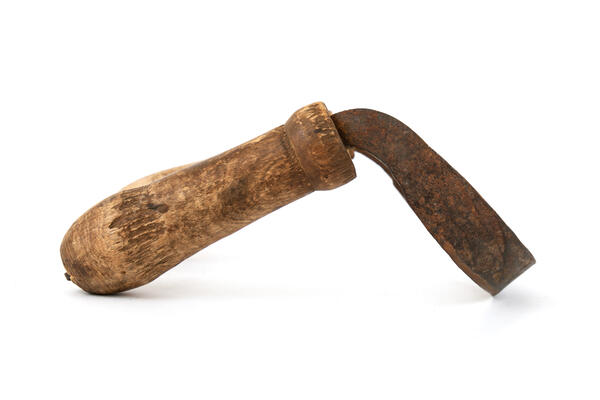
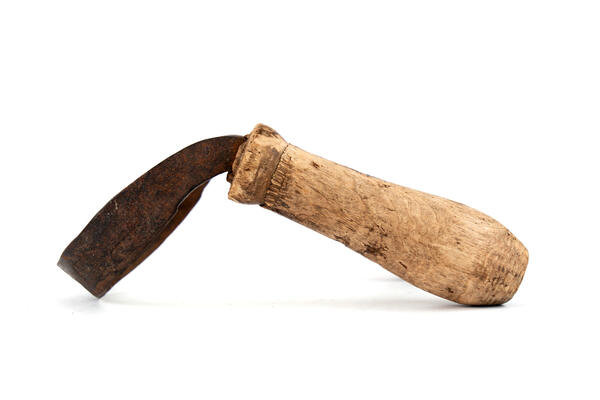
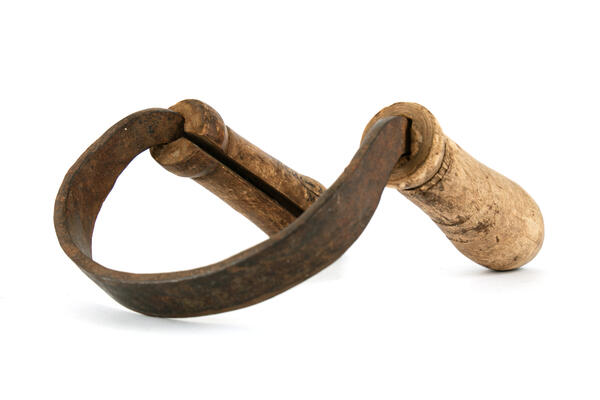
The drawknife is a tool familiar to man since the Stone Age. This is evidenced by archaeological finds — flint plates with an inward-sloping arched edge. With the discovery of iron, the drawknife acquired its present-day look: either a straight or a rounded metal blade with two handles. It is used for removing sapwood and debarking logs.
This tool stands on the borderline between initial processing and detail work. The scraper is used for leveling wooden surfaces, and removing irregularities and small knots. At the same time, the blade does not damage the internal structure of the tree, going as far as keeping bast (the inner surface of the bark) intact.
When debarking a log, the drawknife is dragged from the bottom up. Performing this operation with an ax inevitably leads to chips and notches, which leaves the wood vulnerable to fungus, rot, pests and early deterioration. The drawknife on the other hand leaves the surface intact, smoother than before and without scuffing, in other words, the wood becomes more durable and reliable. The surface, roughly trimmed with an ax or the more gentle adze, is often smoothed with a drawknife to get rid of the so-called “waves”.
A drawknife was also known as a “strug”, “nastug” and “koroder” (debarker). Drawknives with a large bend are used for scraping walls, roofing boards, window and door jambs, door panels and shutters. Working with this tool is quite difficult, as it quickly fatigues the muscles of the arms, abdomen and back. Thus, not every surface was scraped, but only individual structural elements in the interior of churches and dwellings.
Straight surfaces were scraped with a straight scraper, “round” corners in the interior were scraped with a round one. Jambs of door and window openings, door panels, boards, etc. were scraped along the wood fibers; walls — at an angle of about 60 degrees relative to the surface of the log. Since logs inevitably have at least a slight slope of fibers, they need to be scraped in both directions: half a log — in one, and half a log — in the other.
The drawknife was used not only by carpenters, but also by coopers and furriers for manufacturing wooden utensils and leather processing.