#1
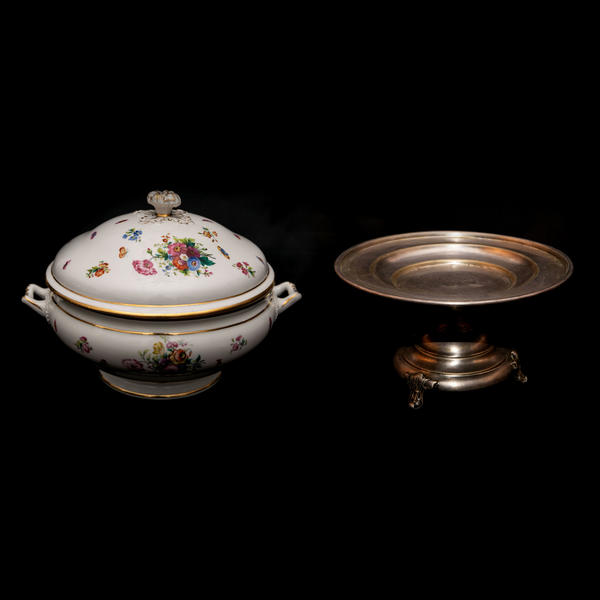
Soup Tureen, Biscuit dish
#2
#4
#6
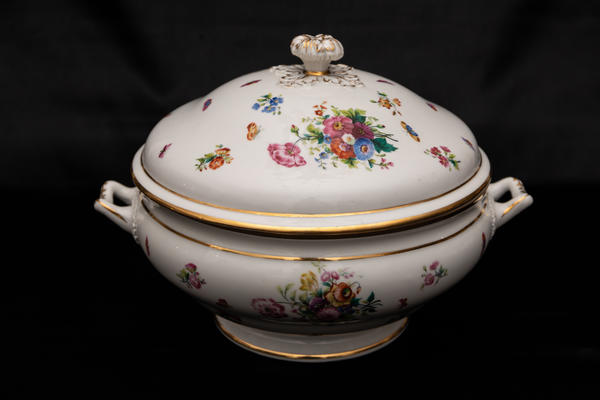
Soup tureen is tableware, in which soup or broth is served and from which it is ladled out into plates.
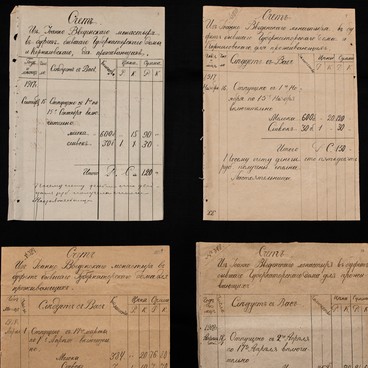
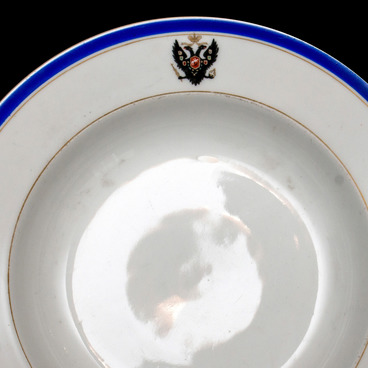
At ceremonies and during important meals, as well as in everyday life, members of imperial family used porcelain dishes, mainly from large Russian manufacturers, Imperial Porcelain Factory in particular. Over the years, this factory produced a variety of porcelain ware specifically for the royal dynasty. Each year, this company manufactured personalized table sets, services that commemorated festive events, and many other china wares.
An important stage in the development of artistic production at Imperial Porcelain Factory began during the reign of Alexander III, in 1881–1894. The Emperor pointed out: The Emperor wishes… to place the Imperial Porcelain Factory in the best possible conditions, both technical and artistic, so that it is worthy of its Imperial name and serves as a model for all private manufacturers in this industry.
So the factory started working on the production of two large table sets. The first set was called Coronation, and the second one was based on Vatican paintings by Raphael. Sketches for the last table set were personally corrected by Alexander III.
The Emperor’s tastes and preferences had a great influence on the artistic development of the whole factory. The sovereign preferred Chinese and Japanese vases, terracotta, colored glaze, and underglaze painting, which was introduced into fashion by Royal Copenhagen manufactory. Therefore, chinaware with underglaze painting became one of the specialties manufactured at the Imperial Porcelain Factory.
During the reign of the last Russian Emperor Nicholas II, from 1894 to 1917, the factory reached the highest technical and technological level. The factory was proud of its artistically designed products. For example, Alexandrinsky and Tsarskoye Selo table sets were created for Empress Alexandra Fyodorovna, who was the patroness of the factory. By order of Nicholas II, the factory produced a series of military plates featuring troops in uniforms of the time of Alexander III and a sculptural series Nations of Russia. During the First World War, unique technologies of the Imperial Porcelain Factory formed the basis of new industrial production of chemical and electrical porcelain.
At ceremonies and during important meals, as well as in everyday life, members of imperial family used porcelain dishes, mainly from large Russian manufacturers, Imperial Porcelain Factory in particular. Over the years, this factory produced a variety of porcelain ware specifically for the royal dynasty. Each year, this company manufactured personalized table sets, services that commemorated festive events, and many other china wares.
An important stage in the development of artistic production at Imperial Porcelain Factory began during the reign of Alexander III, in 1881–1894. The Emperor pointed out: The Emperor wishes… to place the Imperial Porcelain Factory in the best possible conditions, both technical and artistic, so that it is worthy of its Imperial name and serves as a model for all private manufacturers in this industry.
So the factory started working on the production of two large table sets. The first set was called Coronation, and the second one was based on Vatican paintings by Raphael. Sketches for the last table set were personally corrected by Alexander III.
The Emperor’s tastes and preferences had a great influence on the artistic development of the whole factory. The sovereign preferred Chinese and Japanese vases, terracotta, colored glaze, and underglaze painting, which was introduced into fashion by Royal Copenhagen manufactory. Therefore, chinaware with underglaze painting became one of the specialties manufactured at the Imperial Porcelain Factory.
During the reign of the last Russian Emperor Nicholas II, from 1894 to 1917, the factory reached the highest technical and technological level. The factory was proud of its artistically designed products. For example, Alexandrinsky and Tsarskoye Selo table sets were created for Empress Alexandra Fyodorovna, who was the patroness of the factory. By order of Nicholas II, the factory produced a series of military plates featuring troops in uniforms of the time of Alexander III and a sculptural series Nations of Russia. During the First World War, unique technologies of the Imperial Porcelain Factory formed the basis of new industrial production of chemical and electrical porcelain.
#7
Author: Imperial Porcelain Factory
Date: first half of 19th century
Technique: porcelain, overglaze painting, gilding
Dimensions: 27,5×22,5 cm
Collection: Porcelain
Copyright: Tyumen Museum and Educational Society
Date: first half of 19th century
Technique: porcelain, overglaze painting, gilding
Dimensions: 27,5×22,5 cm
Collection: Porcelain
Copyright: Tyumen Museum and Educational Society
#3
Biscuit dish
#5
#8
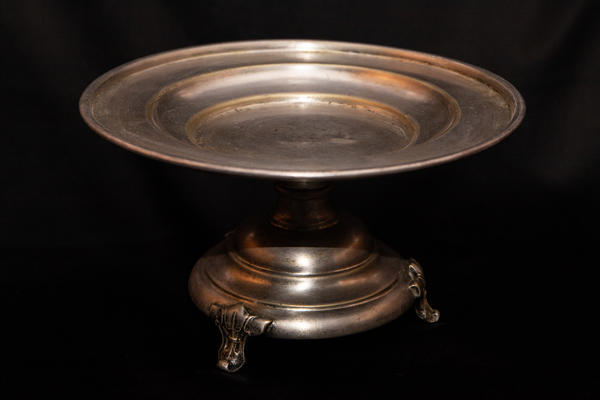
The biscuit dish from the collection of the Tobolsk Historical and Architectural Museum-Reserve was made in the workshops of the Polish company Fraget. A wide flat vase was attached to a round stepped base on a low leg. And the base, in turn, rested on three legs in the form of folded leaves. The biscuit dish was used for serving sweet rusks and biscuits. Similar dishes were also made in the form of baskets; however, legged vases were more popular. The underside of the item has an intact FRAGET manufacture mark.
The Fraget company produced copper and brass products, silver plated in a special way. It was named after its founder Josef Fraget, who organized in 1824 the first laboratory in Warsaw to coat dishes made of base metals in silver or gold. Under the same name, his heirs opened shops and warehouses in large cities of the Russian Empire. The factory got prestigious awards and medals for its products at numerous exhibitions. At the All-Russian Exhibition in Nizhny Novgorod in 1896, it received the right to depict the State Russian Coat of Arms. The company was a supplier to many royal courts.
The silvering method used by the Fraget brothers was complex for its time: a thin sheet of silver foil was laid on red-hot copper and rolled with a press. With the help of electric current, silver fused with copper. In use, such a material did not peel off and looked like fine silver. Such a product was called plated, later they began to call that kind of material plated silver.
Inexpensive ‘imitation silver’ tableware made in Poland was popular until the 1930s. It was used both at the court of Emperor Nicholas II and at the Governor’s House in Tobolsk during the imperial family’s forced exile.
The title of suppliers was granted only for the duration of work being carried out or deliveries made to the Highest Court. The honourary title ‘Supplier to the Court’ was given by the Ministry of the Imperial Court, which was established in August 1826 and answered directly to Emperor.
The Fraget company produced copper and brass products, silver plated in a special way. It was named after its founder Josef Fraget, who organized in 1824 the first laboratory in Warsaw to coat dishes made of base metals in silver or gold. Under the same name, his heirs opened shops and warehouses in large cities of the Russian Empire. The factory got prestigious awards and medals for its products at numerous exhibitions. At the All-Russian Exhibition in Nizhny Novgorod in 1896, it received the right to depict the State Russian Coat of Arms. The company was a supplier to many royal courts.
The silvering method used by the Fraget brothers was complex for its time: a thin sheet of silver foil was laid on red-hot copper and rolled with a press. With the help of electric current, silver fused with copper. In use, such a material did not peel off and looked like fine silver. Such a product was called plated, later they began to call that kind of material plated silver.
Inexpensive ‘imitation silver’ tableware made in Poland was popular until the 1930s. It was used both at the court of Emperor Nicholas II and at the Governor’s House in Tobolsk during the imperial family’s forced exile.
The title of suppliers was granted only for the duration of work being carried out or deliveries made to the Highest Court. The honourary title ‘Supplier to the Court’ was given by the Ministry of the Imperial Court, which was established in August 1826 and answered directly to Emperor.
#9
Author: Poland. FRAGET Factory
Date: late 19th – early 20th century
Technique: metal; silvering
Dimensions: 12,5×21 cm
Collection: Metal
Date: late 19th – early 20th century
Technique: metal; silvering
Dimensions: 12,5×21 cm
Collection: Metal
Copyright: Tobolsk Historical and Architectural Museum - Reserve Restorers
read morehide
00:00
00:00
1x
Soup Tureen, Biscuit dish
0
 Point your smartphone camera to open in the app
Open in app
Share