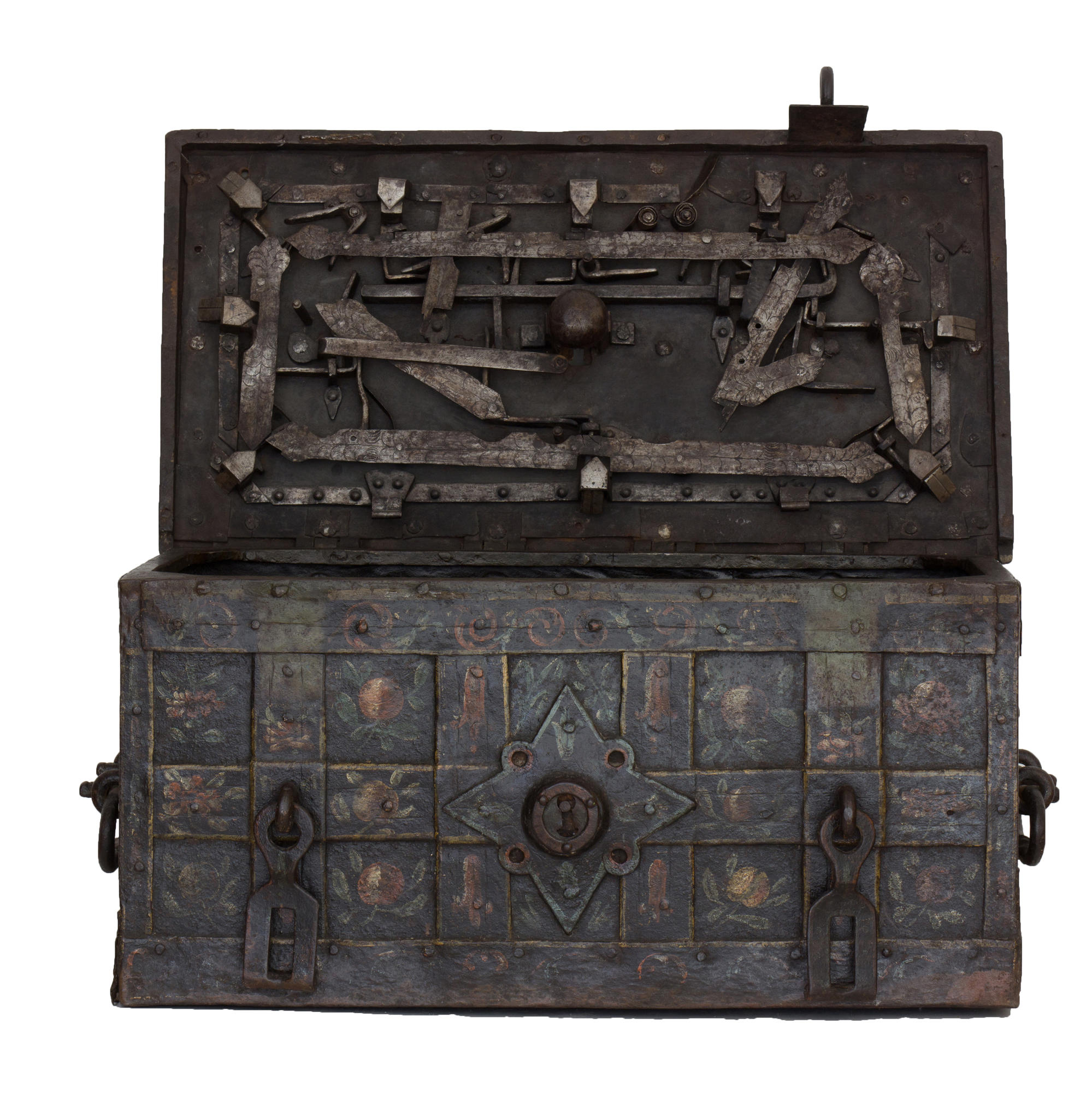


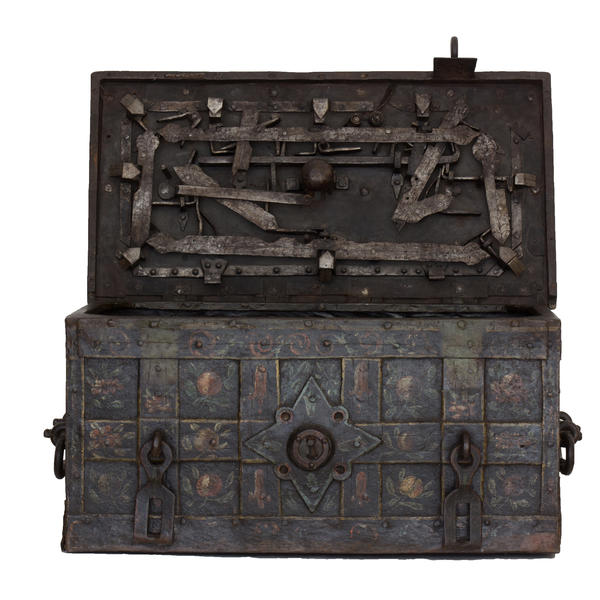
A wrought-iron painted chest intended for storing the treasury entered the museum in the early 1920s from the Kholmogory District Consumers Association. On the inside of its heavy hinged lid there is a complex locking mechanism. On the front side of the lid, there is one cap loop with an eye. Twisted forged handles are attached to the side walls. The false key hole for the key on the front side is decorated with a diamond-shaped trim.
The chest is one of the most traditional items of Russian everyday culture. With its practical and convenient shape, the chests initially was used for storing things, as well as for carrying and transporting home belongings. Starting from the 11th century, chests took an important place in the interior of the Russian house and retained this function until the first half of the 20th century.
The purpose of the chests as a means of storing valuables is well illustrated by the Synodic of Athanasius of Kholmogory of 1689-1690. One miniature depicts three chests studded with iron stripes — red, green and yellow. The red chest is open, and the rows of pouches (possibly with money) stored in it are visible. On the list of belongings of the archbishop of Kholmogory and Vaga Athanasius of 1702, many chests are listed, including ‘the headrest covered with red tinned leather with carved tinned iron contains a hundred rubles in a bag…’
Chest-making was a real urban art. It was associated with the professional skill of carpenters, blacksmiths, as well as icon painters. It required skills to work with very different materials, and some of them had to be purchased from suppliers from abroad. Chests were often decorated with paintings, which greatly increased their value. Floral or plant ornaments were one of the many types of chest decorations. Chests with herbal compositions were widespread and very popular. Stunningly beautiful, shod chest were the most durable and reliable. Sometimes, chests made entirely of metal were used to store especially important valuables.