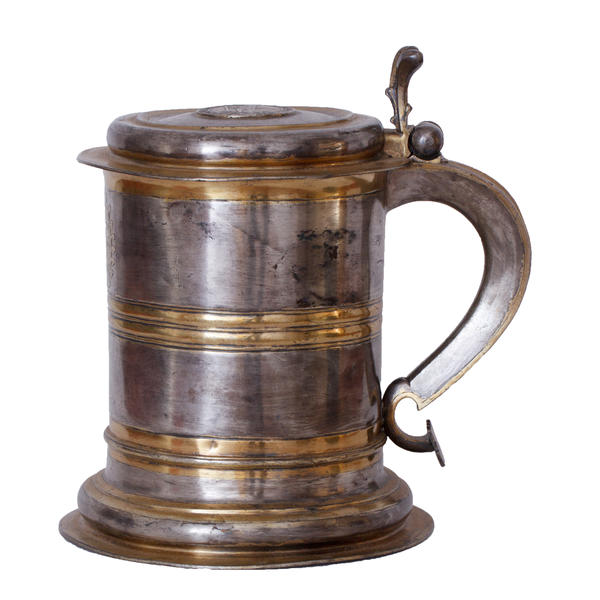
This is a beer mug. Mugs equipped with a lid were invented in Germany in the 14th century. In the 1340-1380s, the bubonic plague raged in Europe. German lawmakers required cookware manufacturers to provide containers with lids to protect contents from insects that carried the deadly disease. This requirement also affected manufacturers of beer mugs. Members of the tin craft guilds invented a mechanism that attached a hinged lid to the mug, which then became its traditional attribute.


Mug
Creation period
17th - the beginning of the 18th century
Dimensions
12х17 cm
Technique
silver, gilding, casting, engraving, chasing, soldering
Collection
3
Open in app#1
Unknown author
The Mug
#7
#3
The mug was commissioned in Germany. It was acquired by the clergy of the Holy Trinity Cathedral for holy water. It entered the Northern Regional Museum (now the Arkhangelsk Regional Museum) from the sacristy of the Trinity Cathedral in 1926.
The characteristic cylindrical shape of the body of the mug is complemented by a curved handle and a wide base. A hinged mechanism of the lid is attached above the upper joint of the handle. The object is decorated with gilded belts. A gilded emblem is engraved in the upper part. It is a circle framed by presumably laurel branches, in the lower part of the coat of arms is a shield with several oblique stripes and an image of a bull standing on its hind legs, above is a larger image of a bull framed by wings.
#5
A silver 1-thaler coin of the German principality of Braunschweig-Wolfenbüttel, dated 1623, is soldered to the centre of the lid. The obverse of the coin is on the inside of the lid, and the coat of arms of the city of Braunschweig with an inscription around it is minted on it:
FRIDERIC ULRIC D G DUX BRUNSUI ET L (‘Friedrich Ulrich by the Grace of God, Duke of Braunschweig-Luneburg’).
The reverse of the coin adorns the outside of the lid. It depicts Wildeman (German: ‘Wild Man’). Also on the reverse, there is a Latin inscription ‘DEO ET PATRIAE ANNO 1623’, which means ‘To God and the Fatherland, the year 1623’.
#8
At the bottom of the mug, there is an inscription: ‘This mug was bought for the Arkhangelsk Cathedral for holy water. It weighs 2 pounds 27 zolotniks (old Russian measure of weight, equivalent to 4.26 gr). 52 rubles 86 kopecks were given. Each zolotnik is 24 kopecks’.
Both the mug and its lid are gilded. There are three stamps on the outside of the base.
Both the mug and its lid are gilded. There are three stamps on the outside of the base.
#9
Arkhangelsk regional museum
read morehide
00:00
00:00
1x
Mug
Creation period
17th - the beginning of the 18th century
Dimensions
12х17 cm
Technique
silver, gilding, casting, engraving, chasing, soldering
Collection
3
 Point your smartphone camera to open in the app
Open in app
Share