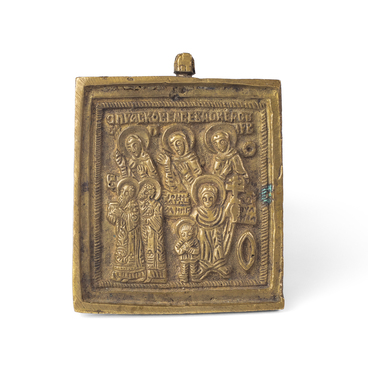
The folding iconostasis from the museum’s collection was created approximately in the 18th or 19th century. This is the third part of the four-leaf folding icon. It received the vernacular name “an iron” because of its weight and shape: a rectangle with a figured keel-shaped top, which was sometimes called a “kokoshnik” — by analogy with a headdress.
The fold was made of a yellowish copper alloy. On two edges, the craftsman made four hinges for attaching other folds. He created convex, bas-relief images on the front side. In the upper “kokoshnik” part the plot “Feast of the Cross” was engraved, in the lower part — the plots “The Resurrection of Christ, ” “Ascension of Jesus, ” “The Life-Giving Trinity, ” and “Dormition of the Mother of God.” The backside was left without images. Traces of oxidation and patina appeared on two sides of the folding icon.
The main types of folding icons that existed in Russia were pectoral and kiot (encased) icons. All of them could be portable, that is intended for journeys. They were taken on a pilgrimage or on a journey, and some of the multi-leaved folding icons were even called travel icons. In the 17th century, mainly three-leaved folding icons were made. Each of the two leaves was equal in width to half of the centerpiece.
In the first half of the 18th century, in connection with the heyday of the Old Believers in some regions, completely new types of folding icons and other iconographic subjects appeared. Technology of copper casting changed as well. Folds of the icons began to be made with hinges, tightly fitted to each other, and pins were inserted into them. Due to this, the design of the folding icons changed: the folds went into one another, which made it possible to increase their number to four. Festive subjects occupied a large place in the Old Believers’ casting. These were primarily the motives of the main church holidays.
Ancient molds for
casting products were also created from stone, sand and earth. Later, wax
models were used, which were coated with clay and then fired. The molten wax
flowed out, and metal was poured into the resulting mold. Folded icons were
cast in huge numbers in the period from the 18th to the beginning of the 20th
century and were in circulation throughout the Russian Empire.