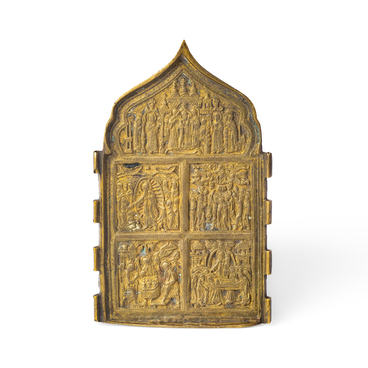
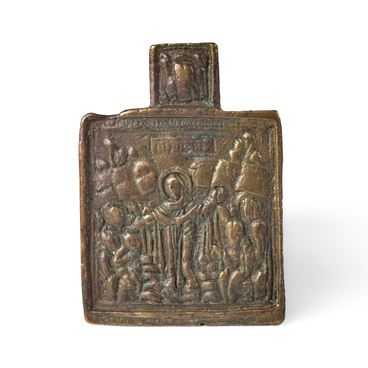
The small rectangular Orthodox amulet icon “Saints Cyricus and Julitta” presented in the museum’s collection was made in the 18th or 19th century. The craftsman executed high profiled edges, narrow smooth margins and a small faceted top; he created the inner framework in the form of a bas-relief oblique stroke.
The canonical, convex images on the icon were arranged in a two-row composition. In the upper row, the craftsman placed the martyrs Paraskeva Friday, Saints Evdokia and Barbara. They are depicted in a three-quarter turn to the left with their arms raised at chest level. In the lower row on the left, Saints Gregory the Theologian and John Chrysostom are seated, dressed in vestments. On the lower right, Saints Cyricus and Julitta are presented full-length. They were early Christian martyrs who suffered during the Great Persecution under Emperor Diocletian.
A six-pointed cross is noticeable in the upraised hand of Saint Julitta. Saint Cyricus’s arms are crossed over his chest. In the center of the top part, the artist created a small oval protrusion with a recess for tying the thread. The reverse side of the icon has irregularities, while the front side is marked with patina spots.
The icon and the hagiography of the Holy Martyrs Cyricus and Julitta were present in almost every Old Believer house. According to the hagiography, Julitta (Julietta) was a young widow of noble origin, who lived in Iconium with her son Cyricus. During the period of persecution, fearing torment, she abandoned all her possessions and left Iconium with a three-year-old Cyricus, accompanied by two slaves. Julitta began to live like a penniless wanderer.
During the persecution of Christians in Tarsus, Julitta was identified and brought along with her son to the court of the mayor Alexander. When asked by the ruler about her religion, Julitta replied that she was a Christian. She was separated from her son and subjected to flagellation. Cyricus, seeing his mother’s torment, cried, and then, saying that he was a Christian too, demanded to be allowed to his mother. In anger, Alexander threw the child off the stone platform, and Cyricus died.
Julitta was subjected to
new tortures, but she refused to sacrifice to the pagan gods. Alexander
sentenced her to beheading, and the sentence was carried out. The bodies were
left by the executioners without burial outside the city, but the slaves of
Julitta secretly buried them at night. Saints Cyricus and Julitta have been
revered in Russia since ancient times.