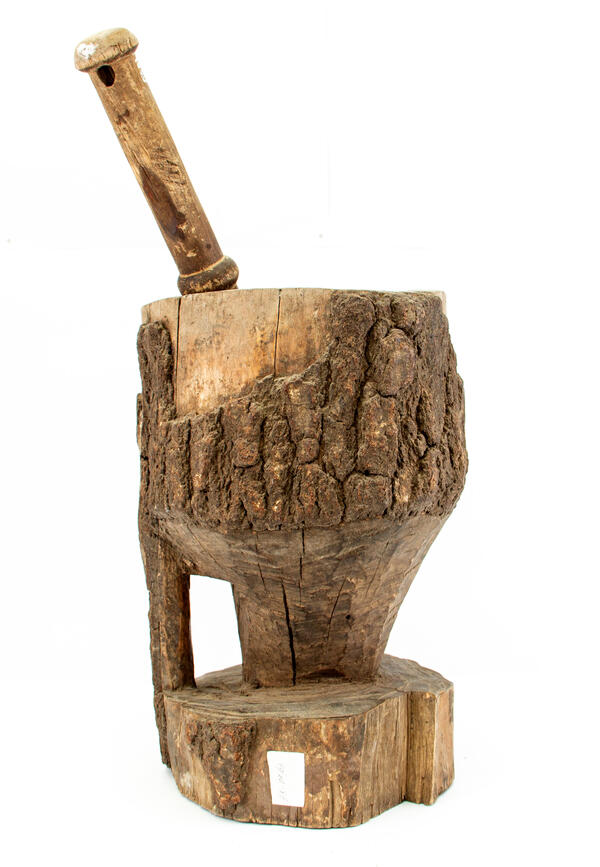
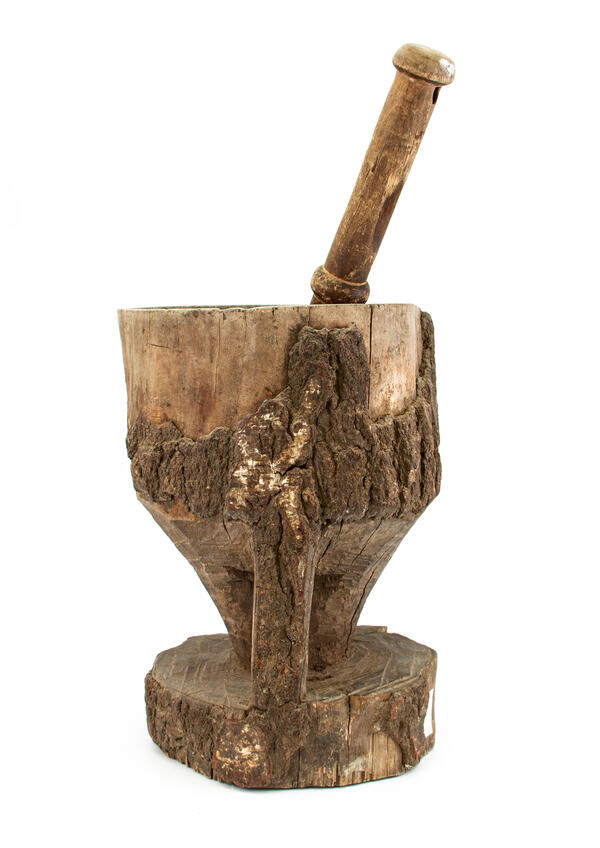
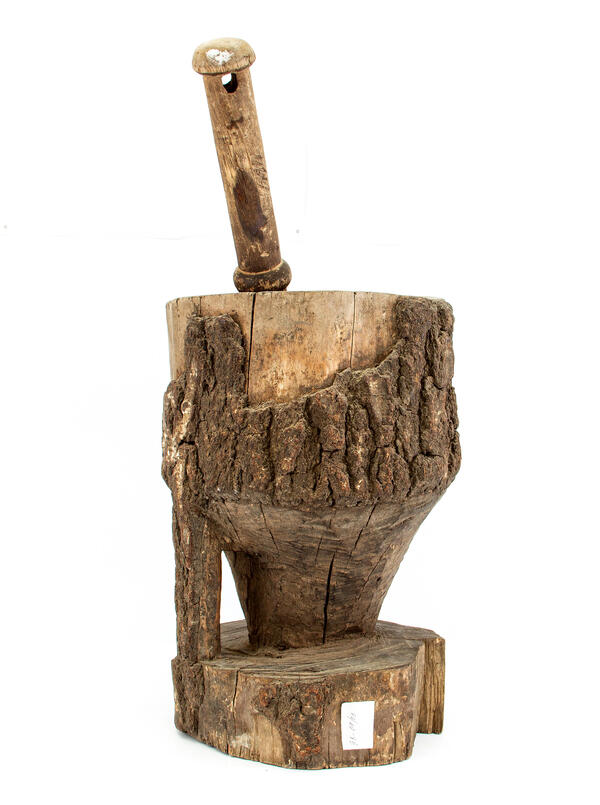
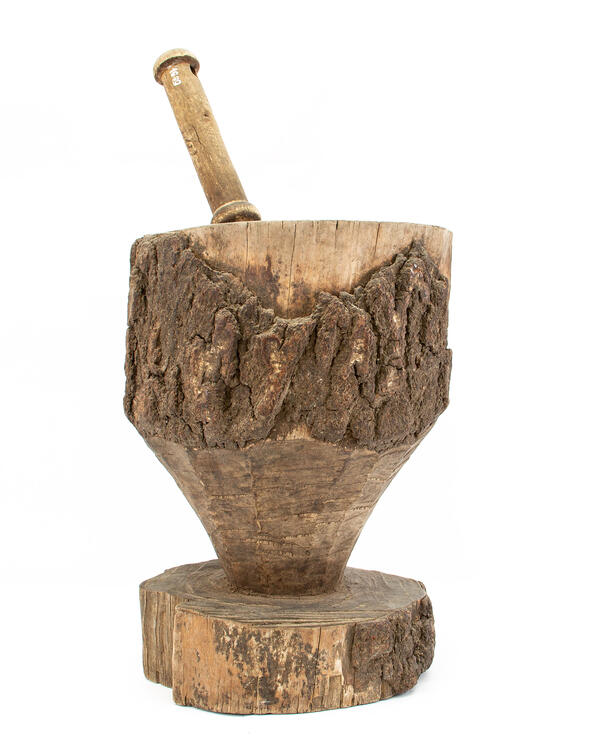
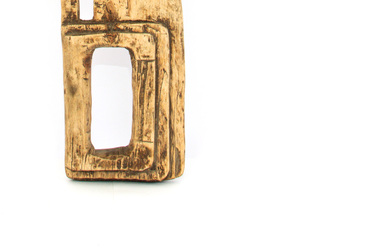
Every traditional village household had mortars. They were hollowed-out cylindrical bowls with upwards expanding sides of a variety of sizes. Depending on the purpose, size and type of the base, they were divided into those that stood on the floor or were placed on the countertop.
Potatoes, salt, flax and hemp seeds and fibers were crushed in mortars. The smallest ones were used for grinding all kinds of spices and garlic. Men had separate mortars for tobacco.
To prepare grains for consumption, they needed to be pounded and separated from the hard husk. Barley, wheat, buckwheat, oatmeal and millet grains were poured into a tall (over half-a-meter-long) mortar, filling it by about a third of the total volume. Slowly and carefully, trying not to scatter the contents, one would start pounding and crushing the contents. Once in a while, they would check with their hand how much grain was separated from the husk. When most of it was clean, it was poured into a bucket, and then winnowed outside over a piece of fabric, thus getting rid of the remnants of husk. Since crushed grits could not be stored for a long time, no more than two weeks worth of grains were crushed at a time.
Etymologically, the Russian word “stupka” (mortar) is related to the word “stupat”, meaning “to step”. This accurately describes the process of using a pestle: when grinding food items, they were “stepped” upon and rearranged from place to place. Pestles had two working ends and a handle between them.
A mortar is made from strong solid pieces of birch or aspen, usually from the part of the trunk closer to the root, where there were no knots. Making a mortar by gluing it from separate parts made little to no sense, as under the load even the most insignificant gap would inevitably lead to cracks. The inner surface of the vessel was rounded, but not polished, so that the pest would not slip.
It was believed that it was
necessary to remove the pestle from the mortar for the night to prevent evil
spirits from using it and spreading diseases. In case of fire, the mortar was quickly turned upside down to calm the wind and not allow the fire to spread. And
during drought, pestles, mortars and pitchers were thrown into the well to
invoke rain.