Since ancient times, all kinds of whips and lashes have been mentioned in folklore and historical descriptions of nomadic peoples. Steppe warriors, shepherds and hunters perfectly mastered this weapon, and when push came to shove they would strike not only with the whip but also with the handle. Heads flying off the body when hit with a whip in folktales, may well not be an exaggeration.
The Bashkirs have long been famous as bee-keepers, farmers, and horse breeders, but fishing and hunting for animals and birds also played a huge role in their lives. Selling animal furs was an important branch of Bashkir economy. This fact and the rich fauna contributed to the development of trade.
The Soviet and Russian ethnologist and archaeologist Sergei Ivanovich Rudenko wrote that “Bashkirs are most engaged in hunting, which benefits them greatly.” Describing this process, the author pointed out that when hunting a hare, wolf or fox, hunters took chekan hatchets with long shafts, clubs and whips, which were drawn only after the beast was cornered.
Whips were an indispensable attribute of traditional Bashkir dances and ancient customs. For example, they held friendly “naked” fights, during which naked riders tried to knock each other out of the saddle with whips; and the tradition of going wolf hunting with only one whip called a kamci.
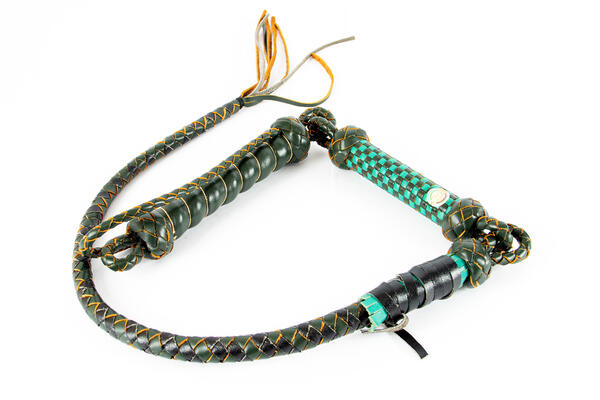
A special feature of the wolf-hunting nagaika was a lead bullet or piece of metal sewn into the tip of the whip; sometimes its handle could be used to conceal a knife. Only a saddler who knew how to make this weapon well was worthy of the title of master.
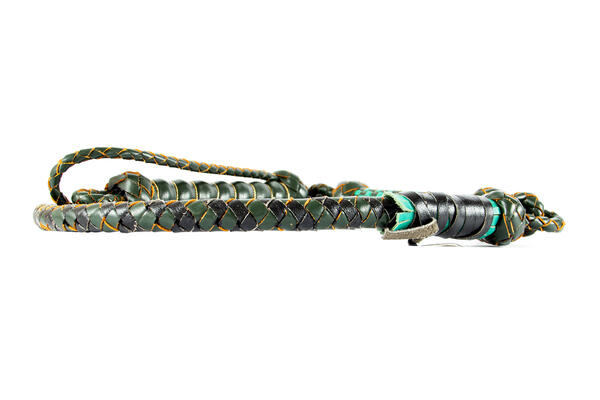
Snake pattern braiding is considered to be the oldest way of making a nagaika. A whip made in such a way looked like it was covered in snake scales. To do this, saddlers used rawhide straps from the dorsal part of the animal’s skin. The straps were then twisted into an elastic “pigtail”. One whip consisted of 6 to 32 such pigtails.
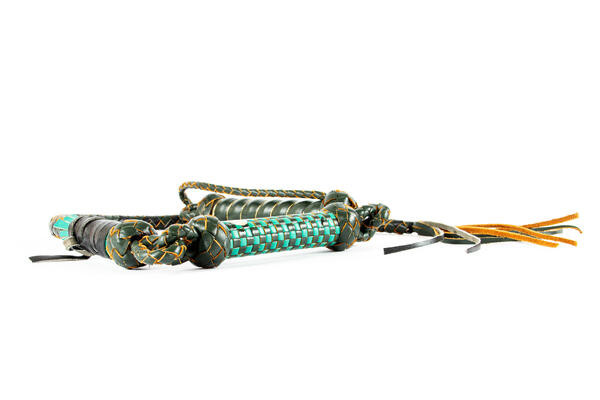
Handles for whips were usually
cut from fruit trees, covered with decorative patterns, carvings and braided
with leather straps. To provide a better grip, a ball was made at the butt of
the handle. Correctly attaching the whip to the handle gave the weapon
necessary balance.