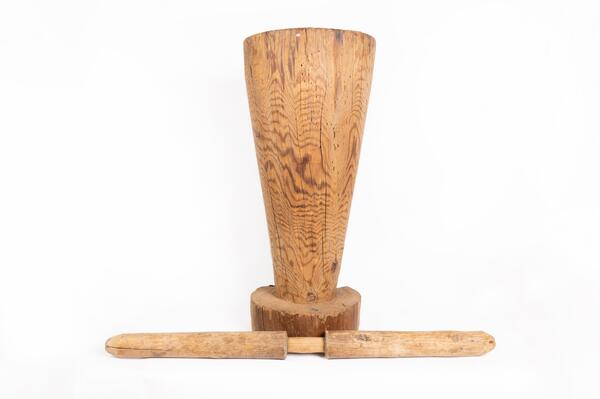
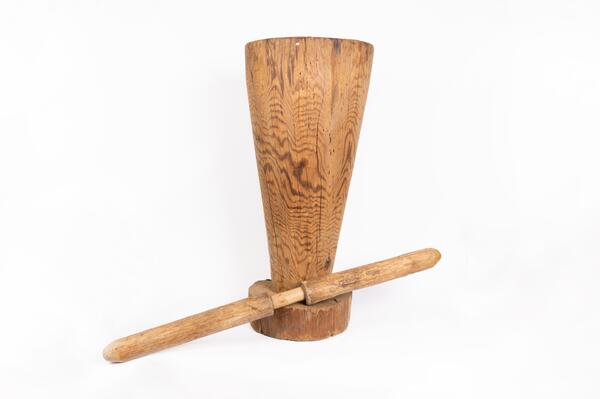
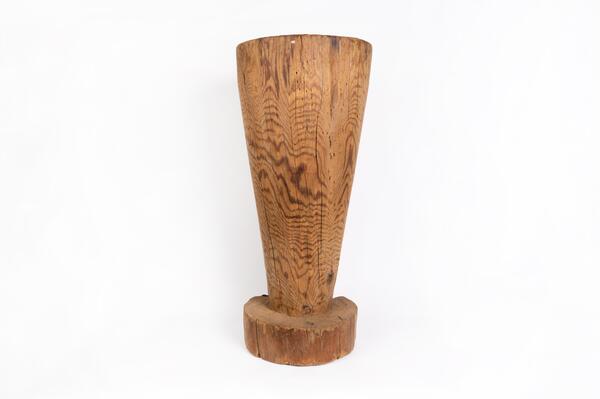
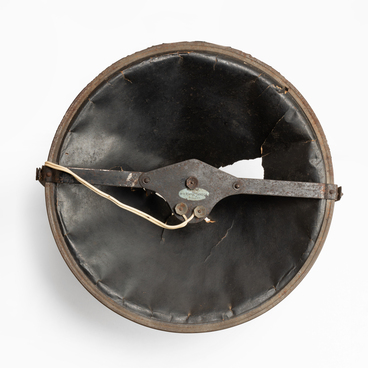
This artifact from the collection of the Unecha Local Lore Museum immediately catches the eye with its impressive size: it is a large wooden mortar. Such tools have been known since ancient times and were used by the Egyptians, Greeks, Romans, and, of course, the Slavic peoples.
In essence, the mortar is a precursor to the modern mill. It was used to pound grain, removing its hull and husk. Two primary processing methods were employed: pounding and grinding. When pounding, the grain was subjected to repeated, sharp blows from the pestle. When grinding, the pestle not only pressed down on the grain but also made circular movements along the bottom of the mortar, grinding the contents more thoroughly.
Rye, wheat, barley, oats, and buckwheat — almost all cereals used for food — were processed in a mortar. Every peasant household owned one. Inside a traditional Russian peasant house, it would typically be found behind the stove, alongside its pestle, which was also known as a “pekhtal”.
Mortars were heavy, massive, and stable to prevent them from moving around during use. They were most often hollowed from a solid oak log, though birch and aspen were also used. Their shape was slightly narrowed towards the bottom for added stability, and the body was often encircled with metal or wooden hoops to prevent the wood from cracking.
A typical mortar could be up to 80 centimeters high, with a depth of 50 centimeters and a diameter of 40 centimeters. Its constant companion, the pestle, could reach a meter in length. It was often double-ended, with a handle in the middle, making it more convenient to work by alternating strokes. Many mortars had two carrying handles, though these have not been preserved on the museum artifact. During operation, the mortar was filled with grain to no more than 5% of its volume; any more would make crushing difficult and cause the grain to spill out.
The mortar is firmly embedded in Russian culture. It is inseparable from the image of the main sorceress of Russian fairy tales, Baba Yaga. It also appears in classical literature, such as in Alexander Pushkin’s “Ruslan and Ludmila”, “There, in a mortar, onward sweeping. / All of itself, beneath the skies. /The wicked Baba-Yaga flies”, and in the folk motifs of Nikolai Gogol’s “Evenings on a Farm Near Dikanka”.
Thus, the mortar was not merely a practical tool in the peasant household but also a significant part of Russian cultural heritage. Even today, one can find a small mortar and pestle in a modern kitchen, used for grinding spices, garlic, or coffee beans — a direct descendant of this ancient tool.