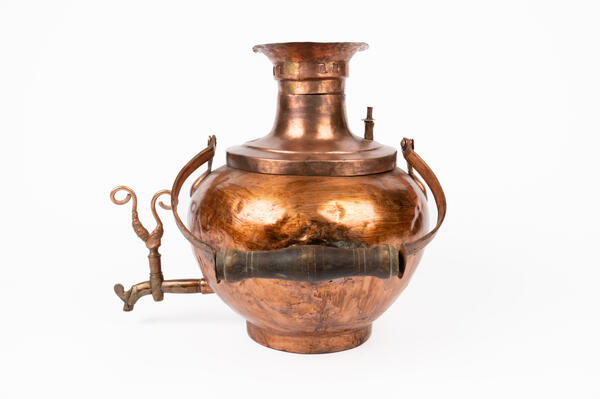
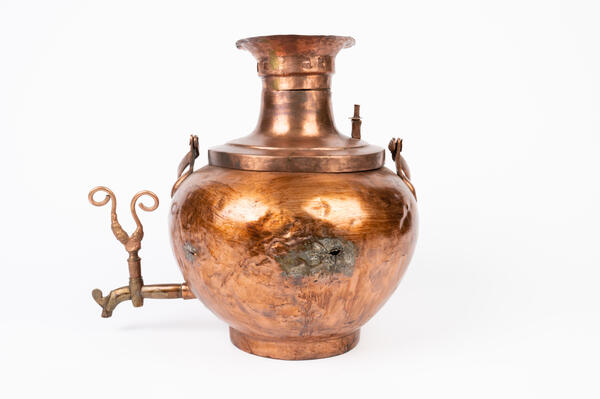
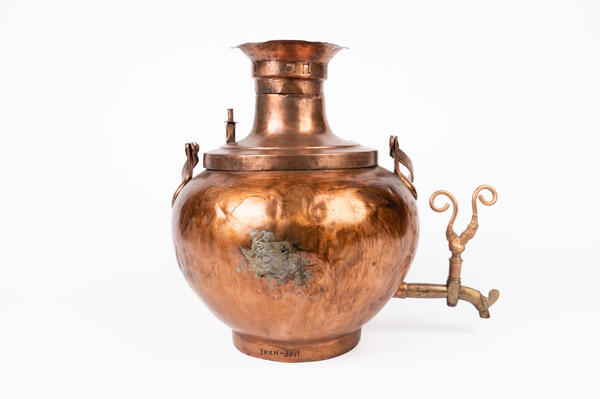
The exhibit, displayed behind glass in the Unecha Local Lore Museum, invariably intrigues the visitors and prompts the question: Is it a kettle or a samovar? In fact, it is neither. This is a sbitennik, or sbiten-maker — a vessel used in the old days to brew sbiten, one of the most beloved drinks in Russia.
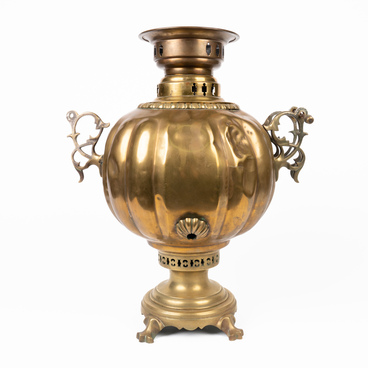
The sbitennik’s form resembles oriental vessels that may have arrived in Russia through contacts with nomadic peoples. Most importantly, it was the direct predecessor of the samovar. The samovar was later developed based on the design of its internal fire tube, and not the other way around.
Inside, the vessel was divided by an airtight partition into two separate sections. Water was poured into one (the tank), where honey and fragrant herbs were added. In the other section, wood chips, pine cones, or embers were placed and lit, heating the liquid in the adjacent compartment. For better airflow, the sbiten-maker was equipped with a blower and a chimney, essentially making it a portable pot. It typically featured a carrying handle, a spout for easy pouring, and legs for stability.
The artifact on display has a samovar-like spout and a kettle-like body and handle, but it lacks legs — suggesting it was probably intended for use on a stand or a flat surface.
Such devices were cast mainly from copper or brass and polished to a mirror-like shine. In daily life, they were not only utilitarian but also decorative objects. Sbiten was immensely popular, especially among the Old Believers, who avoided tea as a “foreign” drink. The first mention of sbiten is found in a chronicle from 1128, and a recipe is described in detail in the Domostroy, a 16th-century compilation of household rules.
The drink was based on water, honey, and aromatic herbs like sage, St. John’s wort, oregano, thyme, fireweed, and linden blossom. Later, hops were added, and with the expansion of trade, spices like cinnamon, cloves, and even bay leaf. Foreigners called it “Russian mulled wine”.
Hot sbiten had warming and anti-inflammatory properties, making it especially valued in winter. A chilled version was also enjoyed in the summer, as it quenched thirst perfectly. Until the late 19th century, sbiten remained a popular alternative to tea and coffee, sold at all fairs, bazaars, and folk festivals.
Sbiten was typically sold by young, strong men. They carried the heavy sbitennik in one hand, had bundles of small, dry biscuits slung over their shoulders, and wore a bast belt with cups around their waists. The sellers did not stand still but moved through the crowd, calling out: “Hey, have some sbiten, have some sbiten! Eat up, girls and boys! Eat and drink! Spare no money!”