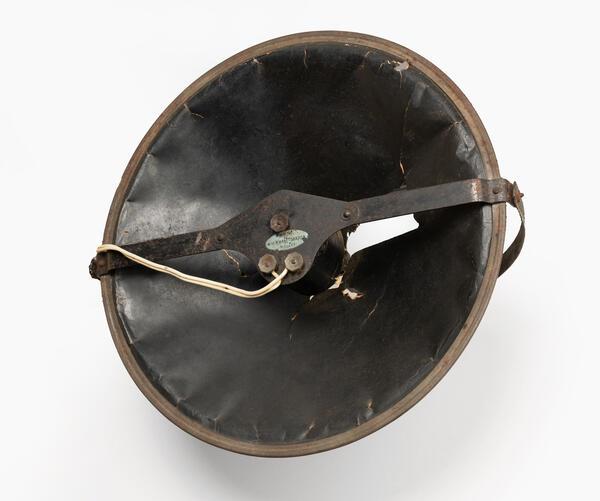
The Unecha Local Lore Museum holds numerous artifacts closely connected with the Great Patriotic War, among which the “Record-3” electromagnetic loudspeaker with a paper diaphragm stands out as especially symbolic. Displayed in the section “Unecha During the War Years”, this device embodies the sound of wartime life in the city.
The Record-3 was a defining feature of both pre-war and wartime Soviet life. It was commonly nicknamed the “plate” or “frying pan” because of its distinctive rounded shape. These loudspeakers were installed not only in homes but also outdoors — mounted on utility poles, building façades, and street corners.
The first such loudspeakers were developed as early as 1924, but mass production began in 1927 at the Kalinin Plant in Leningrad. Later, manufacturing expanded to Moscow, Nizhny Novgorod, and Kharkov. By the 1930s, the loudspeaker had become a fixture of the Soviet interior. Owning a “radio point” was a source of pride — it signified modernity, and often inspired admiration, even envy, among neighbors.
This era marked the rapid expansion of radio broadcasting across the USSR. Radio served not only to inform and entertain, but also as a powerful tool of ideological education and propaganda. For millions of citizens — especially in rural areas — it was the primary, and often sole, source of news.
Design-wise, the Record-3 was simple yet effective. With an output of just 0.25 watts, it featured a conical diaphragm (36 centimeters in diameter) made of pressed paper, held in place by metal brackets. A mechanical volume control sat at its center. An electrical signal traveling through the wires was converted directly into audible sound.
Priced at 29 rubles, the device was quite accessible. Radio broadcasts began daily at 6 a.m. with the sound of chiming bells followed by “The Internationale”, and concluded at midnight.
It was through such a “plate” that the people of the Soviet Union — including the residents of Unecha — heard Vyacheslav Molotov’s somber announcement on June 22, 1941, revealing the treacherous invasion by Nazi Germany. Just three days later, on June 25, the Council of People’s Commissars ordered all citizens to surrender their personal radios to local communications offices. This precaution aimed to prevent the enemy from exploiting radio channels for disinformation or espionage. Notably, after the war, most receivers were returned to their rightful owners.
Outdoor loudspeakers played an even broader role during the conflict. Mounted on poles, they functioned not only as news outlets but also as civil defense alert systems — broadcasting air raid warnings, artillery shelling alerts, and urgent official instructions. These modest “plates” became enduring symbols of a turbulent era: a time of loss and hope, sorrow and resilience, and above all, the unbreakable unity of the Soviet people in the face of a common enemy.