The first benches appeared in Ancient Egypt. They were very low because in those days people used to sit on the ground. Their frames were usually made of stone. The wicker seats made of twigs or leather belts were fixed in special deepenings. In Egypt, benches, unlike beds, hardly ever were decorated with carvings. They were usually put in public places.
Greek benches looked a bit different. They had carved backs and headrests. Unlike the Egyptian ones, they were often used to lay on them, also near the dining table.
An ancient Russian bench looked like a small footrest, which used to be offered to guests of honor. Later, the local men started producing similar, but larger furniture with high legs. The benches could be wooden or made of willow twigs. Over time, people started adding high backs and armrests. They used to be decorated with carvings, wicker patterns, or paintings. Furniture in rich houses was trimmed with precious stones.
There were two types of benches in Russian houses. The small ones served just as seats and were called transfer benches. The large ones were called sleeping benches. The owners used them to rest after dinner. Moreover, they were offered for guests, who stayed overnight.
Benches served as an interior decoration in wealthy merchant families. The housemasters often covered them with mats or rugs made of patchwork or homespun bedspreads with a bright pattern. They also used to pile some pillows one on another and cover them with special coverings.
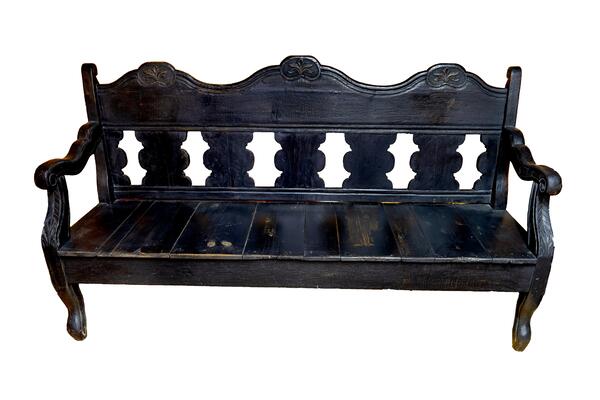
It is believed that the bench from the exhibition of Nizhnevartovsk Museum of Local History belonged to a merchant Abram Kushnikov. That person came from an old Surgut family and was one of the founders of the Russian village — Vartovskie Yurty, also known as future Nizhnevartovsk.
The upper part of this bench back is made of a solid board. Its free edge is wavy shaped. Each bend is crowned with a carved floral-themed medallion. There are five completely figured and two half-figured boards between the upper and lower bars. The armrests are decorated with leaves patterns.
Greek benches looked a bit different. They had carved backs and headrests. Unlike the Egyptian ones, they were often used to lay on them, also near the dining table.
An ancient Russian bench looked like a small footrest, which used to be offered to guests of honor. Later, the local men started producing similar, but larger furniture with high legs. The benches could be wooden or made of willow twigs. Over time, people started adding high backs and armrests. They used to be decorated with carvings, wicker patterns, or paintings. Furniture in rich houses was trimmed with precious stones.
There were two types of benches in Russian houses. The small ones served just as seats and were called transfer benches. The large ones were called sleeping benches. The owners used them to rest after dinner. Moreover, they were offered for guests, who stayed overnight.
Benches served as an interior decoration in wealthy merchant families. The housemasters often covered them with mats or rugs made of patchwork or homespun bedspreads with a bright pattern. They also used to pile some pillows one on another and cover them with special coverings.
It is believed that the bench from the exhibition of Nizhnevartovsk Museum of Local History belonged to a merchant Abram Kushnikov. That person came from an old Surgut family and was one of the founders of the Russian village — Vartovskie Yurty, also known as future Nizhnevartovsk.
The upper part of this bench back is made of a solid board. Its free edge is wavy shaped. Each bend is crowned with a carved floral-themed medallion. There are five completely figured and two half-figured boards between the upper and lower bars. The armrests are decorated with leaves patterns.