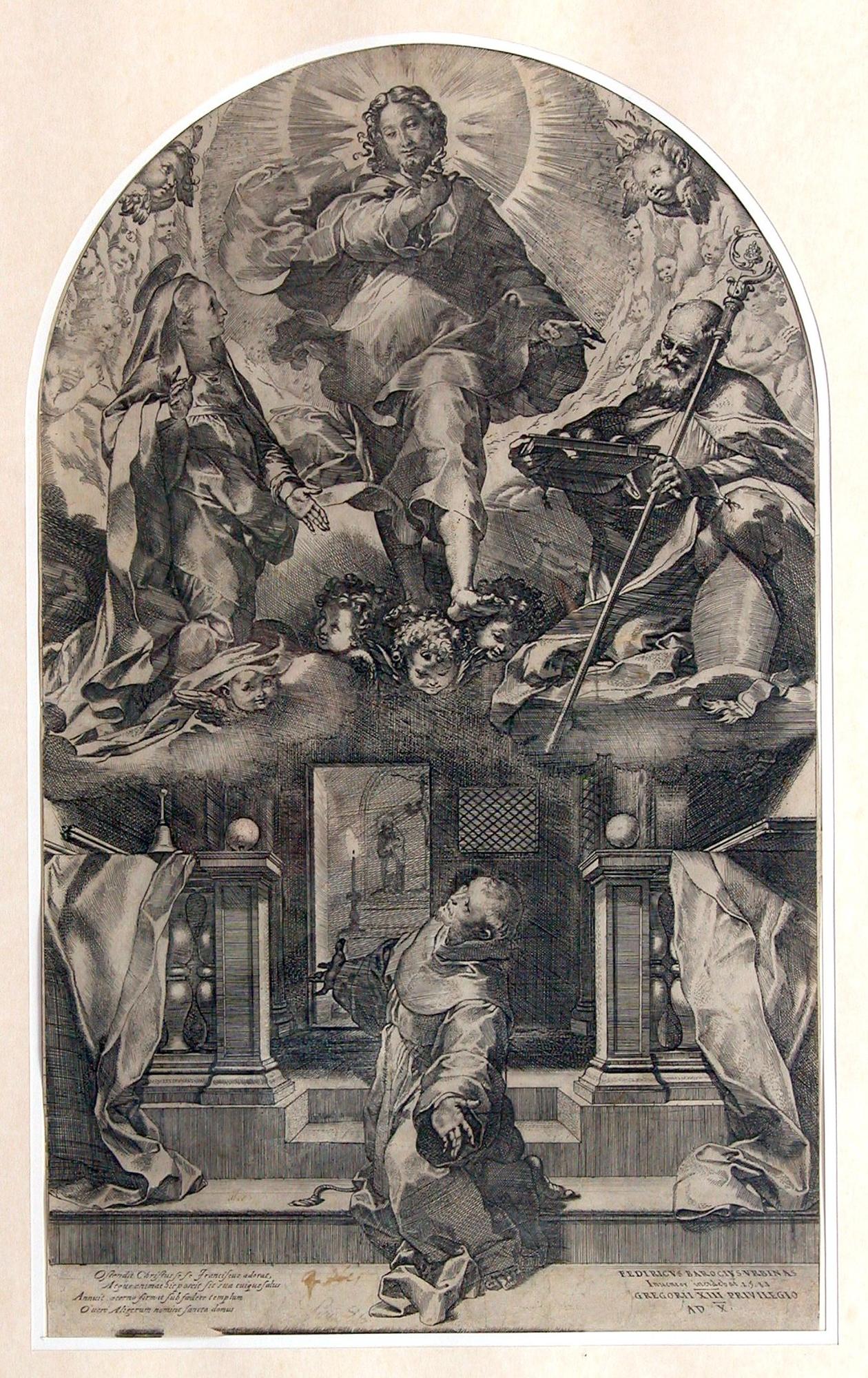


Federico Barocci created the print on display “Saint Francis Receives the Stigmata” using the etching technique. Barocci turned to printmaking only in the later phase of his career — in the 1580s. Today, only four etchings are attributed to him, yet their technical sophistication and expressive power had a profound influence on the development of Italian printmaking.
In his work, Barocci combined etching with engraving using a burin, employed the drypoint technique, and practiced multi-plate etching. The rhythmic, controlled lines of the burin lay beneath the delicate scratches of the drypoint, while additional biting of the plate deepened the tonal richness of the lines. The light in his prints appears soft and gentle, achieved through subtle gradations created by the interplay of these techniques. Barocci employed a vertical composition, and the lighter tonality in the upper portion prevented the image from feeling visually heavy or oppressive.
The image — “Saint Francis Receives the Stigmata” — depicts one of the most mystical and defining moments in the life of the founder of the Franciscan Order. According to tradition, while praying on the feast of the Exaltation of the Holy Cross, Francis experienced a vision of a six-winged seraph bearing the image of the crucified Christ. From this vision, he received the stigmata — wounds mirroring those of Christ’s Passion — in his hands, feet, and side. Upon awakening, he found himself physically marked by these wounds, which bled periodically until his death. Francis thus became the first recorded stigmatized saint in Christian history.
No eyewitness accounts of the event survive. Early visual and literary depictions — including frescoes at the Monastery of St. Benedict in Subiaco — served as key sources for later artists. The most influential written account comes from St. Bonaventure, whose Legenda Maior (“The Life of St Francis of Assisi”) describes how, during a moment of divine ecstasy, nail-like marks appeared in the center of Francis’s palms and soles, while a wound, as if from a spear, opened on his right side — from which blood often flowed. Francis bore these sacred wounds until his death.
Federico Barocci lived and worked primarily in Urbino. He trained first under the guidance of his father, Ambrogio Barocci, a modestly known sculptor, then with the Venetian painter Battista Franco and the architect Bartolommeo Genga. Federico worked in Urbino, Rome, and the Vatican on commissions for the papal court and the court of Charles V, but he declined the position of court artist. Barocci painted religious-themed canvases and frescoes, as well as oil-on-canvas paintings.