


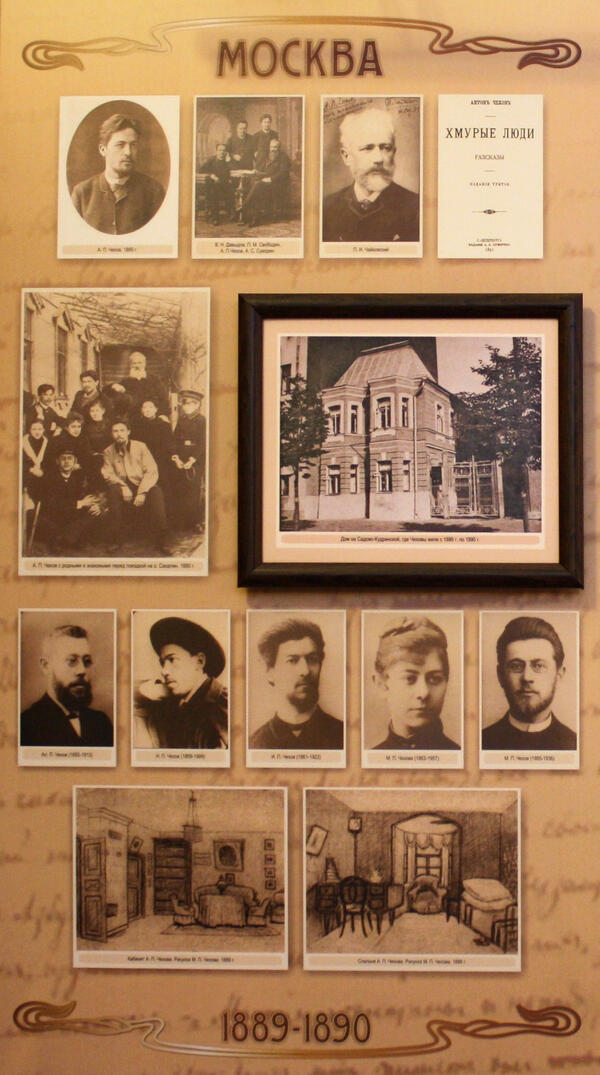
The picture in the frame shows the house at Sadovo-Kudrinskaya street where the Chekhov family lived between 1886 and 1890. The writer’s friends and acquaintances compared the townhouse to a small castle. Chekhov found a less poetic but a more accurate comparison calling the house “a dresser”. The landowner was the medical doctor Yakov Korneev. The Chekhov family occupied both floors of the house. In the bottom part of the stand there are drawings by MikhaIl Chekhov, the writer’s brother, showing Chekhov’s study and bedroom in the dresser-house.
When Chekhov moved to the house at Sadovaya-Kydrinskaya, he was only 26. The picture in the top left corner of the display board gives the idea of how Chekhov looked in 1889. Next to it there is a group picture showing the actors Vladimir Davydov, Pavel Svobodin, Chekhov himself, the journalist and critic Alexey Suvorin.
At that time, Davydov was a very popular actor in Russia. Chekhov went to Fyodor Korsh’s theatre to see that ‘great artist’. Davydov was the first to act as Ivanov in the similarly-named play by Chekhov. Svobodin also acted in ‘Ivanov’ as Schebelsky. Svobodin was a very good friend of Chekhov, he was a welcome guest of the writer in Moscow, in Luka and then, in Melikhovo. In the three and a half years alone, the actor wrote 102 letters to Chekhov. Friendly relations with Suvorin, the publisher of ‘Novoye Vremya’ (New Time) newspaper, lasted 17 years.
A landmark event in the Moscow period of Chekhov’s life was a visit of Pyotr Chaikovsky to the house at Kudrinskaya street. Personal acquaintance with the composer took place in December 1888 in Petersburg. The pictures in the top right corner of the display panel are the composer’s portrait and a cover of the collection of stories called ‘Gloomy People’ dedicated to Chaikovsky.
Over the last months of his life in the house at Kudrinskaya street Checkhov was preparing for a trip to the SakhalIn island. In the second row of the pictures on the stand there is a group picture: Chekhov among his relatives and acquaintances outside the Korneev’s house prior to the trip (in 1890). From left to right, in the first row — Mikhail Chekhov, Anton Chekhov, in the second row — Alexandra Lesova (a teacher from a village near Melikhovo who was for some time the bride of Ivan Chekhov), LIka MizInova (a close friend of the Chekhov family), Maria Chekhova (the writer’s sister), Yevgeniya Chekhova (mother), Seryozha Kiselyov (a son of the writer’s acquaintances who lived with the Chekhovs over the winter if 1889-90). In the third row – Alexander Ivanenko (a flute player, “an eternal friend” of the Chekhov family), Ivan Chekhov, Pavel Chekhov (father).
When Chekhov moved to the house at Sadovaya-Kydrinskaya, he was only 26. The picture in the top left corner of the display board gives the idea of how Chekhov looked in 1889. Next to it there is a group picture showing the actors Vladimir Davydov, Pavel Svobodin, Chekhov himself, the journalist and critic Alexey Suvorin.
At that time, Davydov was a very popular actor in Russia. Chekhov went to Fyodor Korsh’s theatre to see that ‘great artist’. Davydov was the first to act as Ivanov in the similarly-named play by Chekhov. Svobodin also acted in ‘Ivanov’ as Schebelsky. Svobodin was a very good friend of Chekhov, he was a welcome guest of the writer in Moscow, in Luka and then, in Melikhovo. In the three and a half years alone, the actor wrote 102 letters to Chekhov. Friendly relations with Suvorin, the publisher of ‘Novoye Vremya’ (New Time) newspaper, lasted 17 years.
A landmark event in the Moscow period of Chekhov’s life was a visit of Pyotr Chaikovsky to the house at Kudrinskaya street. Personal acquaintance with the composer took place in December 1888 in Petersburg. The pictures in the top right corner of the display panel are the composer’s portrait and a cover of the collection of stories called ‘Gloomy People’ dedicated to Chaikovsky.
Over the last months of his life in the house at Kudrinskaya street Checkhov was preparing for a trip to the SakhalIn island. In the second row of the pictures on the stand there is a group picture: Chekhov among his relatives and acquaintances outside the Korneev’s house prior to the trip (in 1890). From left to right, in the first row — Mikhail Chekhov, Anton Chekhov, in the second row — Alexandra Lesova (a teacher from a village near Melikhovo who was for some time the bride of Ivan Chekhov), LIka MizInova (a close friend of the Chekhov family), Maria Chekhova (the writer’s sister), Yevgeniya Chekhova (mother), Seryozha Kiselyov (a son of the writer’s acquaintances who lived with the Chekhovs over the winter if 1889-90). In the third row – Alexander Ivanenko (a flute player, “an eternal friend” of the Chekhov family), Ivan Chekhov, Pavel Chekhov (father).


