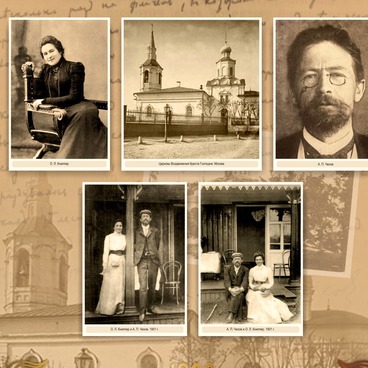
From summer 1899 on, Chekhov and Olga Knipper exchanged letters. Their correspondence continued, with intervals, until spring 1904. 433 letters and telegrams of Chekhov to Knipper are known to exist, and over 400 letters of Knipper to Chekhov – it is Chekhov’s largest correspondence, in terms of volume. The letters are so many, first of all, because after the wedding in 1901, Chekhov and Knipper lived separately, in different cities. He had to stay in Yalta due to his health’s condition, she lived in Moscow as she could not and did not want to leave the Moscow Art Theatre. It has to be said, that Chekhov disallowed her to quit the stage. ‘…if you lived with me in Yalta through the entire winter, your life would have been spoiled and I would have tortured myself with remorse, and it won’t make the situation better …’. Knipper wrote: “He would never agree to my voluntary retirement from the stage…”.
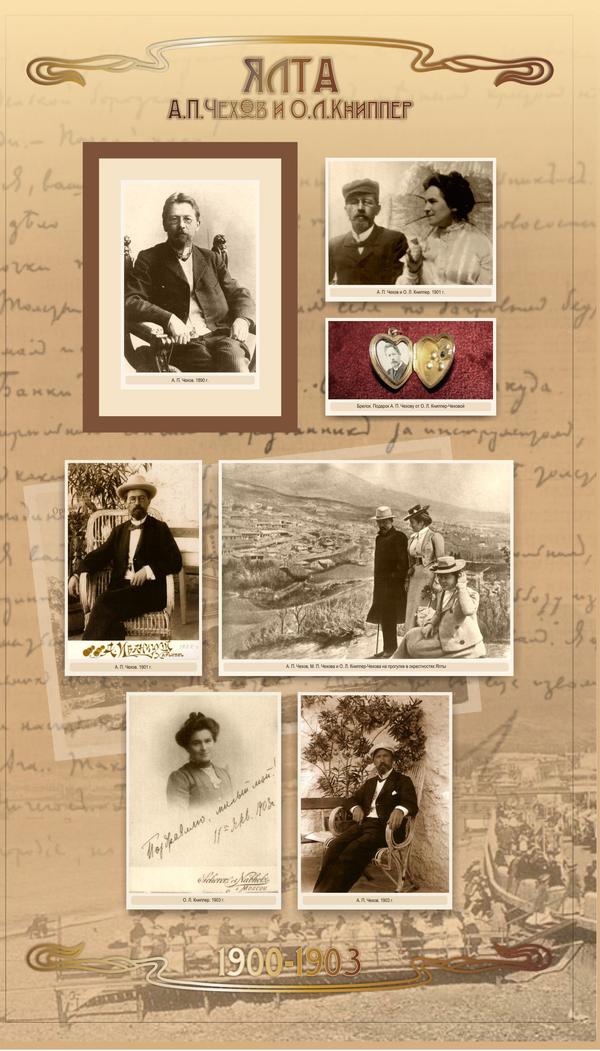
The pictures on the display panel illustrate the history of Chekhov’s and Knipper’s relations between 1901 and 1903. They expected a long life together in Moscow, but those hopes were not destined to be realized: due to the state of his health, Chekhov had to live in Yalta from autumn until spring. Their main connecting link was correspondence. They wrote to each other nearly every day. In Chekhov’s letters to his wife the following lines are encountered: ‘You are kind, you are good, I love you, I love you’. In response letters, Olga confessed: ‘I’m getting better beside you’. In another letter she called the writer “man of the future”.
In 1901, she gave a golden heart-shaped pendant as a present to Chekhov (it can be seen on the colored photo). Initially, there was Knipper’s picture in the locket. Chekhov wore the pendant on a watch-chain. It is visible on the writer’s picture dated 1901 (in the frame, on the left-hand side of the stand). For a long time after the writer’s death, Knipper wore the locket with Chekhov’s picture as the most precious souvenir. In 1903, Chekhov celebrated his birthday in Yalta. On the occasion, among other presents from Moscow, Olga sent to him a signed picture of herself: “Congratulations, my darling!”.
Olga’s letters linked Chekhov to Moscow, to the Art Theatre, and were very interesting and dear to him. ‘I knew that I was taking an actress as a wife, i.e., when getting married I was very well aware that you will stay in Moscow over the winter. I am not feeling injured or set aside, not to a one-millionth part …’ He loved her and was happy with her:
The pictures on the display panel illustrate the history of Chekhov’s and Knipper’s relations between 1901 and 1903. They expected a long life together in Moscow, but those hopes were not destined to be realized: due to the state of his health, Chekhov had to live in Yalta from autumn until spring. Their main connecting link was correspondence. They wrote to each other nearly every day. In Chekhov’s letters to his wife the following lines are encountered: ‘You are kind, you are good, I love you, I love you’. In response letters, Olga confessed: ‘I’m getting better beside you’. In another letter she called the writer “man of the future”.
In 1901, she gave a golden heart-shaped pendant as a present to Chekhov (it can be seen on the colored photo). Initially, there was Knipper’s picture in the locket. Chekhov wore the pendant on a watch-chain. It is visible on the writer’s picture dated 1901 (in the frame, on the left-hand side of the stand). For a long time after the writer’s death, Knipper wore the locket with Chekhov’s picture as the most precious souvenir. In 1903, Chekhov celebrated his birthday in Yalta. On the occasion, among other presents from Moscow, Olga sent to him a signed picture of herself: “Congratulations, my darling!”.
Olga’s letters linked Chekhov to Moscow, to the Art Theatre, and were very interesting and dear to him. ‘I knew that I was taking an actress as a wife, i.e., when getting married I was very well aware that you will stay in Moscow over the winter. I am not feeling injured or set aside, not to a one-millionth part …’ He loved her and was happy with her: