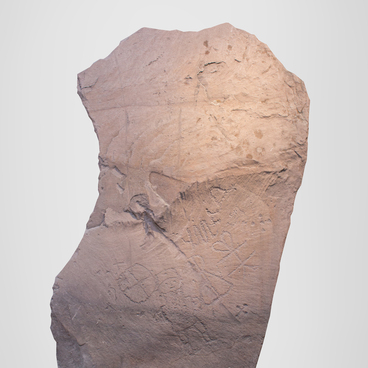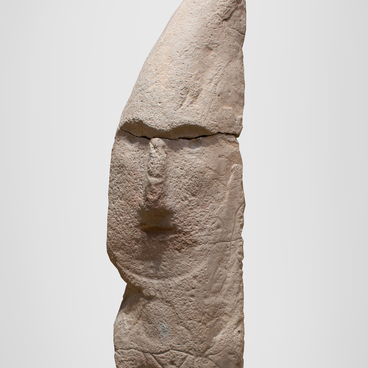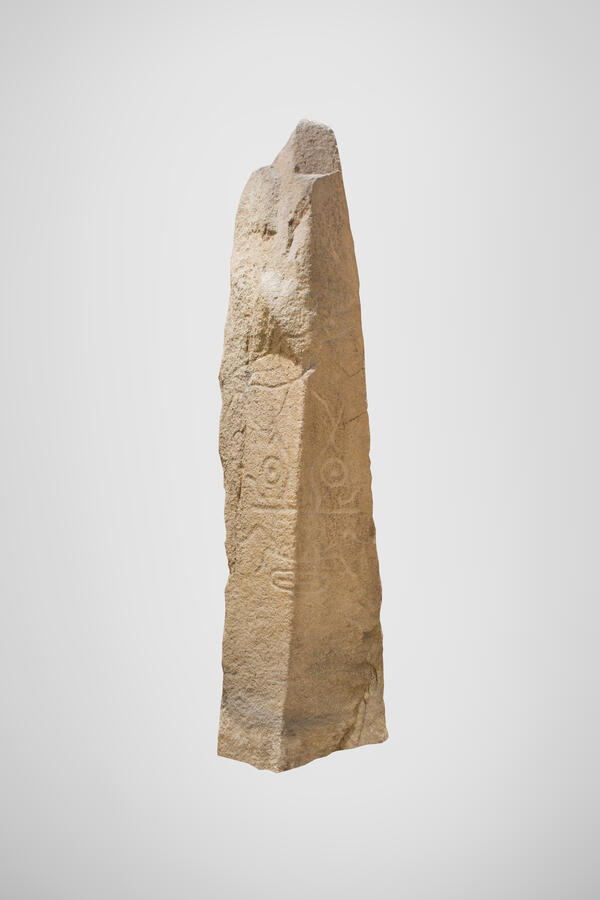
The museum collection includes a stela from the chaatas near the Sartyga ulus of the Ust-Abakan region. The nomad camps are called ulus, and large burial grounds received their own name “chaatas” in the Khakass culture, which means “stone of war”. In addition, a whole era is called chaatas — the time of the early Middle Ages, kurgans were built entirely of stone, and steles were erected there along the perimeter.
The burial ground on which the stela was found was located two kilometers above the mouth of the Sartygoi brook, the right tributary of the Uybat River, and five kilometers south-southwest of the village of Ust-Byur. The images on the stone belong to the Okunev culture and date back to the end of the 3rd — beginning of the 2nd millennium BC. The stela is installed obliquely, and the drawings on it are oriented to the east.
The image on the stela is a mask without an outer outline. The eyes are made in the form of circles with dots in the center, further there is a horizontal line, from which two winding ones extend upward. Below is a line with circles — nostrils, even lower — a horizontal oval — a mouth, in the center of which there is a straight line. Two serpentine stripes are depicted along the outer perimeter on each side. The drawings are made using the technique of point embossing.
The stela is unique as the axis of symmetry of the face is located on the edge of the stone. An image placed on two planes is perceived, as on flat stelas, as a whole. The only difference is that a vertical is structurally introduced into it — the edge of a stone block. The face has no contour, which is typical for flat faces, it does not show a “third eye”, but the area where it should normally be located is marked by two vertical sinuous lines.
Above the anthropomorphic image, as on many statues, the figure of an animal is placed. Here it is a moose. In ancient mythological concepts, it was a creature personifying the upper world and even the entire part of the Universe visible to man. The moose also symbolized the sun: people believed that it carried it across the sky on his horns.
The burial ground on which the stela was found was located two kilometers above the mouth of the Sartygoi brook, the right tributary of the Uybat River, and five kilometers south-southwest of the village of Ust-Byur. The images on the stone belong to the Okunev culture and date back to the end of the 3rd — beginning of the 2nd millennium BC. The stela is installed obliquely, and the drawings on it are oriented to the east.
The image on the stela is a mask without an outer outline. The eyes are made in the form of circles with dots in the center, further there is a horizontal line, from which two winding ones extend upward. Below is a line with circles — nostrils, even lower — a horizontal oval — a mouth, in the center of which there is a straight line. Two serpentine stripes are depicted along the outer perimeter on each side. The drawings are made using the technique of point embossing.
The stela is unique as the axis of symmetry of the face is located on the edge of the stone. An image placed on two planes is perceived, as on flat stelas, as a whole. The only difference is that a vertical is structurally introduced into it — the edge of a stone block. The face has no contour, which is typical for flat faces, it does not show a “third eye”, but the area where it should normally be located is marked by two vertical sinuous lines.
Above the anthropomorphic image, as on many statues, the figure of an animal is placed. Here it is a moose. In ancient mythological concepts, it was a creature personifying the upper world and even the entire part of the Universe visible to man. The moose also symbolized the sun: people believed that it carried it across the sky on his horns.