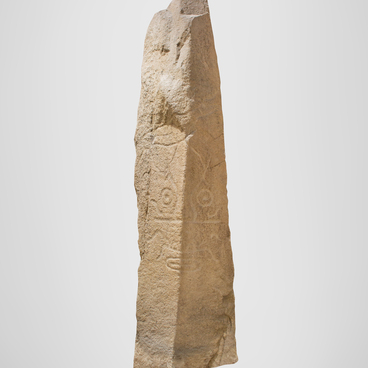
A slab of Devonian sandstone with an image was found in the northeastern wall of the Tagarsky mound, near the farm of the Askiz sheep farm in the village of Ust-Kamyshta in Khakassia. The mound belongs to the early stages of the Tagar culture and dates back to the 8th–7th centuries BC.
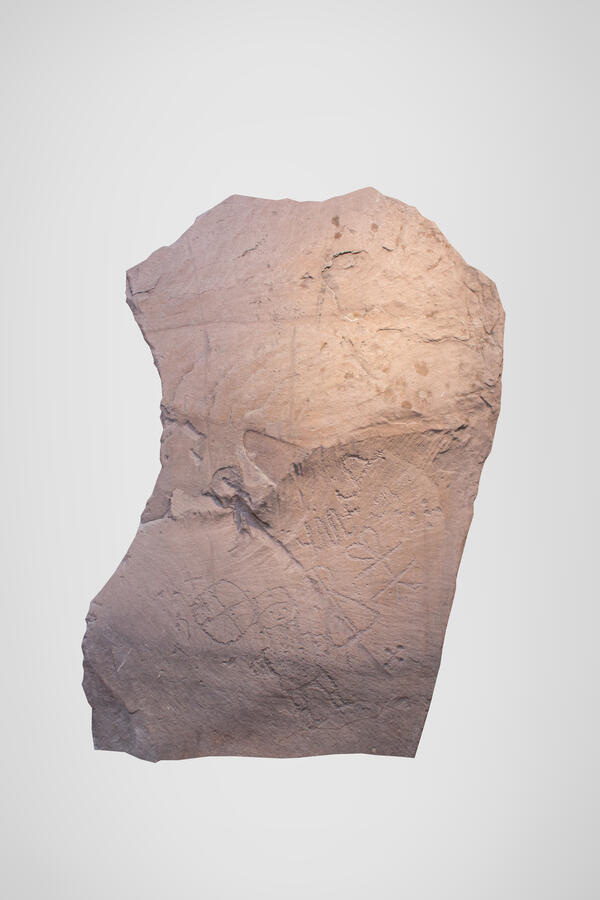
In the lower part of the slab, using the technique of pecking, an image of a human figure is engraved, outerwear, shoes and a headdress are drawn. The eyes are shown with dots, the nose and mouth with simple short lines. A small circle is engraved in the center of the headdress. To the left of the human figure is another circle, inside which a cross is marked by two lines, to the right of it is a figure in the form of an animal’s shoulder blade. Above, on the left, tamga-like images are visible — the tamga was the clan sign. On the lower end of one of them there are crossed lines and on the upper end there is a heart-shaped figure. The other tamga is made in the form of a serpentine line. In the lower part, under the image of the scapula, you can see a cruciform sign with rounded ends.
The image on the slab is dated presumably to the end of the 19th — the beginning of the 20th century, much later than the time of the construction of the mound. The ancient tradition of applying meaningful drawings on the rock developed over millennia and has been preserved in the culture of the Khakass people. Researchers have no doubt that the slab has an image of a shaman with a tambourine.
Shamanism as a belief has existed on the territory of the Khakass-Minusinsk depression for several millennia. Shamans were considered carriers of supernatural abilities; they represented a special social stratum, and thanks to them religious rites were performed. According to Khakass mythology, the first person was created by the supreme creator Khudai, and the first shaman (in Khakassian — kam) was created by the god of the underworld, Irlik Khan. One of the shaman’s ritual attributes and a tool for communicating with higher powers was a tambourine. Spirits were concentrated in it; it replaced a portable altar, served as a vehicle for travel to the upper and lower worlds, and was a weapon. The depicted shoulder blade of the animal is probably a fortune-telling device: for this, the right shoulder blade of lamb was often used. It was dried and kept tucked under the roof of a yurt in the male quarters. The signs engraved above are called tamgami and denote belonging to one or another Khakass clan.
In the lower part of the slab, using the technique of pecking, an image of a human figure is engraved, outerwear, shoes and a headdress are drawn. The eyes are shown with dots, the nose and mouth with simple short lines. A small circle is engraved in the center of the headdress. To the left of the human figure is another circle, inside which a cross is marked by two lines, to the right of it is a figure in the form of an animal’s shoulder blade. Above, on the left, tamga-like images are visible — the tamga was the clan sign. On the lower end of one of them there are crossed lines and on the upper end there is a heart-shaped figure. The other tamga is made in the form of a serpentine line. In the lower part, under the image of the scapula, you can see a cruciform sign with rounded ends.
The image on the slab is dated presumably to the end of the 19th — the beginning of the 20th century, much later than the time of the construction of the mound. The ancient tradition of applying meaningful drawings on the rock developed over millennia and has been preserved in the culture of the Khakass people. Researchers have no doubt that the slab has an image of a shaman with a tambourine.
Shamanism as a belief has existed on the territory of the Khakass-Minusinsk depression for several millennia. Shamans were considered carriers of supernatural abilities; they represented a special social stratum, and thanks to them religious rites were performed. According to Khakass mythology, the first person was created by the supreme creator Khudai, and the first shaman (in Khakassian — kam) was created by the god of the underworld, Irlik Khan. One of the shaman’s ritual attributes and a tool for communicating with higher powers was a tambourine. Spirits were concentrated in it; it replaced a portable altar, served as a vehicle for travel to the upper and lower worlds, and was a weapon. The depicted shoulder blade of the animal is probably a fortune-telling device: for this, the right shoulder blade of lamb was often used. It was dried and kept tucked under the roof of a yurt in the male quarters. The signs engraved above are called tamgami and denote belonging to one or another Khakass clan.