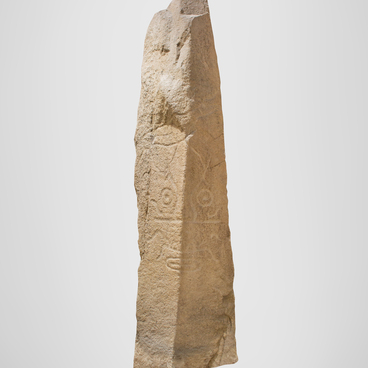
The statue, presented in the collection of the museum, was found on the right bank of the Bely Iyus River near the Troshkin ulus of the Shirinsky district of Khakassia. Archaeologist Albert Lipsky took it to the Khakass Museum in the 1960s. This monument is made of Devonian sandstone and belongs to the Okunev archaeological culture of the late 3rd — early 2nd millennium BC.
The ancient sculpture is an elongated stone, narrowed at the top. Its shape presupposes a special surface treatment: the excess was removed by the picket technique, that is, with small point blows, and then polished as needed. The main image is embossed here. In the Okunev culture, the technique of point embossing was widespread, but this statue was created with the help of volumes protruding from the plane of the background.
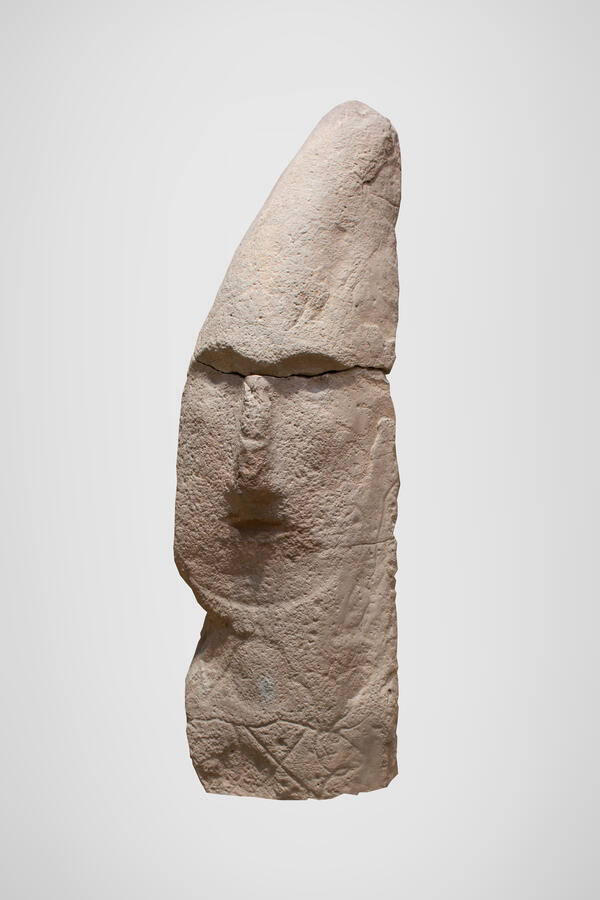
In the center, on the wide side, there is a relief image of a human face. Its features are realistic: powerful brow ridges, a massive straight nose, a clearly drawn mouth, and a chin are highlighted. It is possible that the artist working on the sculpture was referring to a real person. On the nose of the figure is an image of a miniature anthropomorphic mask. Small masks are also visible on the side faces — perhaps they denoted ancestor spirits or deities of the local pantheon. Below the face, on the chest, there is a figure of a sacred cow applied using the technique of point beating. It was a symbol of fertility, abundance and prosperity. In the Okunev era, there was a myth about a divine cow pregnant with a golden calf. After he was born, he became the brightest light in the sky — the life-giving sun.
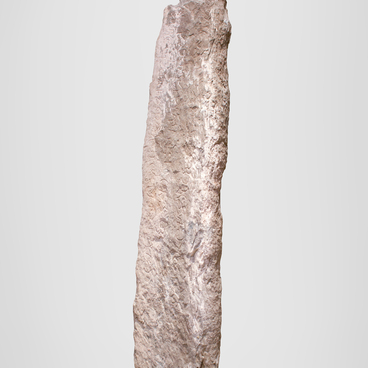
On the back of the statue, there is an image of a zoo-anthropomorphic creature or a fantastic animal. It expresses the most ancient mythological plot of space hunting. Ancient people believed that one element can pursue another, and the elements themselves were animate to them and were represented as different animals. The main idea of the “eternal pursuit” in the Okunev culture is most clearly expressed in the image of a fantastic creature chasing the sun.
The ancient sculpture is an elongated stone, narrowed at the top. Its shape presupposes a special surface treatment: the excess was removed by the picket technique, that is, with small point blows, and then polished as needed. The main image is embossed here. In the Okunev culture, the technique of point embossing was widespread, but this statue was created with the help of volumes protruding from the plane of the background.
In the center, on the wide side, there is a relief image of a human face. Its features are realistic: powerful brow ridges, a massive straight nose, a clearly drawn mouth, and a chin are highlighted. It is possible that the artist working on the sculpture was referring to a real person. On the nose of the figure is an image of a miniature anthropomorphic mask. Small masks are also visible on the side faces — perhaps they denoted ancestor spirits or deities of the local pantheon. Below the face, on the chest, there is a figure of a sacred cow applied using the technique of point beating. It was a symbol of fertility, abundance and prosperity. In the Okunev era, there was a myth about a divine cow pregnant with a golden calf. After he was born, he became the brightest light in the sky — the life-giving sun.
On the back of the statue, there is an image of a zoo-anthropomorphic creature or a fantastic animal. It expresses the most ancient mythological plot of space hunting. Ancient people believed that one element can pursue another, and the elements themselves were animate to them and were represented as different animals. The main idea of the “eternal pursuit” in the Okunev culture is most clearly expressed in the image of a fantastic creature chasing the sun.