Back in the 6th century BC, Indian tribes of North America grew tobacco and used it in medicine (to relieve pain) and rituals (to communicate with spirits). There is a popular theory that relates the word “tobacco” with Tobago — the name of the island where the expedition of Christopher Columbus first got acquainted with the tradition of smoking twisted leaves.
Thanks to Spanish and Portuguese navigators, not only the leaves, but also the seeds of this plant made their way to Europe, and by the end of the 16th century, the first tobacco plantation in Europe appeared in Ireland. The spread of tobacco was promoted, among other things, by the long-lasting popular opinion about its healing properties.
In Russia, smoking as a truly European tradition was introduced by Peter I, who acquired this habit in Holland. Under Catherine the Great, imported tobacco was in fashion. It came from Germany, France and Spain. At the same time rapid development of tobacco production began in Siberia.
Special containers were made for snuff from a variety of diverse materials: papier-mache, wood, ivory, precious metals, stones.
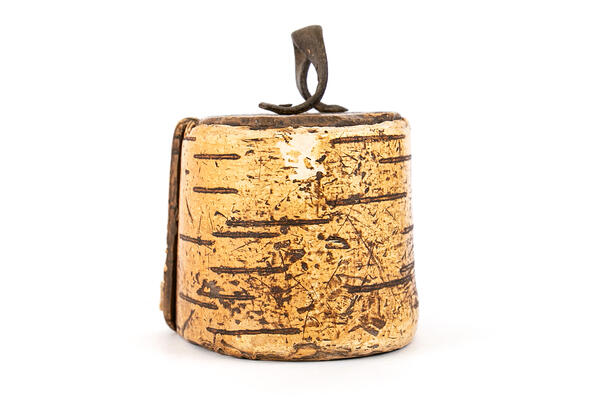
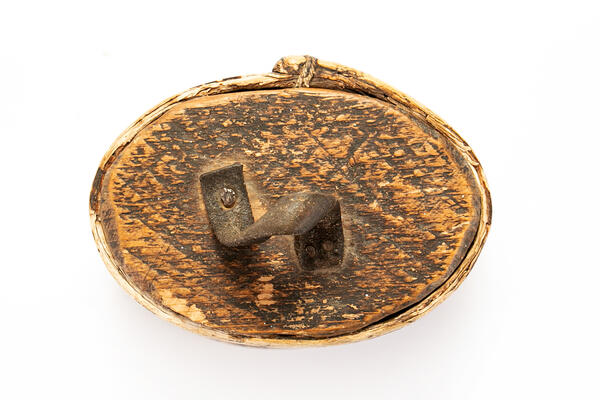
Flat-bottomed birch bark snuffboxes with lids were made in Western Siberia. The ends of the walls formed by two layers of birch bark were usually fastened together with flag-shaped profiling of the edges. The bottom and lid were made of wood and, less often, bark. To conveniently open or fasten the snuffbox to the belt, the center of the lid featured a loop or a handle made of birch bark or leather.
The presented snuffbox was made the same way a tuyes (a birch bark container with a lid) was made. The body for such products was rolled from layers of birch bark. The wooden bottom and lid were inserted into the steamed workpiece so that if they dried, they were tightly clamped and could not fall out. To keep the lid tight, but still openable, its bottom part had slightly beveled sides.
At home, tobacco was ground in a special mortar and stored in large snuffboxes.
Craftspeople valued birch bark for its antiseptic properties and impermeability: in such a box, expensive tobacco did not get wet and did not lose its aroma.
Such snuffboxes were mentioned
in the works by Russian writers Nikolai Vasilyevich Gogol, Mikhail Yevgrafovich
Saltykov-Shchedrin, Ivan Sergeyevich Turgenev and others.