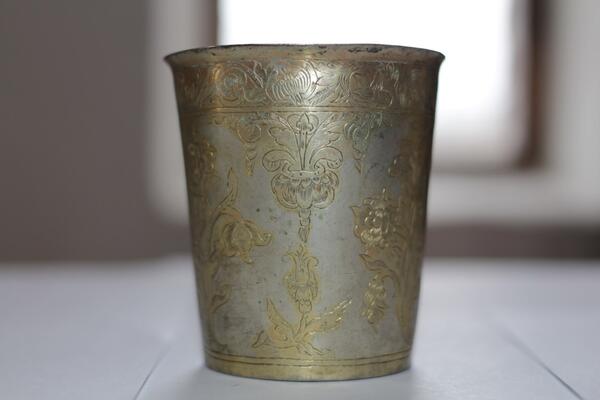
In Rus and later in the united Russian state, artisans created a variety of drinking vessels: bratinas, goblets, bowls, and ladles. Unlike them, most cups had neither feet nor handles. Their capacity, as a rule, equaled approximately 0.273 liters, which was about one twelfth of a “garnets” (pot) or one forty-fifth of a bucket (all these are obsolete Russian units of measure).
Wood, ceramics, glass and metal could be used as materials to make cups. On the one hand, such vessels were maximally simplified in form, on the other hand, cups were often decorated with painting, precious and semi-precious stones, as well as engraving.
In the 16th- and 17th-century Russia, cups had a large flaring neck. Over time, they began to look more like a cylinder. In the 17th century, some cups rested on small (usually three) feet.
Richly decorated cups became part of the royal and princely life; it was a ceremonial object used in church and secular rituals. Cups were used to serve drinks to honored guests. In such a situation, the trays or dishes on which the cups were brought were also of great importance. They were supposed to play a decorative role and create an atmosphere of solemnity.
Cups could be made to commemorate special events and feature the dates. Engravers depicted coats of arms and inscriptions. The latter could be performed along the rim of the cup or at the bottom. Silver cups were decorated with floral patterns. One of the favorite motifs of Russian artisans is large flowers, berries and fruits. Sometimes the image was so true-to-life that it was possible to distinguish between specific types of plants, such as cornflowers or sunflowers.
In the second half of the 17th century, artisans began to decorate cups with biblical scenes, as well as copy the images of Dutch engravings. Many of them were allegorical.
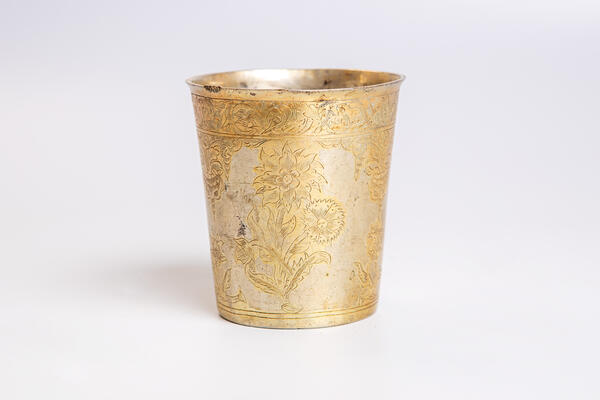
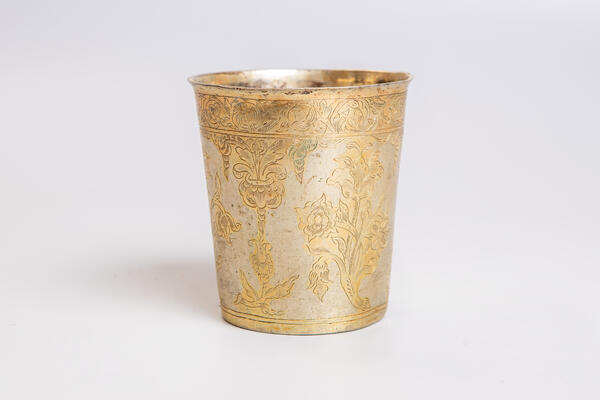
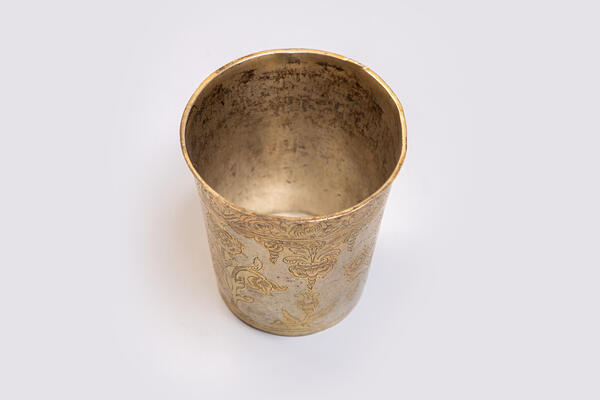
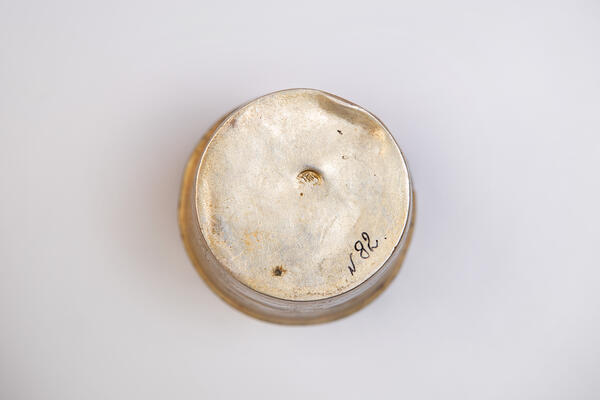
The cup from the museum’s collection was made of gilded silver using the cold forging technique. In the center of an engraved floral pattern, there is a flower, and above it in the branches is a bird.
Wood, ceramics, glass and metal could be used as materials to make cups. On the one hand, such vessels were maximally simplified in form, on the other hand, cups were often decorated with painting, precious and semi-precious stones, as well as engraving.
In the 16th- and 17th-century Russia, cups had a large flaring neck. Over time, they began to look more like a cylinder. In the 17th century, some cups rested on small (usually three) feet.
Richly decorated cups became part of the royal and princely life; it was a ceremonial object used in church and secular rituals. Cups were used to serve drinks to honored guests. In such a situation, the trays or dishes on which the cups were brought were also of great importance. They were supposed to play a decorative role and create an atmosphere of solemnity.
Cups could be made to commemorate special events and feature the dates. Engravers depicted coats of arms and inscriptions. The latter could be performed along the rim of the cup or at the bottom. Silver cups were decorated with floral patterns. One of the favorite motifs of Russian artisans is large flowers, berries and fruits. Sometimes the image was so true-to-life that it was possible to distinguish between specific types of plants, such as cornflowers or sunflowers.
In the second half of the 17th century, artisans began to decorate cups with biblical scenes, as well as copy the images of Dutch engravings. Many of them were allegorical.
The cup from the museum’s collection was made of gilded silver using the cold forging technique. In the center of an engraved floral pattern, there is a flower, and above it in the branches is a bird.