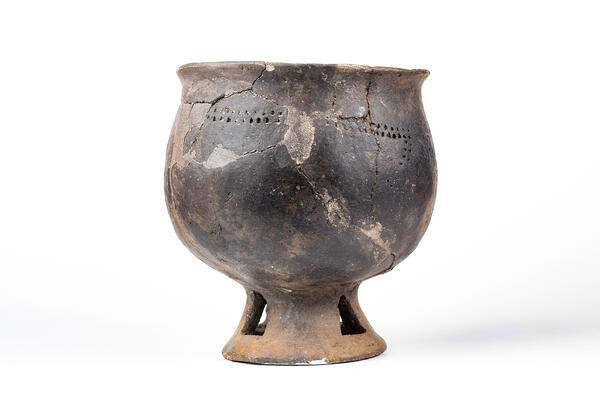
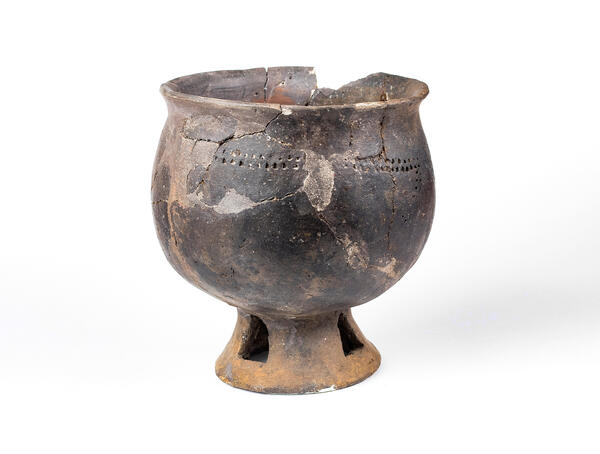
The dark clay cup-shaped vessel with a dot ornament on the body was made in the period from the 2nd century BCE to the 5th century CE. On the foot, the craftsman made through holes of a sub-triangular shape. The vessel was glued and plastered. This object was discovered by the Beya archaeological expedition of the Institute of the History of Material Culture of the Russian Academy of Sciences.
The excavations in the period from July 1 to October 4, 1993 were led by Margarita Nikolaevna Pshenitsyna. The group conducted research on archaeological sites in the territory of individual construction of the Ai-Dai settlement in the city of Sayanogorsk. As a result of the work, a settlement of the Tashtyk archaeological culture of Southern Siberia was discovered.
Being in many ways the successor of the Tagars, the Tashtyk culture was fundamentally different from it by the widespread use of iron. The economy was still agricultural and pastoral. The open settlement covered an area of at least 12 hectares and was probably one of the largest in the foothill zone.
Finds of grinding stones, ceramics, and numerous bones of domestic and wild animals testify about the economic life of this area inhabitants. The slag fragments found during the investigation of the site suggest that in addition to agriculture, breeding of large and small cattle, pottery, fishing and hunting, the residents were engaged in metalworking.
Researchers have encountered cups and jars like the Tagar ones. Nobaly, they were decorated with a strip of ornament along the upper edge or slightly below. The stripes consisted of impressions, notches, lines, serrations, brackets, dots, and a stampornament. Spherical vessels were always decorated by a third or more. They looked elegant because of the carved ornament in the form of spirals, circles, arches, shaded triangles, and applied rollers.
Cup-shaped vessels have
become traditional for the Minusinsk Basin since the Saragashen stage of Tagar
culture. Later they appeared in Tashtyk monuments. Archaeologists also found
cups in Kyrgyz burials, but such finds were rare. Given the small number of
cup-shaped vessels with holes in the foot, it can be assumed that they were
used for ritual purposes.