Font
Color
Graphics
Изображение точки

To see AR mode in action:

1. Install ARTEFACT app for iOS or Android;

2. Find the exhibition «From Century to Century»

3. Push the «Augmented reality» button and point your phone's camera at the exhibit;

Скрыть точки интересаПоказать точки интереса
Показать в высоком качестве

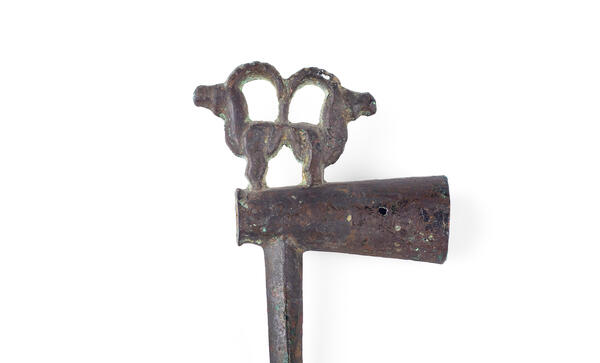
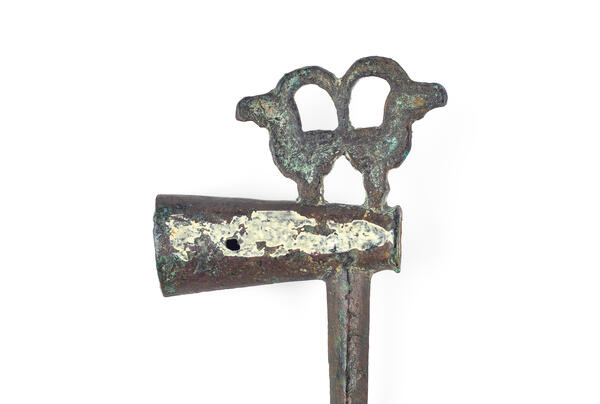
Bronze sagaris with goats figures

Creation period
4th–3rd century BCE
Place of сreation
Khakass-Minusinsk Basin
Dimensions
5x13,5 cm
Technique
bronze, casting
3
Open in app
#6

The sagaris, a combat weapon with a four-sided pointed head, was made of bronze. As a decoration on the butt, the craftsman created two opposing stylized figures of mountain goats. He also included in the design an elongated cone-shaped sleeve with two rounded holes for fixing the handle. Scientists have dated the artifact to the period from the 4th to the 3rd century BCE. This sagaris is a weapon of the Tagar archaeological culture.

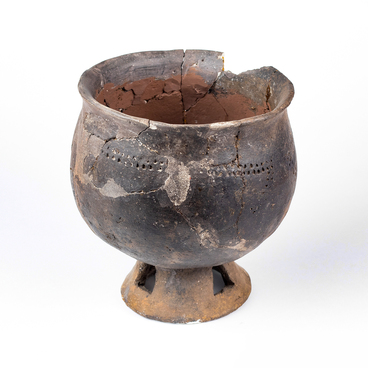
The item was included in the burial inventory of the Tagar burial mound. The burial ground was located in the city of Sayanogorsk, in the area of the construction of an aluminum smelter. Rescue archaeological work was carried out by the Beya expedition of the Institute of the History of Material Culture in 2004–2007. The head of the group was Margarita Nikolaevna Pshenitsyna.

Such short-staffed cold steel weapons as a sagaris, often had a beak-shaped head as the main striking element. On the territory of the Khakass-Minusinsk Basin, sagaris was known already in the Late Bronze Age, but it became widely used only by the time of the Tagar culture. Almost throughout its existence, sagaris were one of the most important types of melee weapons and were designed to inflict stab wounds.

In the archaeological literature, there is an opinion about the non-combat purpose of a number of sagarises at a later, Saragashen stage of culture. They could be considered as votive objects, that is, intended exclusively for ritual use, as an accompanying inventory of the deceased.

Tagar petroglyphs demonstrate two types of sagarises — large and small. The analysis of the objects and their images allowed the researchers to talk about the combat use of both reduced and full-size types in the early stages. It can be assumed that the reduction in the size of the sagaris was due to a change in combat tactics.
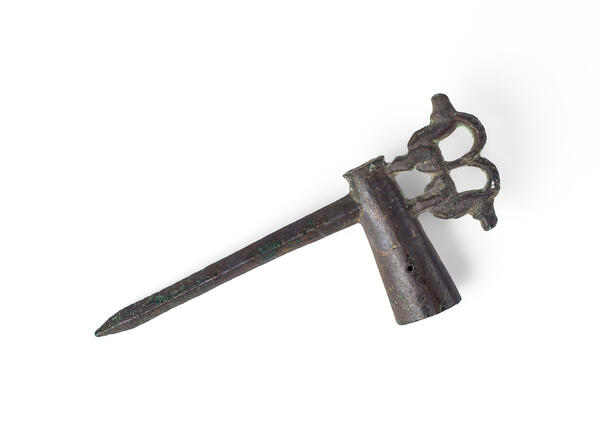
In the period from the 7th to the 6th century BCE, bronze sagarises were made with a long narrow sleeve. The earliest ones had round or polyhedral heads, flat or polyhedral butts. In later times, the number of head edges decreased to six and four.

#8
Bronze sagaris with goats figures
#7
View in the State Catalogue
read morehide
00:00
00:00
1x

Bronze sagaris with goats figures

Creation period
4th–3rd century BCE
Place of сreation
Khakass-Minusinsk Basin
Dimensions
5x13,5 cm
Technique
bronze, casting
3
Point your smartphone camera to open in the app
Share
VkontakteOdnoklassnikiTelegram
Share on my website
Copy linkCopied
Copy
Open in app
To see AR mode in action:
  1. Install ARTEFACT app for 
  2. iOS or Android;
  3. Find and download the «Paintings in Details» exhibition
  4. Push the «Augmented reality» button and point your phone's camera at the painting;
  5. Watch what happens on your phone screen whilst you flip through the pictures.
 
We use Cookies
Cookies on the Artefact Website. We use cookies to ensure that we give you the best experience on our website. If you continue without changing your settings, we'll assume that you are happy to receive all cookies on the Artefact website. However, if you would like to, you can change your cookie settings at any time.
Learn more about cookie useHide
Content is available only in Russian

X

Нашли опечатку?...

%title%%type%