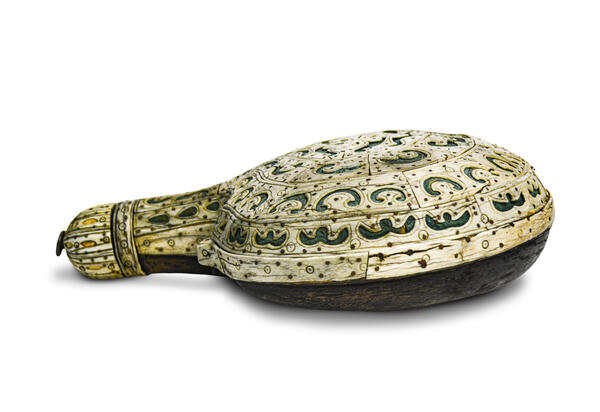
A torsuk (or tursuk) is a vessel used to store and transport the traditional Kazakh drink koumiss. This item dated back to the early 20th century was transferred to the museum’s collection from the Geographical Society in 1923.
Torsuks were made of leather or wood. Their volume usually ranged from four to five liters. The vessels were characterized by a variety of shapes: round, trapezoidal, and horn-shaped. Such items were usually decorated with zoomorphic patterns.
The base of the torsuk from the museum’s exhibition was made of a piece of wood. It was turned to make its body rounded and its neck cylindrical. Also, a sleeve was made of the same wood in the form of a hemispherical top. An iron hinge was nailed to the surface of the lid, into which a ring of wire was inserted. This design made it easy for the owner to open the sealed vessel.
Similar hinges with iron rings were hammered into the shoulders of the torsuk on both sides of the neck. During nomadic migration, the vessel was tied to the saddle or to the shaded part of an arba two-wheeled cart, by threading a rope through these rings. While moving, the drink was whipped inside, and its flavor became richer.
The craftsman covered the front side of the body with green leather, and the back side with two pieces of tin. The chosen color of the leather symbolized spring and youth. The vessel was decorated with carved bone plates fixed with copper nails. Traditionally, the scapula, shin, ribs, hooves and jaws of horses, camels, as well as sheep horns were used as materials for creating these decorative elements. Bones of thick-fleshed animals were considered the best. They were easier to cut and produced a yellow color, close to amber. Bones or horns were boiled for several hours before being processed.
The following elements
are distinguished on the museum torsuk: “at bas”, or “horse’s heads” (on both
sides of the neck), horseshoes (around the circumference of the vessel).
Historians and ethnographers have identified more than 200 types of Kazakh
decorative patterns. The work of a decorator was highly valued, not everyone
could buy a carved utensil. Such products were offered as a gift for weddings
and other special occasions.