Font
Color
Graphics
Изображение точки

To see AR mode in action:

1. Install ARTEFACT app for iOS or Android;

2. Find the exhibition «History of My Land»

3. Push the «Augmented reality» button and point your phone's camera at the exhibit;

Скрыть точки интересаПоказать точки интереса
Показать в высоком качестве

Vessel for koumiss (Choron)

Creation period
the late 19th — early 20th century
Place of сreation
Boturussky ulus, Yakutsk region, Russian Empire
Dimensions
38x13 cm
Technique
wood; three-dimensional carving, artisanal production
0
Open in app
#1

The remote location of the areas where the ancient Yakut people lived accounts for the fact that they produced household items using their own resources. The form of wooden and birch bark products was primarily functional and practical. The craftsmen of that time knew and took into account the natural properties of the material, its strength and durability. The items created by Sakha craftsmen were easy to use and durable, and many of them have survived to this day.

The shapes of Yakut wooden tableware have not changed since ancient times. Kitchen utensils were made using chiseling and carving techniques, similar to those which can be found in the cattle-breeding cultures of the Altai and South Siberian peoples.

The collection of the Churapchinsky museum includes the following utensils for koumiss: “choroon” vessels, konkoloy funnels, “khamnatar” whorls, “kerien ymyja” cups, “yhaaiakh” ladles, and “siri ihit” leather containers. Items of everyday use are represented by large and small “kytakh” and “kytiya” cups, “et khotoror uhum” meat platters, wooden calendars, snuff boxes, “mallaakh tuchut” boxes for sewing accessories, as well as furniture.

The symbolic meaning of koumiss utensils is closely connected with the cult of the horse and the culture of the summer festival “ysyakh”.

The Sakha people prepared for this celebration in advance: craftsmen made koumiss ware sets, silver jewelry, saddles, and forged bridles. Craftswomen wove birch bark utensils, embroidered caparisons and kychyms, and created smart costumes. Women churned koumiss, while young people prepared for competitions.

Everyone was expecting the arrival of summer, and the choron with koumiss was the most important item at this national holiday.

A choron is a ritual goblet with rich decoration, which is intended for drinking koumiss.
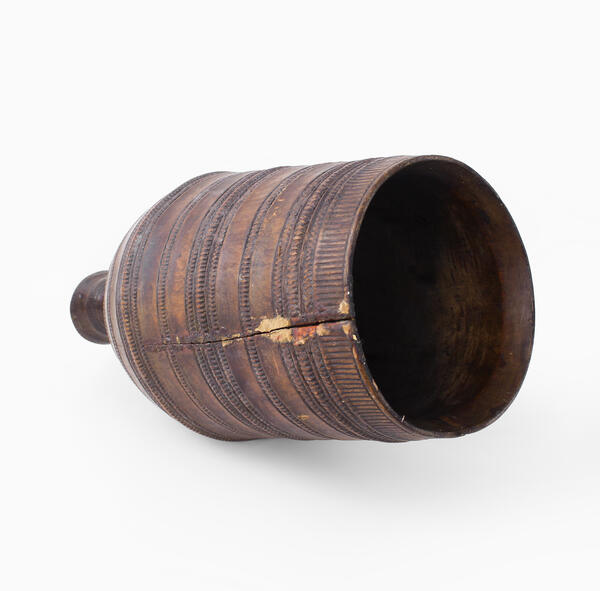
These large or small items are placed on one cone-shaped support or on three legs. Chorons can be identified by the specific appearance of the body: pointed shape in the middle and cone-shaped mouth. The geometric pattern of the vessel is usually rather modest. The neck is bordered by a distinctive motif, the rest of the repeats, or other basic elements of the design, are filled with a fine drawing of the “tonoqos-ojuu” pattern. This simple pattern with pointed protrusions effectively emphasizes the angular shape of ancient chorons.

#3
Vessel for koumiss (Choron)
#2
View in the State Catalogue
read morehide
00:00
00:00
1x

Vessel for koumiss (Choron)

Creation period
the late 19th — early 20th century
Place of сreation
Boturussky ulus, Yakutsk region, Russian Empire
Dimensions
38x13 cm
Technique
wood; three-dimensional carving, artisanal production
0
Point your smartphone camera to open in the app
Share
VkontakteOdnoklassnikiTelegram
Share on my website
Copy linkCopied
Copy
Open in app
To see AR mode in action:
  1. Install ARTEFACT app for 
  2. iOS or Android;
  3. Find and download the «Paintings in Details» exhibition
  4. Push the «Augmented reality» button and point your phone's camera at the painting;
  5. Watch what happens on your phone screen whilst you flip through the pictures.
 
We use Cookies
Cookies on the Artefact Website. We use cookies to ensure that we give you the best experience on our website. If you continue without changing your settings, we'll assume that you are happy to receive all cookies on the Artefact website. However, if you would like to, you can change your cookie settings at any time.
Learn more about useHide
Content is available only in Russian

X

Нашли опечатку?...

%title%%type%