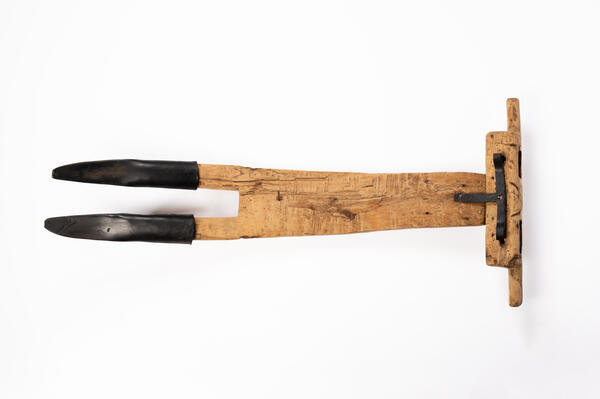
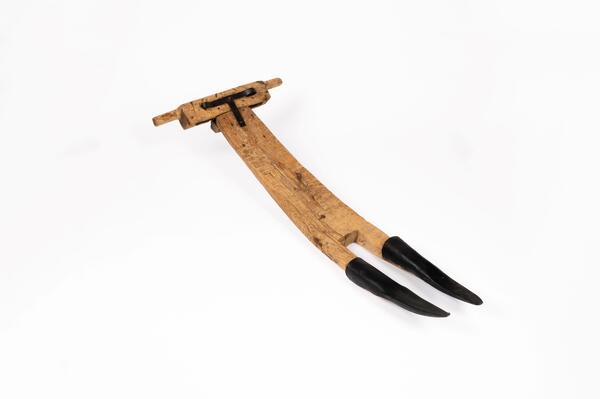
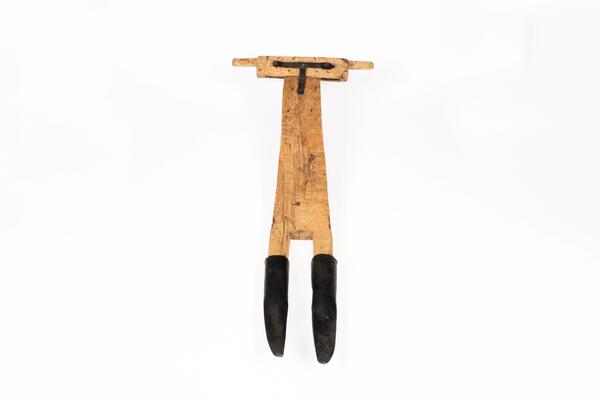
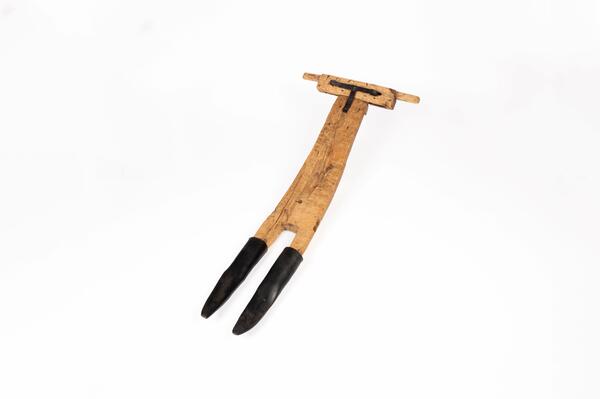
The sokha, or forked ard, is one of the oldest soil-cultivating tools, known long before the development of the plow. Unlike the plow, which turns over the soil, the sokha only loosened the top layer. This animal-drawn implement was widespread mainly among Slavic peoples in Eastern Europe and Russia. Its use was closely tied to slash-and-burn agriculture, where simply breaking up the nutrient-rich ash and surface layer was sufficient for planting.
The word sokha comes from the Proto-Slavic word meaning “a forked tree” — a reference to the distinctive Y-shaped frame that formed its main structure. Chronicles from the 13th–14th centuries mention the sokha, and archaeologists have uncovered metal coulters (the cutting tips) dating back to the 7th–8th centuries.
The sokha remained in use until the late 19th century, when it was gradually replaced by the more efficient moldboard plow. In some remote regions, however, it persisted into the mid-1920s — and the example displayed in this exhibition was still in use on peasant farms of the Unechsky District as late as the 1930s.
Working with a sokha demanded considerable physical effort and yielded a shallow tillage depth of only about 12 centimeters. Although it was relatively inexpensive compared to the iron-reinforced plow, the sokha’s wooden frame was prone to warping, moisture damage, and rapid wear.
Despite these drawbacks, the sokha was a remarkably versatile tool. Farmers used it not only for initial soil preparation but also for covering seeds, weeding potatoes, and performing various other field tasks. Its ability to work effectively in both dry and wet conditions was especially valuable, as soil rarely stuck to its simple frame.
Still, operating the sokha was no easy task — particularly for an inexperienced farmer. The plowman had to grip the handles firmly and constantly monitor the tool’s depth: if the coulters dug too deeply, he had to lift the sokha to maintain an even furrow. At the end of each row, the implement had to be pulled from the ground, lifted, and turned around — a maneuver requiring both strength and skill. A healthy, strong, and obedient horse was essential to ease the burden. For small-scale subsistence farming, however, the sokha remained the most practical and accessible tool for centuries.