The samovars displayed at the Unecha Local Lore Museum are among its most striking and intriguing exhibits. For three centuries, the samovar has been a quintessential Russian symbol of hospitality and an integral part of daily life. Although similar water-heating devices existed in Ancient Rome and the East, it was in Russia that the samovar developed its unique form and profound cultural significance. Indeed, the Russian word “samovar” has entered languages worldwide, from German and Turkish to French.
It is often said that the samovar arrived in Russia during the reign of Peter I, who allegedly brought it from Holland. However, the first reliable records of Russian samovar production date to the 1740s, under Empress Elizabeth Petrovna. Contrary to popular belief, these early samovars were not made in Tula but in the Urals at the factories of the Lisitsyn brothers. Tula’s famed production began a bit later. Along with the samovar, tea became a staple in Russia, quickly becoming a favorite drink across all social classes.
Samovars were crafted from copper, brass, and nickel silver; some were even made of silver or gold, though more affordable models were used in everyday life. Their shapes were remarkably diverse — Tula alone produced about 150 distinct types. Popular designs included egg-shaped models, as well as those resembling glasses, jars, ancient Greek amphorae, and even watermelons.
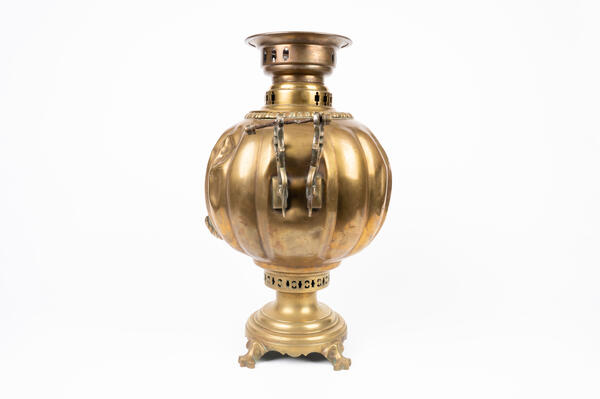
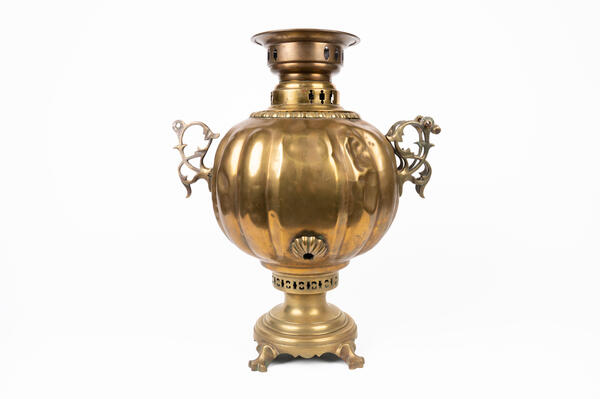
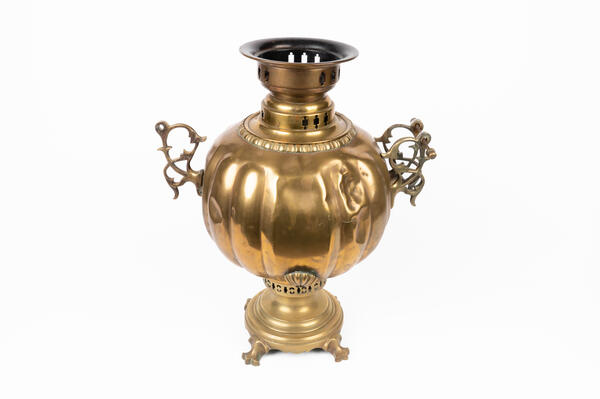
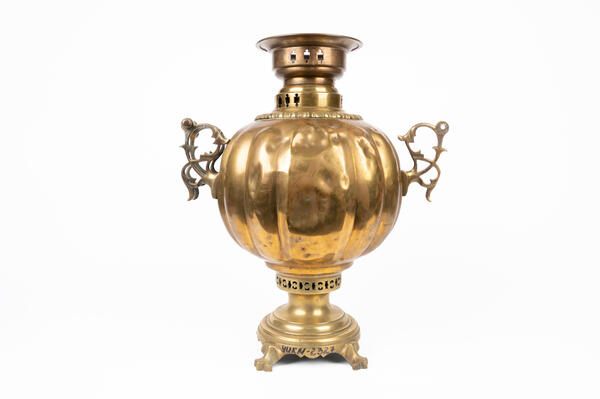
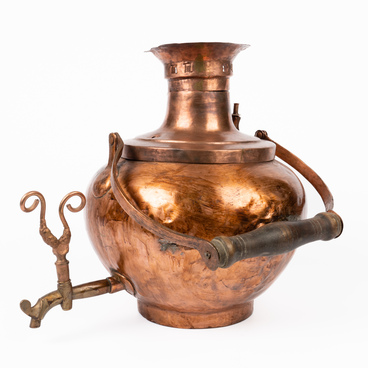
The samovar featured in the Unecha Museum’s collection is a faceted, spherical model known as a “watermelon”. It is yellow and shiny, with delicate, gracefully shaped handles.
Regionally, the samovar was known by various names, such as “samogar”, “samokipets”, and “samogrey”. Standard volumes ranged from three to eight liters, and the price was typically determined by weight: the heavier, the more expensive.
Despite the cost, the samovar quickly became a fashionable necessity. A simple, unadorned model — most often from Tula or the Batashev factories — could be found in nearly every peasant home and was often passed down as an heirloom. Most samovars in the museum’s exhibition are products of the famous Batashev brothers’ factories.
The samovar’s design is remarkably simple: a body with handles and an internal chimney where kindling or coal is burned. Hot gases rise through the chimney, heating the surrounding water, and exit through a small opening at the top. Thanks to this efficient design, the water stayed hot for a long time. The samovar thus became an indispensable household fixture, eliminating the need to fire up the stove simply to boil water.