It is often said that victory in war depends not only on the courage of soldiers, weapons, and equipment — but also on the smallest, seemingly insignificant details. Among these is the practicality and comfort of a soldier’s gear. During the Great Patriotic War, military equipment was continually refined to meet the brutal demands of the front lines.
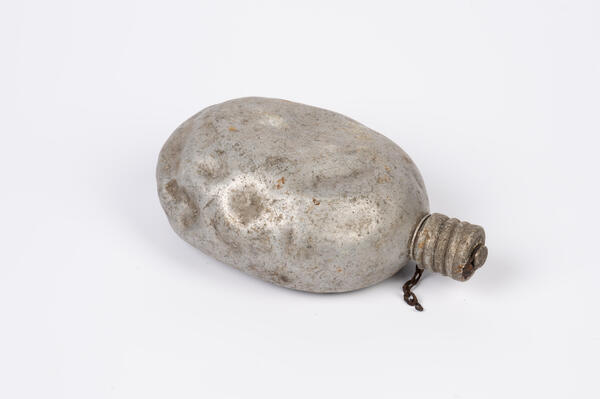
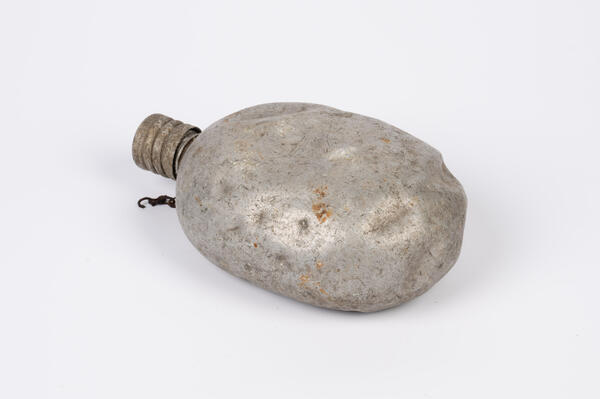
One of the most trusted companions of the Soviet soldier in those harrowing years was a simple aluminum canteen. Modest in appearance, it was utterly essential: survival on the battlefield was impossible without water. This unassuming object carries a rich history that mirrors the evolution of military gear across centuries.
Water containers have accompanied warriors since antiquity. The Russian word fliaga (flask) was borrowed from German. In the 19th century, the British and Prussian armies were widely admired as models of military discipline, renowned for their precision, order, and drill. Though both suffered defeats, their equipment, including canteens, became a standard emulated by many nations, including the Russian Empire.
Early military canteens were made of tinplate (cold-rolled steel coated with a thin layer of tin) and featured two or four lugs for attaching to a satchel, but they were fragile and costly. Later versions used wood or glass, wrapped in vine or leather for protection — but these materials proved impractical for frontline use and never gained lasting favor in the army.
A true breakthrough came at the end of the 19th century with the adoption of the aluminum canteen. Typically oval in shape, it had a convex back and a concave front to fit comfortably against the body. A cork stopper sealed the opening, and the manufacturer’s mark was stamped on the neck. The canteen was carried in a laced felt cover, secured to the waist belt with a strap. In the Russian Empire, cloth covers were also common, and soldiers often wore the flask across the chest on a shoulder strap.
The first Soviet canteen was introduced in 1923 — also made of aluminum, with a capacity of 0.75 liters. By 1932, its volume was increased to one liter. Starting in 1940, canteens were painted in protective green-brown colors for camouflage, though unpainted, silvery-white versions remained in wide use.
The Unecha Local Lore Museum houses several wartime canteens — each bearing scars of battle: pierced by bullets, stabbed with bayonets, crushed under tanks, or torn apart by shell blasts. These silent witnesses speak of both heroism and tragedy, carrying within them the story of a single soldier and his arduous journey toward Victory.