The konchuk bag was made approximately in the late 19th or early 20th century. Similar bags were used by Kazakhs during hunting. This item was handed over to the museum by the Geographical Society in 1923. The oval-shaped bag was made of leather and decorated with brass elements and beads. Sheep sinews were used as threads.
Two sides and the lateral part of the hunting bag were made of thick leather, dyed in light and dark brown color, and undyed suede was used for the upper part. Each side consists of three parts: a narrow upper strip, a middle rectangular strip, and a lower strip with a rounded bottom edge. The middle part of the side was decorated with a mosaic of zigzag and diamond-shaped pieces of leather. Smooth round plaques were attached in the upper part of the side. Their ears were inserted into the slots and fastened on the other side with straps.
There are holes under the plaques, into which straps with colored beads and wire rings were inserted. The lower edge of the middle side was also decorated with metal plaques and laces with white beads. There is a fringe made of leather strip inserted into the seam along the perimeter of the sides up to the middle of the middle part of the bag. The side part of the bag was made of a long solid strip of leather. The upper part of the bag was tucked so that it was possible to pull a cord into the hem to tighten the bag.
Every Kazakh family was engaged in processing hides and skins. Raw materials for making household utensils and clothes were produced in their own farms and rarely bought on the market. The most common purchased items were factory-made needles and threads made of durable camel’s hair.
Leatherworking was considered a men’s craft, but women were also involved in it. Cleaned of wool skins of large domestic animals, such as cattle, horses and camels, were used as material. The leather was soaked in water for a few days and then, in a damp state, clamped into a press.
In the course of this
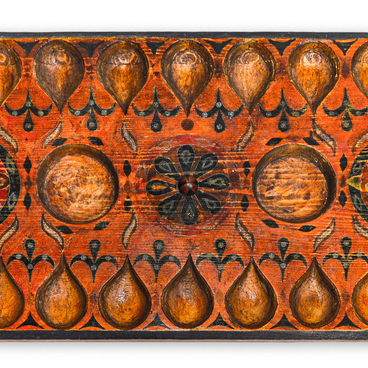
work men took two boards, carved a pattern on the surface of one, and repeated
exactly the same pattern as a relief on the other. When they were combined, the
pattern of the second board had to fit exactly into the recesses of the first
board. A pile of stones was placed on top of the wood. The stamped leather
remained in the press until the pattern was completely dried and hardened.