#1
Mica window, lock
#9
#2
#4
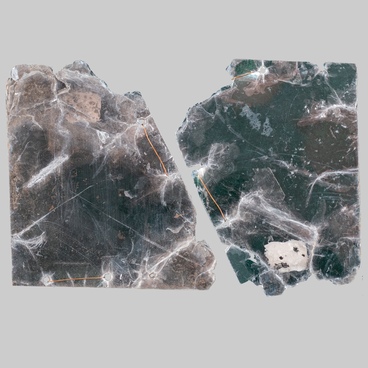
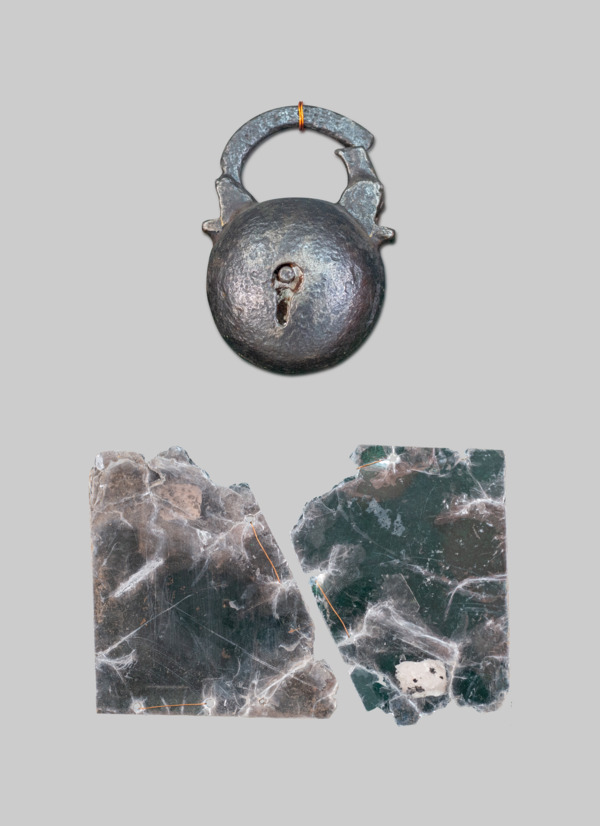
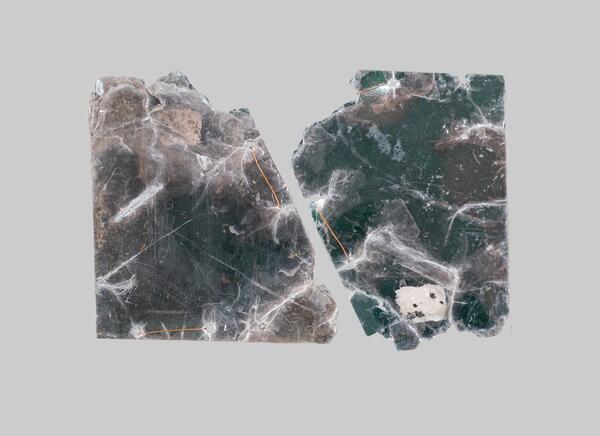
In the museum collection two fragments of mica window (‘shitUkha’) from Kuznetsk excavations are exhibited. As windows were almost never glassed in XVII century, mica sheets were installed instead. A sheet of sewn mica pieces was put into a lead frame and inserted in a shutter window.
The principal function of the window is to let light into the room. At the same time, the windows isolated the house interior from adverse weather conditions: wind, precipitation, humidity and temperature fluctuations.
Mica windows met those requirements to a sufficient extent. With a good quality of mica, such window let the required light through, and properly assembled and seated mica sheet protected the house from wind and atmospheric precipitation. The design of ancient windows hindered the air exchange thus allowing to maintain the required temperature inside.
Most frequent window aperture shape was a rectangle. Usually, such windows were larger in height than widthh-wise. However, there were windows whose width was larger than their height. Arch bar apertures were also popular, sometimes with double-arch lintels and a drop ornament. For certain windows rounded apertures were made and the apertures with a keel arch.
The decoration of the window frames, their size, shape and proportions directly depended on the apertures where those were set. The aperture parameters, in their turn, were selected depending on the required amount of light, the height of the ceilings and specific design features – the shape of the lintel block or the wall above.
Typologically, the mica window frames are divided into five principal groups by their design: with jamb posts connected on the skew, rectangular, geometrized, ring mesh, cubic-shaped mesh and radial-circular. Most popular was the frame with jamb posts connected on the skew, due to the stiffness of the structure and easy fabrication. About a half of all windows were of that type. The strips there are inclined, at an angle to the contour strip and wooden fastenings.
Apart from a one-piece vertically elongated diamond-shape mesh window frame there were centrical frames with jamb posts connected on the skew. In the center of such frames there are usually circles, ovals, octangles or flowers.
The principal function of the window is to let light into the room. At the same time, the windows isolated the house interior from adverse weather conditions: wind, precipitation, humidity and temperature fluctuations.
Mica windows met those requirements to a sufficient extent. With a good quality of mica, such window let the required light through, and properly assembled and seated mica sheet protected the house from wind and atmospheric precipitation. The design of ancient windows hindered the air exchange thus allowing to maintain the required temperature inside.
Most frequent window aperture shape was a rectangle. Usually, such windows were larger in height than widthh-wise. However, there were windows whose width was larger than their height. Arch bar apertures were also popular, sometimes with double-arch lintels and a drop ornament. For certain windows rounded apertures were made and the apertures with a keel arch.
The decoration of the window frames, their size, shape and proportions directly depended on the apertures where those were set. The aperture parameters, in their turn, were selected depending on the required amount of light, the height of the ceilings and specific design features – the shape of the lintel block or the wall above.
Typologically, the mica window frames are divided into five principal groups by their design: with jamb posts connected on the skew, rectangular, geometrized, ring mesh, cubic-shaped mesh and radial-circular. Most popular was the frame with jamb posts connected on the skew, due to the stiffness of the structure and easy fabrication. About a half of all windows were of that type. The strips there are inclined, at an angle to the contour strip and wooden fastenings.
Apart from a one-piece vertically elongated diamond-shape mesh window frame there were centrical frames with jamb posts connected on the skew. In the center of such frames there are usually circles, ovals, octangles or flowers.
#5
Full name Mica window (‘shitUkha’), a fragment
Date XVII century
Place Russia
Technique mica delamination, sewing together
Dimensions 7,1×5,5 cm and 6,8×6 cm
Copyright Kuznetsk fortress
Collection XVII – XVIII cent. Kuznetsk ostrog – the town of Kuznetsk. Excavations of various years
Goskatalog Number 6539938
Date XVII century
Place Russia
Technique mica delamination, sewing together
Dimensions 7,1×5,5 cm and 6,8×6 cm
Copyright Kuznetsk fortress
Collection XVII – XVIII cent. Kuznetsk ostrog – the town of Kuznetsk. Excavations of various years
Goskatalog Number 6539938
#8
Lock
#3
#6
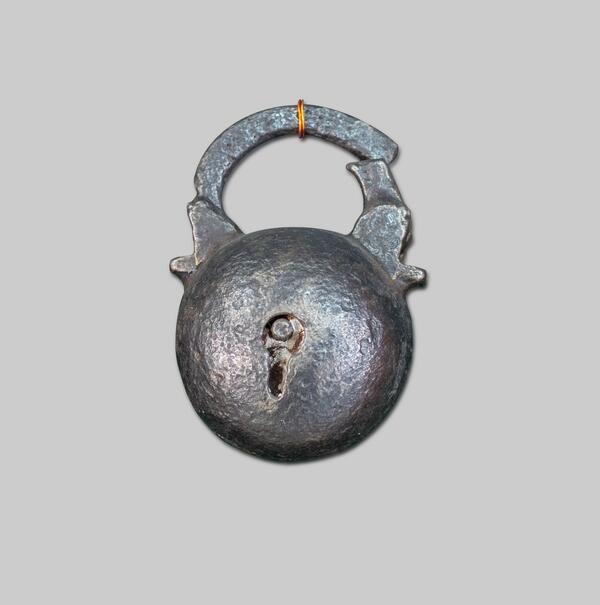
A ball-shaped padlock is a very small size item. It is very likely to have been used for locking a chest or a travelling bag. It is assumed to have been imported from Western Europe. The padlock shackle is broken but certain parts of it have been preserved.
The first padlocks worked on the principle of stationary ones – they had several pins inside that kept the mechanism locked in down position. The key raised them to the required level, they released and opened the lock. Such technology was popular in the European countries.
The ancient padlocks had only one mechanism – a spring assembly, and on that principle all the subsequent locks were fabricated. When the key was inserted into the orifice, the spring was released and it dismissed the pad. That principle was used in the West until XIV century, and it is still popular in the East, namely, in China.
However the tradespeople and noblemen required better protection, and a spring type lock with a turning key was invented. To open such lock it was required not just to insert the key into the orifice but to turn it. Such mechanism could protect from the thieves who used lock picks. In the locks of the Renaissance the orifice and the lock latch were often hidden behind complicated armorial ornaments and exuberant drawing details.
Approximately at the same time there appeared vertical lock orifices. Certain locks fabricated to special order could only be opened with three or five keys simultaneously. In order to impede the access of strangers to the possessions, injuring fixtures were often fitted into the locks, like steel darts suddenly sticking into the hand of the intruder, or a pressing mechanism that could lame the fingers.
In 1778, an English designer Robert Barron invented a lever tumbler lock with several levers. Unlike the locks invented previously, it was much more reliable: in order to open such lock, all levers had to be lifted to a certain height.
By XIX century the locksmith’s trade developed rapidly, and there appeared padlocks with twisted-in keys. The relief of the key fully matched the wards inside the hull – it was impossible to open the lock otherwise. At the same time, “personalized” or “verbal” locks became popular. They had several cylinders with the letters to be used for putting together a password.
The first padlocks worked on the principle of stationary ones – they had several pins inside that kept the mechanism locked in down position. The key raised them to the required level, they released and opened the lock. Such technology was popular in the European countries.
The ancient padlocks had only one mechanism – a spring assembly, and on that principle all the subsequent locks were fabricated. When the key was inserted into the orifice, the spring was released and it dismissed the pad. That principle was used in the West until XIV century, and it is still popular in the East, namely, in China.
However the tradespeople and noblemen required better protection, and a spring type lock with a turning key was invented. To open such lock it was required not just to insert the key into the orifice but to turn it. Such mechanism could protect from the thieves who used lock picks. In the locks of the Renaissance the orifice and the lock latch were often hidden behind complicated armorial ornaments and exuberant drawing details.
Approximately at the same time there appeared vertical lock orifices. Certain locks fabricated to special order could only be opened with three or five keys simultaneously. In order to impede the access of strangers to the possessions, injuring fixtures were often fitted into the locks, like steel darts suddenly sticking into the hand of the intruder, or a pressing mechanism that could lame the fingers.
In 1778, an English designer Robert Barron invented a lever tumbler lock with several levers. Unlike the locks invented previously, it was much more reliable: in order to open such lock, all levers had to be lifted to a certain height.
By XIX century the locksmith’s trade developed rapidly, and there appeared padlocks with twisted-in keys. The relief of the key fully matched the wards inside the hull – it was impossible to open the lock otherwise. At the same time, “personalized” or “verbal” locks became popular. They had several cylinders with the letters to be used for putting together a password.
#7
Full name Padlock
Date XVII-XVIII centuries
Technique fitter’s work
Place Russia
Dimensions 3,2×3,3×4,8 cm
Collection XVII – XVIII cent. Kuznetsk ostrOg – the town of Kuznetsk. Excavations of various years
Copyright Kuznetsk fortress
Restorers Scheglakov A.P.
Goskatalog Number 6539917
Date XVII-XVIII centuries
Technique fitter’s work
Place Russia
Dimensions 3,2×3,3×4,8 cm
Collection XVII – XVIII cent. Kuznetsk ostrOg – the town of Kuznetsk. Excavations of various years
Copyright Kuznetsk fortress
Restorers Scheglakov A.P.
Goskatalog Number 6539917
read morehide
00:00
00:00
1x
3
 Point your smartphone camera to open in the app
Open in app
Share