


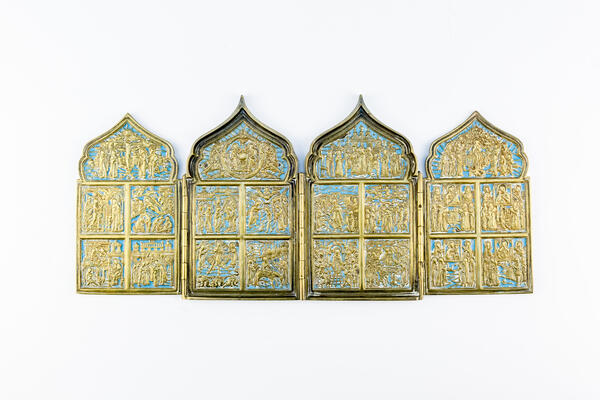
Polyptych icons are also called a “traveling church”: their design makes it easy to insert one part into another and get a compact and durable portable iconostasis. The parts are tightly fixed to each other and the icons remain standing when opened.
In the old days, polyptych icons were called travel icons: Russian soldiers carried them to pray before battles. Triptych icons were most common, where the middle icon was flanked by the other two.
A tetraptych icon with four parts is an invention of the Vygovsky Old Believer craftsmen. In the first half of the 18th century, when the community was flourishing, the artisans came up with completely new types of copper works. The artisans developed technological methods of metal casting: they began to make items with hinges tightly fitted to each other and had pins inserted. The units could be stacked one into the other, and this made it possible to increase their number to four.
This type of icon was colloquially called “Great Feasts”, but its full name was “Twelve Great Feasts and the Worship of the Icons of the Mother of God.” The elaborate systematic way, in which the feast were depicted, corresponded to the annual circle of worship.
At the top of each part, the craftsmen placed keeled tops — their shape was supposed to resemble church domes. In general, believers perceived these polyptych icons as a miniature Orthodox church.
The iconography of most scenes was familiar to believers, but the tetraptych form was something new in the world of religious art. The creative approach of the Vygovsky artisans was vividly manifested in the fourth part of the composition, dedicated to the icons of the Mother of God. The plots of the right part reflected not only the attitude of the Russian people towards the Virgin Mary as the main intercessor, but also the importance of Her miraculous icons, which saved Russia from many troubles more than once.
The scenes should be read from left to right and from top to bottom along each part.
The first section:
1. Crucifixion of Christ (in the kokoshnik)
2. Annunciation
3. Nativity of Christ
4. Nativity of the Virgin
5. The Presentation of the Virgin at the Temple
The second section:
6. New Testament Trinity (in the kokoshnik)
7. Presentation of the Lord
8. Theophany or Baptism of the Lord
9. Transfiguration
10. Entry into Jerusalem
The third section:
11. Exaltation of the Cross of the Lord (in the kokoshnik)
12. Resurrection of Christ and Descent into Hell
13. Ascension of the Lord
14. Life-giving Trinity
15. Dormition of the Theotokos
The fourth section:
16. Praise of the Mother of God (in a kokoshnik)
17. Worship of the Tikhvin icon of the Mother of God
18. Worship of the Vladimir icon of the Mother of God
19. Worship of the Smolensk icon of the Mother of God
20. Worship of the icon “Our Lady of the Sign”.
In the old days, polyptych icons were called travel icons: Russian soldiers carried them to pray before battles. Triptych icons were most common, where the middle icon was flanked by the other two.
A tetraptych icon with four parts is an invention of the Vygovsky Old Believer craftsmen. In the first half of the 18th century, when the community was flourishing, the artisans came up with completely new types of copper works. The artisans developed technological methods of metal casting: they began to make items with hinges tightly fitted to each other and had pins inserted. The units could be stacked one into the other, and this made it possible to increase their number to four.
This type of icon was colloquially called “Great Feasts”, but its full name was “Twelve Great Feasts and the Worship of the Icons of the Mother of God.” The elaborate systematic way, in which the feast were depicted, corresponded to the annual circle of worship.
At the top of each part, the craftsmen placed keeled tops — their shape was supposed to resemble church domes. In general, believers perceived these polyptych icons as a miniature Orthodox church.
The iconography of most scenes was familiar to believers, but the tetraptych form was something new in the world of religious art. The creative approach of the Vygovsky artisans was vividly manifested in the fourth part of the composition, dedicated to the icons of the Mother of God. The plots of the right part reflected not only the attitude of the Russian people towards the Virgin Mary as the main intercessor, but also the importance of Her miraculous icons, which saved Russia from many troubles more than once.
The scenes should be read from left to right and from top to bottom along each part.
The first section:
1. Crucifixion of Christ (in the kokoshnik)
2. Annunciation
3. Nativity of Christ
4. Nativity of the Virgin
5. The Presentation of the Virgin at the Temple
The second section:
6. New Testament Trinity (in the kokoshnik)
7. Presentation of the Lord
8. Theophany or Baptism of the Lord
9. Transfiguration
10. Entry into Jerusalem
The third section:
11. Exaltation of the Cross of the Lord (in the kokoshnik)
12. Resurrection of Christ and Descent into Hell
13. Ascension of the Lord
14. Life-giving Trinity
15. Dormition of the Theotokos
The fourth section:
16. Praise of the Mother of God (in a kokoshnik)
17. Worship of the Tikhvin icon of the Mother of God
18. Worship of the Vladimir icon of the Mother of God
19. Worship of the Smolensk icon of the Mother of God
20. Worship of the icon “Our Lady of the Sign”.


