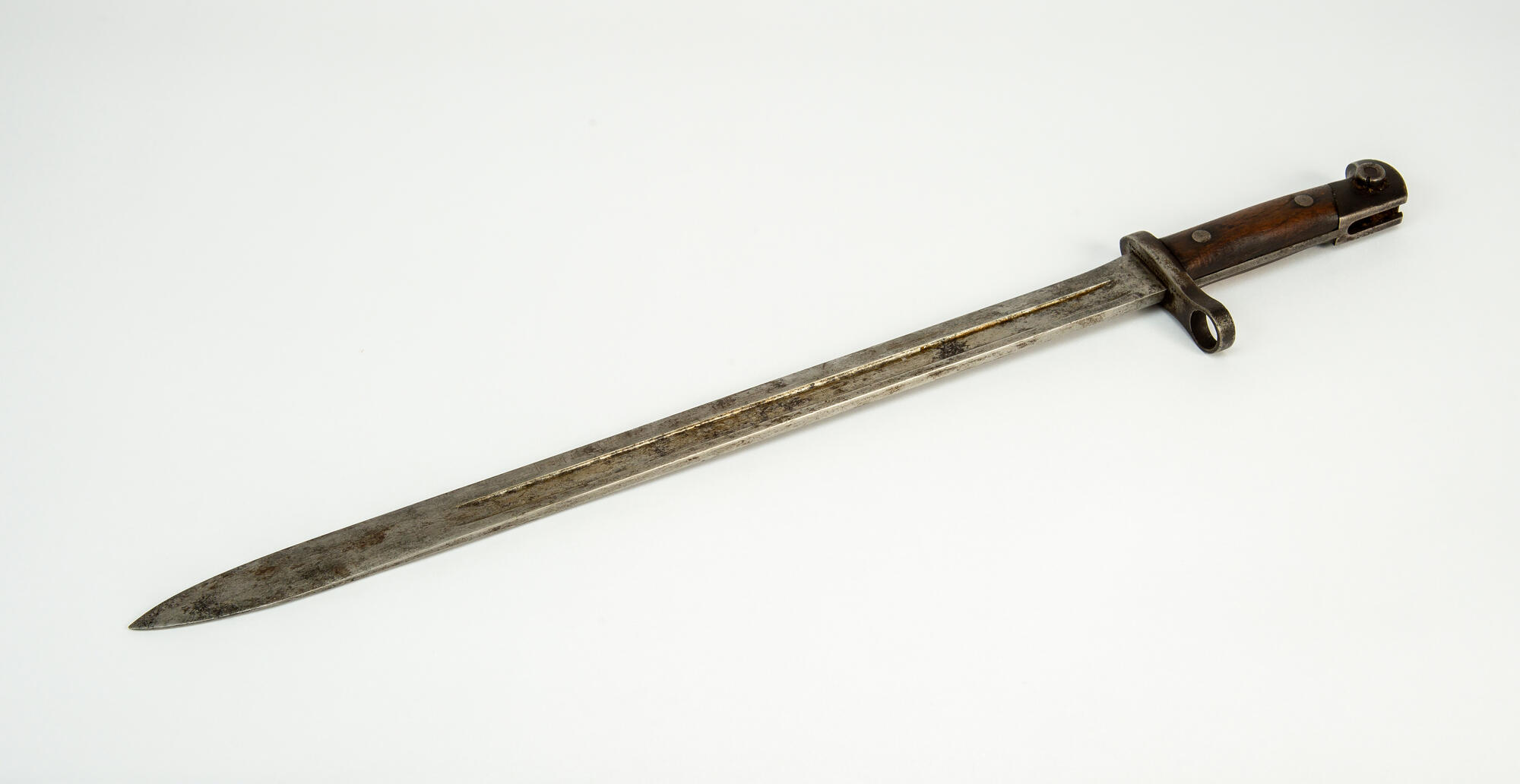


The knife bayonet from the collection of the Verkhnyaya Pyshma museum was made in America between 1915 and 1917. It was suitable for the rifle model M1895, which was also called Winchester by the name of the manufacturer.
With the outbreak of World War I, the Russian army had to have large amounts of weapons. There was not enough production capacity in the country; the factories were unable to cope, so the Russian Empire ordered a lot from abroad.
In September 1914, Russian specialists were sent to the United States to inspect local factories and equipment. As a result, the Russian Empire signed a contract for the supply of 300 thousand M1895 rifles in an updated configuration. There was one important condition for the order: the weapon had to be remodeled so that it would suit Russian cartridges.
As a result, American factories designed an updated Winchester model, which could be loaded with cartridges from a revolver of the Nagant system and a Mosin rifle. In addition, a bayonet was added to the M1895 to use the weapon in close combat.
Initially, the model 1895 rifle did not have a bayonet lug, so the design of the crosspiece had to be developed almost from scratch. This led to the increased length of the barrel.
After consulting the customer, the plant management abandoned the idea to produce the needle bayonet traditional for the Russian army. Instead, they decided to use a wide one-sided bayonet that would be about 32 centimeters long. The company had already produced it for the Lee Model 1895 rifle, which Winchester had previously produced for the US Navy.
The bayonet handle resembled the handle of a knife: it consisted of two wooden parts, fastened with metal nails. Below there was a metal head with a T-shaped groove and a spring latch ¬– they were used to attach the blade to the Winchester.
Modifying the rifle turned out to be quite difficult and took too much time. As a result, the first batch of weapons with a bayonet was sent to Russia with a delay.
After the Russian Empire received 15 thousand new rifles, it demanded to change the design: the Russian military were not satisfied with the size of the knife. Then there was an updated bayonet for the M1895 that was 52 centimeters long. The rest of the order included these models.
M1895 rifles with bayonets were used during World War I and then the Civil War. Over time, they became obsolete and were replaced by other models.
With the outbreak of World War I, the Russian army had to have large amounts of weapons. There was not enough production capacity in the country; the factories were unable to cope, so the Russian Empire ordered a lot from abroad.
In September 1914, Russian specialists were sent to the United States to inspect local factories and equipment. As a result, the Russian Empire signed a contract for the supply of 300 thousand M1895 rifles in an updated configuration. There was one important condition for the order: the weapon had to be remodeled so that it would suit Russian cartridges.
As a result, American factories designed an updated Winchester model, which could be loaded with cartridges from a revolver of the Nagant system and a Mosin rifle. In addition, a bayonet was added to the M1895 to use the weapon in close combat.
Initially, the model 1895 rifle did not have a bayonet lug, so the design of the crosspiece had to be developed almost from scratch. This led to the increased length of the barrel.
After consulting the customer, the plant management abandoned the idea to produce the needle bayonet traditional for the Russian army. Instead, they decided to use a wide one-sided bayonet that would be about 32 centimeters long. The company had already produced it for the Lee Model 1895 rifle, which Winchester had previously produced for the US Navy.
The bayonet handle resembled the handle of a knife: it consisted of two wooden parts, fastened with metal nails. Below there was a metal head with a T-shaped groove and a spring latch ¬– they were used to attach the blade to the Winchester.
Modifying the rifle turned out to be quite difficult and took too much time. As a result, the first batch of weapons with a bayonet was sent to Russia with a delay.
After the Russian Empire received 15 thousand new rifles, it demanded to change the design: the Russian military were not satisfied with the size of the knife. Then there was an updated bayonet for the M1895 that was 52 centimeters long. The rest of the order included these models.
M1895 rifles with bayonets were used during World War I and then the Civil War. Over time, they became obsolete and were replaced by other models.