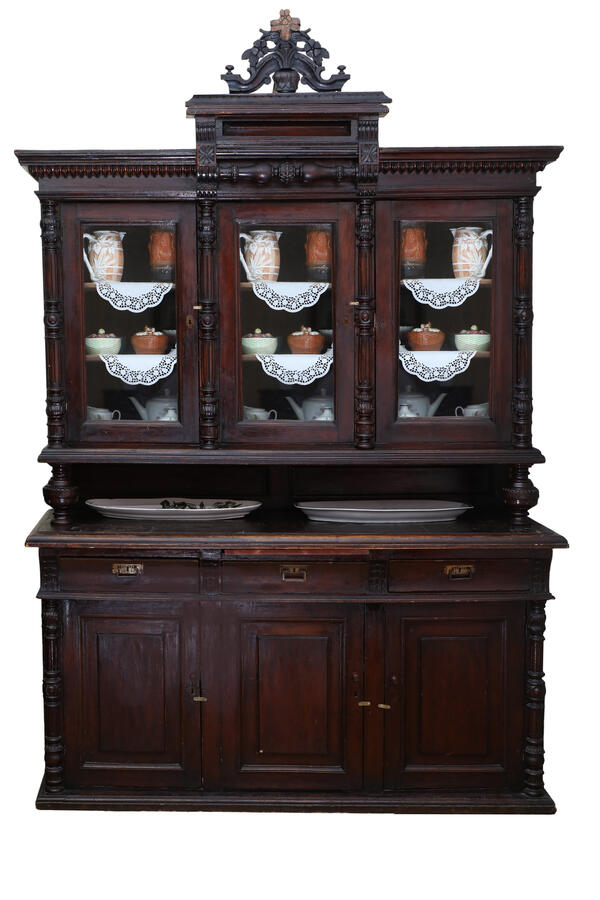
Until 1941, the cupboard from the museum collection belonged to the director of the Pyshminsky mine and was used at his dacha on Lake Baltym. The location of the piece of furniture during the Great Patriotic War is unknown.
After 1945, the cupboard was moved to the house of the deputy director of the mine, Semyon Grigoriev. In 1960, the owner sold it to the Pykhov family, and later Maria Loginova (nee Pykhova) donated transferred the cupboard to the the Verkhnyaya Pyshma Historical Museum.
The first cupboards appeared in the 17th century; family porcelain and silverware were displayed on their shelves. The sideboards were made of fine wood and decorated with cornices, carved elements and paintings. Cabinets differed in design depending on what type of room they were intended for: for the kitchen, living room or dining room.
There were one-tier and two-tier cupboards. They had many doors and locks to make storage more convenient. There were boxes between the tiers: most often, there were two compartments, and less often — three, like in the exhibit from the museum collection.
The upper part served as a showcase. Rare and valuable dishes were displayed behind glass doors and taken out only on holidays. The lower niche was used in different ways, depending on the region. In France, bottles of wine and fruit vases were put into the compartment. In Germany — decorative vases and large beer mugs made of porcelain or metal.
In Russia, behind the closed doors of the lower tier, there were samovars on a tray, kettles for heating water, and vases with fruit. Sometimes, if the sideboard was high and the niche was large, a large copper bowl for jam was placed there.
For a long time, cupboards were expensive and unaffordable furniture, they were used only by noble families and the intelligentsia. They began to appear in peasant homes after the Great Patriotic War. In Russian villages, there were different types of such furniture: horizontally elongated low dining cupboards, corner cupboards, which were called ‘gorky’, and sideboards.
In the second half of the 20th century, cabinets for dishes continued to be massively produced and used: they could be found in almost every apartment and they became one of the symbols of Soviet life.
After 1945, the cupboard was moved to the house of the deputy director of the mine, Semyon Grigoriev. In 1960, the owner sold it to the Pykhov family, and later Maria Loginova (nee Pykhova) donated transferred the cupboard to the the Verkhnyaya Pyshma Historical Museum.
The first cupboards appeared in the 17th century; family porcelain and silverware were displayed on their shelves. The sideboards were made of fine wood and decorated with cornices, carved elements and paintings. Cabinets differed in design depending on what type of room they were intended for: for the kitchen, living room or dining room.
There were one-tier and two-tier cupboards. They had many doors and locks to make storage more convenient. There were boxes between the tiers: most often, there were two compartments, and less often — three, like in the exhibit from the museum collection.
The upper part served as a showcase. Rare and valuable dishes were displayed behind glass doors and taken out only on holidays. The lower niche was used in different ways, depending on the region. In France, bottles of wine and fruit vases were put into the compartment. In Germany — decorative vases and large beer mugs made of porcelain or metal.
In Russia, behind the closed doors of the lower tier, there were samovars on a tray, kettles for heating water, and vases with fruit. Sometimes, if the sideboard was high and the niche was large, a large copper bowl for jam was placed there.
For a long time, cupboards were expensive and unaffordable furniture, they were used only by noble families and the intelligentsia. They began to appear in peasant homes after the Great Patriotic War. In Russian villages, there were different types of such furniture: horizontally elongated low dining cupboards, corner cupboards, which were called ‘gorky’, and sideboards.
In the second half of the 20th century, cabinets for dishes continued to be massively produced and used: they could be found in almost every apartment and they became one of the symbols of Soviet life.