In 1949, a uniform school attire was introduced in the Soviet Union. The girls wore brown dresses, on ordinary days with a black apron, and on holidays with smart white. This form did not change until the mid-1990s, until it was finally canceled. School clothes for boys were different over the years. The museum exhibits a dark gray woolen uniform tunic from the early 1950s.
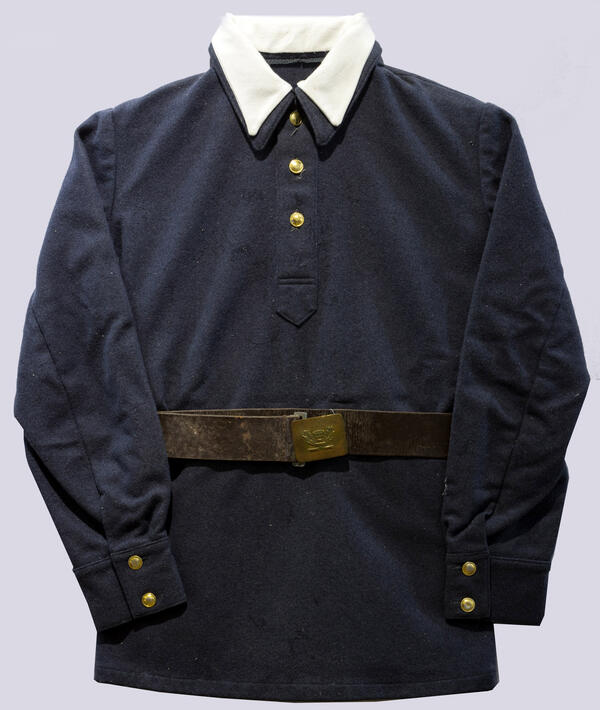
The museum exhibits a dark gray woolen uniform tunic from the early 1950s. Such blouses of a paramilitary model were worn by students until the early 1960s. The uniform in those years was considered mandatory, but for boys it was not so strictly. Due to the high cost of clothing, students often wore simple shirts and jackets. Under the school’s tunic, or ‘uniform, ” as it was also called, the rules required to wear a white shirt. However, more often replaceable white collars were simply hemmed to the tunic.
The obligatory set of uniforms for boys also included a wide belt that was used to gird a tunic. The school belt had a distinctive feature — a special buckle with an emblem. The buckle featured two laurel branches tied with a ribbon. In the center of the image is the letter “Ш” — school, student. The uniform set also included a cap with a visor.
In 1962, a reform was carried out, and the boys began to go to school in a suit — a jacket and trousers in gray, and later in blue. This tunic was found in the premises of secondary school No. 7 in Severodvinsk, one of the oldest and largest schools in the city. It began to work in the 1950s, children from new residential areas, which were built up with stone multi-storey buildings, came here. In total, there were eight schools in the city at the beginning of the 1950s; by the end of the 1960s, there were already 23 schools. Over these decades, not only had the number of schools and students enrolled in them increased, but also qualitative changes have taken place in the educational system itself.
In 1944, the familiar five-point grading system appeared in schools. In 1949, a universal seven-year education was introduced, and in 1959 — an eight-year education and polytechnic education. In 1954, girls and boys began to study together.
The museum exhibits a dark gray woolen uniform tunic from the early 1950s. Such blouses of a paramilitary model were worn by students until the early 1960s. The uniform in those years was considered mandatory, but for boys it was not so strictly. Due to the high cost of clothing, students often wore simple shirts and jackets. Under the school’s tunic, or ‘uniform, ” as it was also called, the rules required to wear a white shirt. However, more often replaceable white collars were simply hemmed to the tunic.
The obligatory set of uniforms for boys also included a wide belt that was used to gird a tunic. The school belt had a distinctive feature — a special buckle with an emblem. The buckle featured two laurel branches tied with a ribbon. In the center of the image is the letter “Ш” — school, student. The uniform set also included a cap with a visor.
In 1962, a reform was carried out, and the boys began to go to school in a suit — a jacket and trousers in gray, and later in blue. This tunic was found in the premises of secondary school No. 7 in Severodvinsk, one of the oldest and largest schools in the city. It began to work in the 1950s, children from new residential areas, which were built up with stone multi-storey buildings, came here. In total, there were eight schools in the city at the beginning of the 1950s; by the end of the 1960s, there were already 23 schools. Over these decades, not only had the number of schools and students enrolled in them increased, but also qualitative changes have taken place in the educational system itself.
In 1944, the familiar five-point grading system appeared in schools. In 1949, a universal seven-year education was introduced, and in 1959 — an eight-year education and polytechnic education. In 1954, girls and boys began to study together.