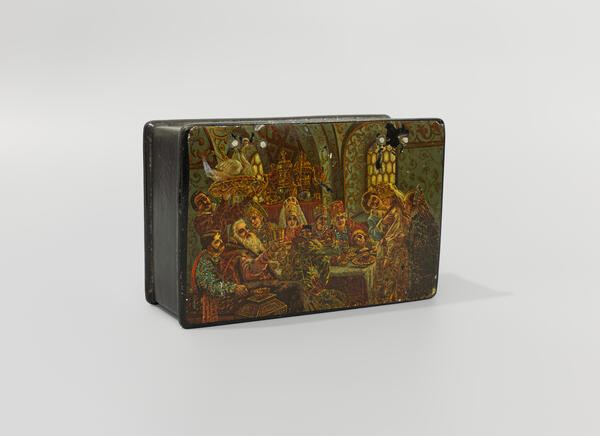
The tea casket from the museum collection was made in the early 20th century. The craftsman decorated the lid with an image based on “A Boyar Wedding Feast”, a painting by Konstantin Yegorovich Makovsky. The painter finished this work in 1883. Nowadays, it is housed in Hillwood Museum in the United States. From the notes left by his son, the poet Sergey Konstantinovich Makovsky, it is known that the painting features some objects from the artist’s personal collection, including sundresses, kokoshnik headdresses, and jewelry.
Konstantin Makovsky chose not to display the work at the exhibitions of the Society for Traveling Art Exhibitions although he was a member of this organization from 1870. In 1883, when “A Boyar Wedding Feast” was painted, he ceased to be part of the Society. By then, his paintings had already gained commercial success and enjoyed great demand.
The tea casket “A Boyar Wedding Feast” is a piece from a mass-produced series that was commissioned by haberdashery and tea factories. Various museums house other similar items, replicas of the works by Konstantin Makovsky. For example, there is a casket based on the 1886 painting “Tsar Alexis Mikhailovich Choosing a Bride” which is now kept in Puerto Rico. Another example is the 1900 painting “Hide and Seek”, sold at auction in 2018.
The casket “A Boyar Wedding Feast” was made at the factory of the successors of Aleksey Gubkin. Until 1919, this partnership sold tea and was one of the industry’s largest companies in the Russian Empire. It was founded in the early 1880s based on the enterprise of the merchant Aleksey Semyonovich Gubkin, which had operated since 1840.
In Russia, such caskets replaced trunks only during the reign of Peter the Great. Before the development of industrial production, all caskets were handmade, often ordered by a specific customer and tailored to their wishes. Tea caskets were made of porcelain, glass, wood and metal. Some featured inscriptions, like “This drink precipitates vapors, refreshes, and purifies the blood” or “If you don’t drink tea, where would you find strength?“
The first caskets emerged in the Middle East, Egypt, Japan, and China. Archaeologists have found fragments of wooden caskets richly decorated with inlay and carving in Mesopotamia and Egypt. The finds date back several millennia.