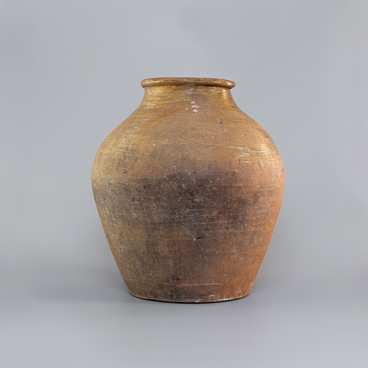
The jugs encountered by archaeologists and historians vary in shape and design. The reason for this diversity is that these vessels were widely used in various aspects of human life. The primary purpose of a jug was to store bulk products and liquids. Wine was placed in small jugs with rounded and wide facets, dairy products were stored in pitchers, and traditional jugs with handles were used for water and kvass.
Clay jugs were either red-glazed or black-glazed. The former had the natural color of the clay, while the latter acquired a black color during the firing process in a kiln without access to oxygen, followed by smoldering in thick black smoke. To create dense smoke at the end of the firing, resinous pine wood, rags, raw manure, or grass were added to the pottery kiln. Black ceramics came to be known as “smoldered” or “fumed”. The method of making black-glazed ceramics was discovered in ancient times.
To create a pottery item, the clay undergoes several stages of processing. The main operation involves preparing the clay mass, which is shaped, fired, and then coated with glaze. The extracted clay is first piled into clods or laid in layers and watered to soften it. Later, the clay mass is weathered, and in winter, frozen. This process is necessary for loosening the clay.
At the next stage, the clay is watered again, cut into pieces, kneaded, and dried. This process achieves uniformity. After drying, the clay is broken up with pestles or hammers to make it easier to grind in mills. The grinding stones are used to grind the clay to a flour-like consistency. The raw material is then sifted through a sieve. Finally, the crushed clay is “washed” meaning it is rinsed with water.
The clay jug from the collection of the Nizhny
Lomov Museum of Local Lore, which dates back to the beginning of the 20thcentury, features an image of a castle on one side and a forest on the other. Such
jugs were also made in Latvia, of a similar shape and design, with protruding
decorative elements, carved ornaments at the neck, and a narrative image on the
body.