


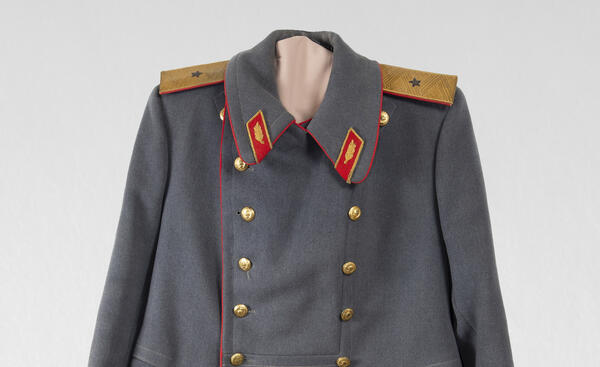
The Zimovniki Museum of Local History houses an overcoat of Major General Timofey Kruglyakov, part of his post-war dress uniform.
Overcoat was a winter uniform military coat with folds on the back and a strap that held them in place. Uniforms differed among officers depending on the rank, and were also divided into ceremonial and casual.
Officers' overcoats were double-breasted with a turndown collar and two rows of six buttons in front. Ordinary overcoats had steel hooks at the bottom on the inside. With their help, the outer clothing could be tucked in during running and exercising so that the legs would not get tangled in the hem. The ceremonial officers' overcoats of the USSR Armed Forces were sewn without hooks and made of gray cloth.
Kruglyakov’s overcoat is a general’s one. It has lapels lined with red material and red cuffs at the seams. On the shoulders of the overcoat, there are the Major General shoulder marks: one large star on the background with a geometric pattern and red edging on three sides.
Although Timofey Kruglyakov was from another district, his military career was connected with Zimovniki. Since 1918, he worked as military head of the Cossack village Zimovniki executive committee of the Salsky district. Kruglyakov participated in the Civil War and in March 1918 formed a Zimovniki Red partisan volunteer detachment. He fought against the White Guard units of General Pyotr Popov.
During the Great Patriotic War, Timofey Kruglyakov was a representative of the Central Headquarters of Partisan Movement at the Stalingrad front. He later became the chief of the headquarters of the partisan detachment “Southern Front”, and his units actively participated in the liberation of Zimovniki from the Nazi invaders.
Timofey Kruglyakov was a full Cavalier of St. George — he received four George Crosses of all four classes. In addition, over the years of service he was awarded the Red Banner of the RSFSR (twice), the Red Star, the Order of Lenin, the Order of Kutuzov of the 2nd class, and medals “20 Years of the Red Army”, “30 Years of the Red Army”, “For the Defense of Stalingrad”, and “For Victory over Germany in the Great Patriotic War of 1941–1945”.
Overcoat was a winter uniform military coat with folds on the back and a strap that held them in place. Uniforms differed among officers depending on the rank, and were also divided into ceremonial and casual.
Officers' overcoats were double-breasted with a turndown collar and two rows of six buttons in front. Ordinary overcoats had steel hooks at the bottom on the inside. With their help, the outer clothing could be tucked in during running and exercising so that the legs would not get tangled in the hem. The ceremonial officers' overcoats of the USSR Armed Forces were sewn without hooks and made of gray cloth.
Kruglyakov’s overcoat is a general’s one. It has lapels lined with red material and red cuffs at the seams. On the shoulders of the overcoat, there are the Major General shoulder marks: one large star on the background with a geometric pattern and red edging on three sides.
Although Timofey Kruglyakov was from another district, his military career was connected with Zimovniki. Since 1918, he worked as military head of the Cossack village Zimovniki executive committee of the Salsky district. Kruglyakov participated in the Civil War and in March 1918 formed a Zimovniki Red partisan volunteer detachment. He fought against the White Guard units of General Pyotr Popov.
During the Great Patriotic War, Timofey Kruglyakov was a representative of the Central Headquarters of Partisan Movement at the Stalingrad front. He later became the chief of the headquarters of the partisan detachment “Southern Front”, and his units actively participated in the liberation of Zimovniki from the Nazi invaders.
Timofey Kruglyakov was a full Cavalier of St. George — he received four George Crosses of all four classes. In addition, over the years of service he was awarded the Red Banner of the RSFSR (twice), the Red Star, the Order of Lenin, the Order of Kutuzov of the 2nd class, and medals “20 Years of the Red Army”, “30 Years of the Red Army”, “For the Defense of Stalingrad”, and “For Victory over Germany in the Great Patriotic War of 1941–1945”.


