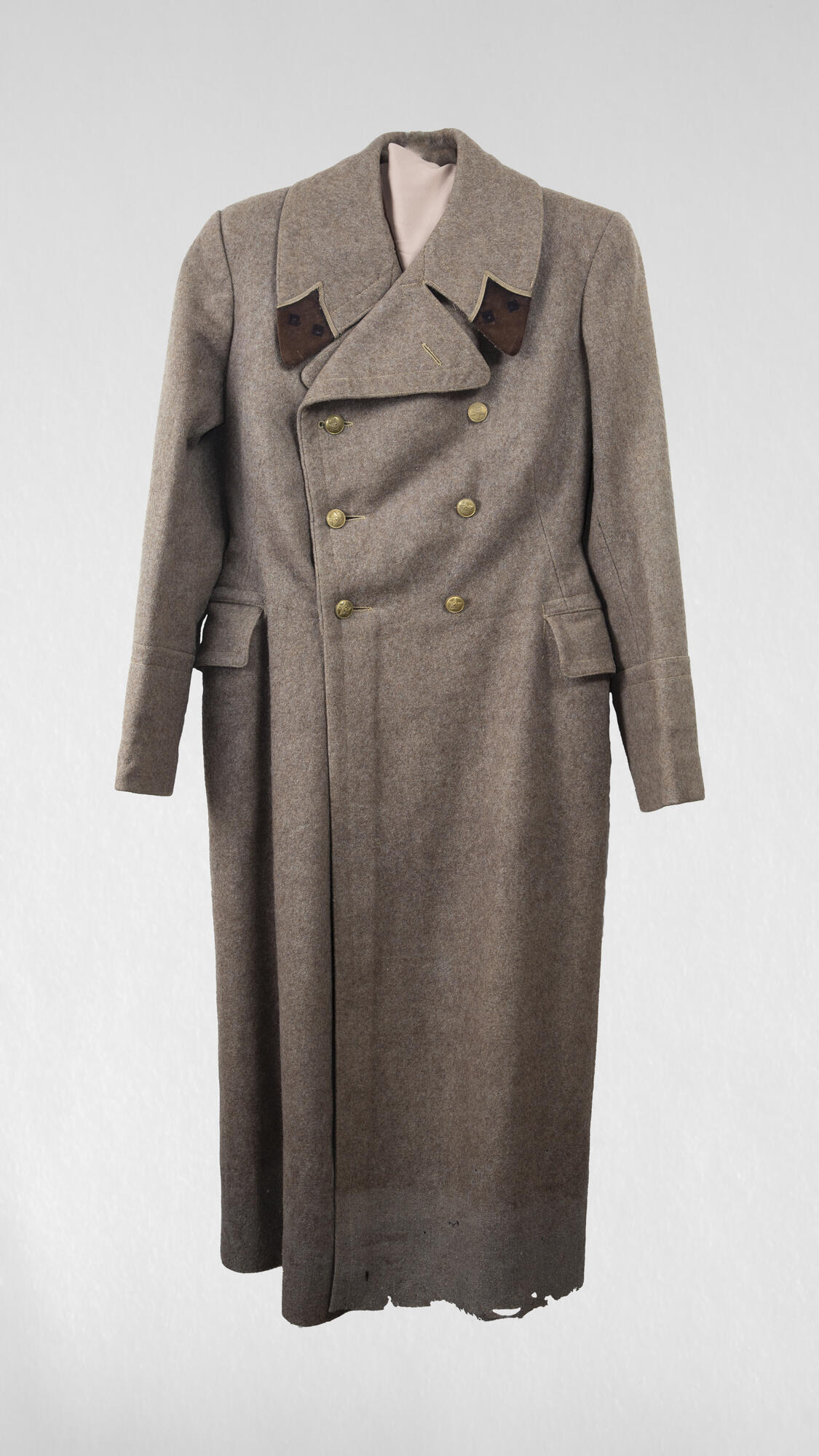


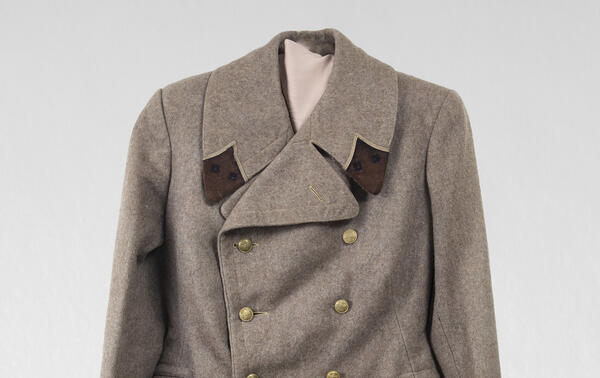
The collection of the Zimovniki Museum houses an overcoat of the pre-1943 model — a winter military coat worn in the Soviet army. It was made of military cloth — a dense gray wool or half-wool fabric.
The first time an overcoat is mentioned in Russia refers to the end of the 18th century. Firstly, Catherine II introduced a long cloth overcoat for the jaegers — members of the Russian infantry, and then Paul I extended the use of this uniform to all soldiers and officers.
The Red Army made the overcoat part of its uniform in 1926. It was a single-breasted gray coat with a detachable collar, pockets and secret fastener. Since 1935, the overcoat became double-breasted; it was made of gray-brown cloth. There was only one pleat on the back, instead of six or seven, like on the previous model. The flap — a narrow strip of cloth on the back — was 8-shaped and was fastened on two large gold buttons.
The length of the hem, according to the statute, varied in different troops: for infantrymen it was 32 centimeters above the floor, and for cavalrymen it was floor-length. Other servicemen had their overcoat 18–22 centimeters above the ground, and often they trimmed it themselves. Overcoats had steel hooks along the inside bottom edge. While running the skirt of the overcoat could be bent up and hooked on the belt with hooks.
During the Great Patriotic War, soldiers and officers wore overcoats with the belt and with insignia on the top. In 1943, double-breasted overcoats for officers and commanders began to have six buttons sewn on each side — 12 in total. Uniforms of junior officers and rank and file did not have buttons — they were fastened on hooks.
Overcoat made of thick cloth protected the owner from the rain. In addition, it was very warm: it was used as a blanket in the field. Soldiers unbuttoned a strip; overcoat became much wider, and could be used as a cover.
The soldiers' overcoat was also used in a completely unconventional way. For example, during the attacks the overcoat was thrown over the wire fences, the thick cloth protected soldiers from cuts and wounds. Sometimes coats were thrown under the wheels to pull stranded vehicles out of the mud.
The first time an overcoat is mentioned in Russia refers to the end of the 18th century. Firstly, Catherine II introduced a long cloth overcoat for the jaegers — members of the Russian infantry, and then Paul I extended the use of this uniform to all soldiers and officers.
The Red Army made the overcoat part of its uniform in 1926. It was a single-breasted gray coat with a detachable collar, pockets and secret fastener. Since 1935, the overcoat became double-breasted; it was made of gray-brown cloth. There was only one pleat on the back, instead of six or seven, like on the previous model. The flap — a narrow strip of cloth on the back — was 8-shaped and was fastened on two large gold buttons.
The length of the hem, according to the statute, varied in different troops: for infantrymen it was 32 centimeters above the floor, and for cavalrymen it was floor-length. Other servicemen had their overcoat 18–22 centimeters above the ground, and often they trimmed it themselves. Overcoats had steel hooks along the inside bottom edge. While running the skirt of the overcoat could be bent up and hooked on the belt with hooks.
During the Great Patriotic War, soldiers and officers wore overcoats with the belt and with insignia on the top. In 1943, double-breasted overcoats for officers and commanders began to have six buttons sewn on each side — 12 in total. Uniforms of junior officers and rank and file did not have buttons — they were fastened on hooks.
Overcoat made of thick cloth protected the owner from the rain. In addition, it was very warm: it was used as a blanket in the field. Soldiers unbuttoned a strip; overcoat became much wider, and could be used as a cover.
The soldiers' overcoat was also used in a completely unconventional way. For example, during the attacks the overcoat was thrown over the wire fences, the thick cloth protected soldiers from cuts and wounds. Sometimes coats were thrown under the wheels to pull stranded vehicles out of the mud.


