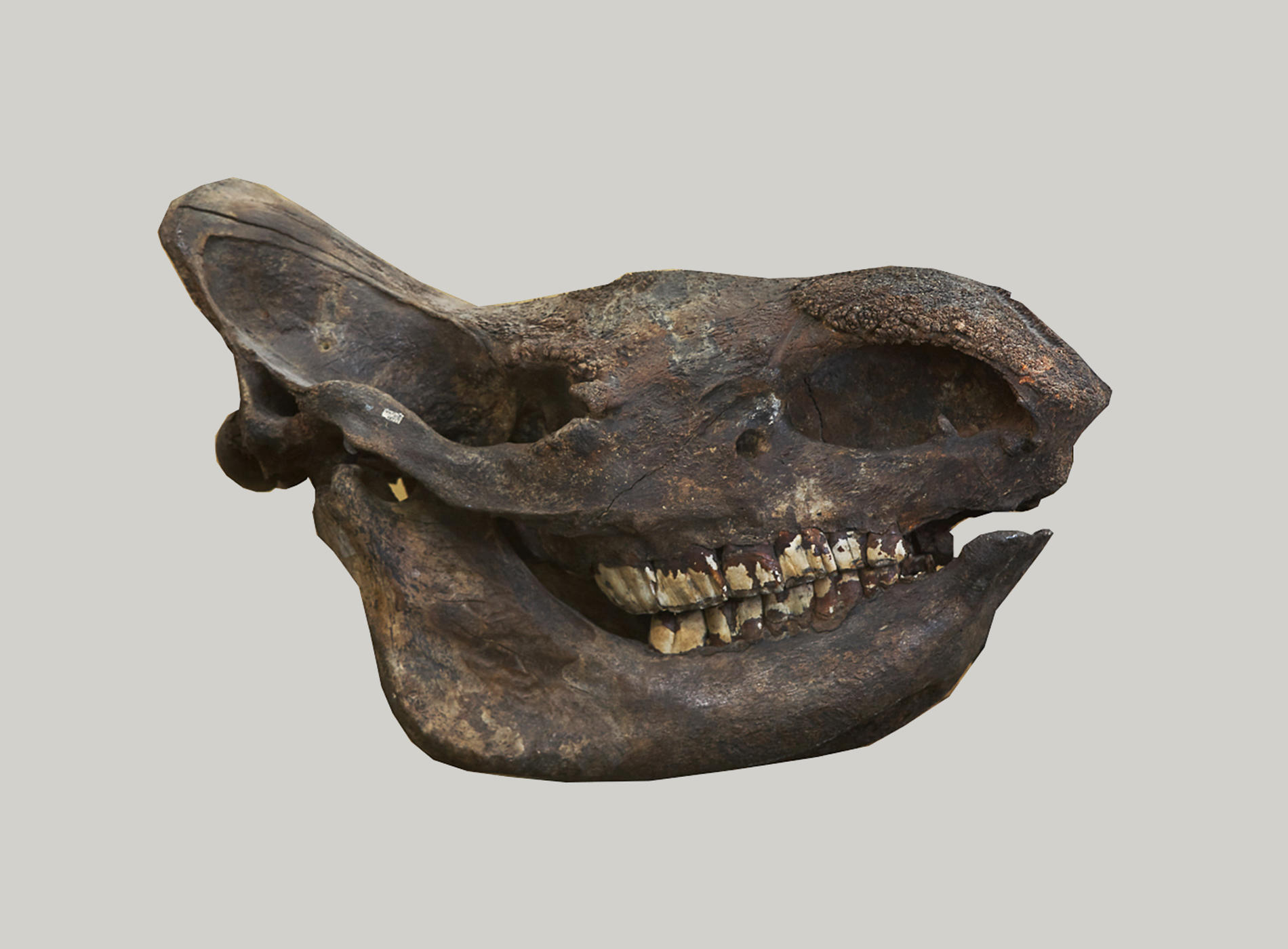


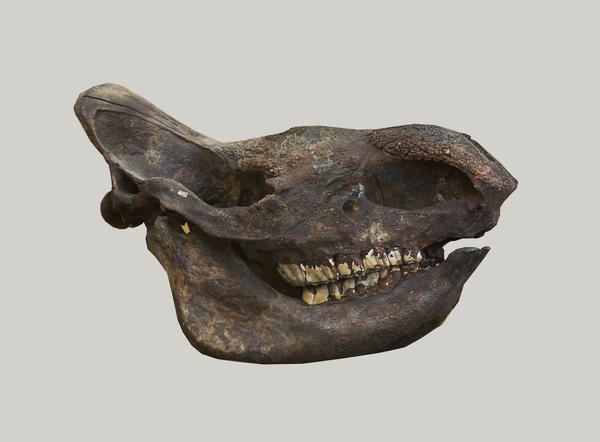
The window displays the skull of a woolly rhinoceros, a mammal from the order of artiodactyls, extinct about 12 or 14 thousand years ago. The animal lived during the Pleistocene and Early Holocene in the territories of central and southern Europe, in southeastern and southwestern Siberia, on the Russian Plain, in Mongolia, Northern China and Primorye.
Woolly rhinoceros was a large mammal. The body of an adult individual was up to 4.5 m long, 1.5 to 2 m high and weighed 1.5 to 3.5 tons. The mammal had two horns on its head, strongly compressed from the sides. The front horn was located on the nasal bones; it often reached one meter (sometimes 1.4 m) in length, and weighed up to 15 kg. The rear horn was on the frontal bone, grew up to 50 cm and was directed forward. The nasal septum between the horns was ossified. Interestingly, all rhinos regardless of their sex had horns.
The life span of a woolly rhinoceros was about 40 years. The animal moved on short three-fingered legs. The peculiarity of this species is its long coat with a thin dense undercoat. Thanks to the lush coat and the skin reaching 4 cm in thickness, rhinos perfectly withstood strong and lengthy frosts.
The rhino lived in open steppes and forest-tundra. These extinct mammals preferred to live near ponds. In the warm season, they ate grass and young shoots of bushes, and in the cold season, their ration consisted of willow, tree bark, thin branches of alder and birch. With the onset of snowy winter, food had to be obtained from under the snow, and the rhino dug up plants using its front horn.
Woolly rhinoceros encountered the primordial man who lived during the Stone Age. Ancient people used these giants’ meat for food and drew hunting scenes on the walls of their caves. Studies have shown that woolly rhino was large, but rare prey. Its remains are found only in 11% of the sites of primitive tribes of the Paleotic period.
It is assumed that woolly rhinos abstained from forming large groups. The beast preferred loneliness to the herd lifestyle, pairing once every 3-4 years for a short time with an individual of the opposite sex for breeding. But the rhinoceros did not die out due to its rare mating; climate change affected the extinction of the species. Lush grassy meadows, swamps and steppes became replaced with dense forests. This led to a significant reduction in the food supply and to a gradual decrease in the number of these mammals.
Woolly rhinoceros was a large mammal. The body of an adult individual was up to 4.5 m long, 1.5 to 2 m high and weighed 1.5 to 3.5 tons. The mammal had two horns on its head, strongly compressed from the sides. The front horn was located on the nasal bones; it often reached one meter (sometimes 1.4 m) in length, and weighed up to 15 kg. The rear horn was on the frontal bone, grew up to 50 cm and was directed forward. The nasal septum between the horns was ossified. Interestingly, all rhinos regardless of their sex had horns.
The life span of a woolly rhinoceros was about 40 years. The animal moved on short three-fingered legs. The peculiarity of this species is its long coat with a thin dense undercoat. Thanks to the lush coat and the skin reaching 4 cm in thickness, rhinos perfectly withstood strong and lengthy frosts.
The rhino lived in open steppes and forest-tundra. These extinct mammals preferred to live near ponds. In the warm season, they ate grass and young shoots of bushes, and in the cold season, their ration consisted of willow, tree bark, thin branches of alder and birch. With the onset of snowy winter, food had to be obtained from under the snow, and the rhino dug up plants using its front horn.
Woolly rhinoceros encountered the primordial man who lived during the Stone Age. Ancient people used these giants’ meat for food and drew hunting scenes on the walls of their caves. Studies have shown that woolly rhino was large, but rare prey. Its remains are found only in 11% of the sites of primitive tribes of the Paleotic period.
It is assumed that woolly rhinos abstained from forming large groups. The beast preferred loneliness to the herd lifestyle, pairing once every 3-4 years for a short time with an individual of the opposite sex for breeding. But the rhinoceros did not die out due to its rare mating; climate change affected the extinction of the species. Lush grassy meadows, swamps and steppes became replaced with dense forests. This led to a significant reduction in the food supply and to a gradual decrease in the number of these mammals.