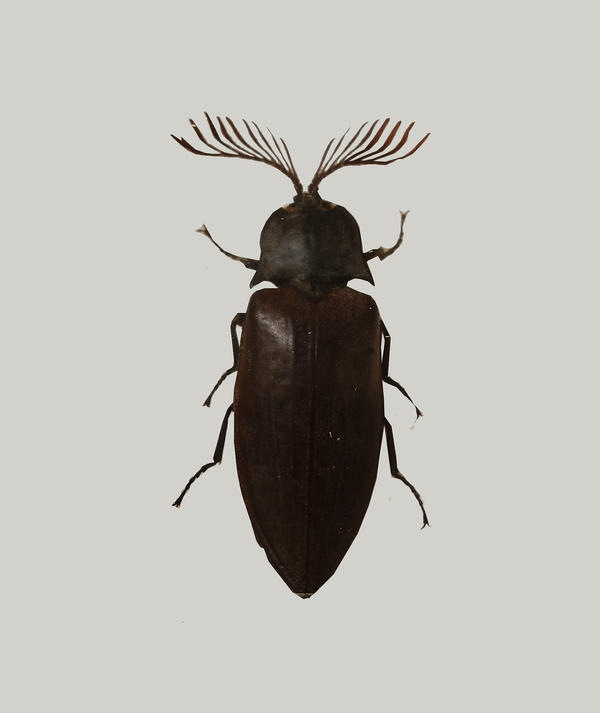
This insect with small antennae and an elongated black or dark brown body with a metallic tint is easy to recognize: when tipped onto its back, the click beetle (Athous haemorrhoidalis) bounces high with a characteristic sound that resembles a click. The family of this beetle is called elaterida, which is translated from ancient Greek as ‘hurler’ or ‘fast moving one’. One way or another, the name is associated with the ability to jump.
Click beetle has yet another incredible ability worthy of the Guinness Book of Records: when it soars up in an attempt to hide from a predator or other threat, its brain is subject to 400-fold overload. Scientists have noted a curious record: a click beetle with body length of 1.2 centimeters jumped 30 centimeters high, while analytical calculations revealed that its brain experienced 2300-fold overload during the jump.
In Russia alone, 335 species of click beetles are known, and there are more than a thousand species of them in the world. They live safely in sandy soil and on the banks of rivers, use anthills and burrows for housing, settle down under bark, moss, and in almost completely rotten wood. A wedge-shaped head and a narrow body reaching up to two centimeters in length facilitate their rapid movement.
After hibernation, beetles appear in May. Females live a nocturnal lifestyle, going out for nectar, pollen, or young leaves by night, and hiding in shelter during the daytime. Males go for a meal in the afternoon, and in the evening they can be seen flying towards sources of light.
The female lays eggs in rotten stumps or under the bark of decaying trees. Normally, beetles don’t damage living trees, only when they are thirsty of hungry. Larvae crawl out of eggs in 14 to 28 days. Larvae can molt up to 15 times during their development period, and this period lasts up to three years.
Surely, you’ve come across potatoes with perfect round holes and passages, as if made with a special tool. This is the work of the click beetle larvae, the so-called wireworms. These larvae got their second name because of their resemblance to copper wire: they are narrow, shiny and hard to touch. These larvae are brisk, they move lightning fast in the ground, drilling root crops and flower tubers easily and quickly. For food, they use both tubers and weed roots.
Click beetles pose a double danger for agriculture, because not only the beetles themselves are voracious, but also their larvae. Therefore, farm owners are struggling with them, treating the soil with special chemicals.
Click beetle has yet another incredible ability worthy of the Guinness Book of Records: when it soars up in an attempt to hide from a predator or other threat, its brain is subject to 400-fold overload. Scientists have noted a curious record: a click beetle with body length of 1.2 centimeters jumped 30 centimeters high, while analytical calculations revealed that its brain experienced 2300-fold overload during the jump.
In Russia alone, 335 species of click beetles are known, and there are more than a thousand species of them in the world. They live safely in sandy soil and on the banks of rivers, use anthills and burrows for housing, settle down under bark, moss, and in almost completely rotten wood. A wedge-shaped head and a narrow body reaching up to two centimeters in length facilitate their rapid movement.
After hibernation, beetles appear in May. Females live a nocturnal lifestyle, going out for nectar, pollen, or young leaves by night, and hiding in shelter during the daytime. Males go for a meal in the afternoon, and in the evening they can be seen flying towards sources of light.
The female lays eggs in rotten stumps or under the bark of decaying trees. Normally, beetles don’t damage living trees, only when they are thirsty of hungry. Larvae crawl out of eggs in 14 to 28 days. Larvae can molt up to 15 times during their development period, and this period lasts up to three years.
Surely, you’ve come across potatoes with perfect round holes and passages, as if made with a special tool. This is the work of the click beetle larvae, the so-called wireworms. These larvae got their second name because of their resemblance to copper wire: they are narrow, shiny and hard to touch. These larvae are brisk, they move lightning fast in the ground, drilling root crops and flower tubers easily and quickly. For food, they use both tubers and weed roots.
Click beetles pose a double danger for agriculture, because not only the beetles themselves are voracious, but also their larvae. Therefore, farm owners are struggling with them, treating the soil with special chemicals.