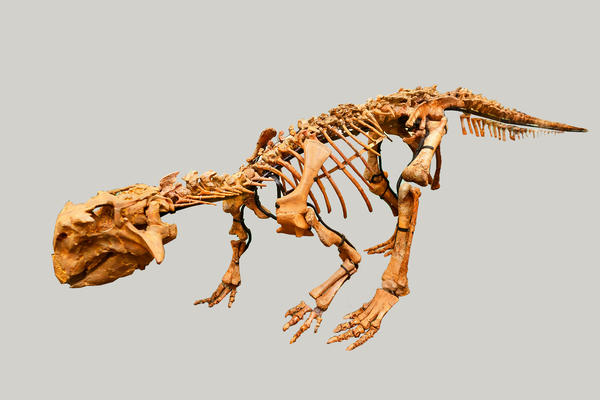
The Siberian psittacosaurus is the largest representative of the psittacosaurus genus. The length of the adult reached 2.5 m, and its weight was a little more than 20 kg. In the ancient Greek language, ‘psittacosaurus’ means ‘parrot pangolin’. This dinosaur did not have wings, but it had a certain resemblance to parrot thanks to its huge beak covered with a cornea.
Psittacosaurus was an herbivorous pangolin who cut off stiff stems of the plants with the sharp edges of its beak. Another feature in common with a parrot is its lack of teeth. The animal grinded plant food with its lower jaw, which moved forward and backward relative to the upper jaw. Near one of the skeletons of the psittacosaurus, in the place where the stomach was located, archaeologists discovered a bunch of smooth stones.
According to scientists, the pangolin swallowed pebbles for better digestion of that plant fibers. This is exactly what chickens and ostriches do in our days. In China, a skeleton of a psittacosaurus of another species with well-preserved imprints of the skin was discovered. On its tail, there are fragments similar to bristles. German archaeologists who investigated the find came to the conclusion that those were protofeathers.
The skin of the animal’s body was covered with large round flaps, with small scales located between them. A distinctive feature of the Siberian psittacosaurus is that it has many horn-shaped growths on the front of its skull: on the cheekbones and around the eyes. The hind legs are much more powerful and longer than the front. Scientists believe that most of the time the pangolin moved on two hind limbs, although it could graze on four if necessary.
Psittacosaurs settled by waterside; they lived in family groups, which included individuals of different ages. The only place in the world where the remains of a Siberian psittacosaurus were found is the vicinity of the village of Shestakovo, Chebulinsky district, Kemerovo region. For the first time, archaeologists discovered skeletons of prehistoric dinosaurs here in 1953. However, back then the find was not classified as a separate species of psittacosaurs.
Only in 1998, paleontologists of Tomsk University who found the remains of two dinosaurs came to the conclusion that this was a completely new species of psittacosaurus, Psittacosaurus sibiricus. Since 2014, excavations have been carried out by employees of the Kemerovo Oblast Museum of Local History. In a small lens about 1.5×4 m in size, archaeologists found 12 perfectly preserved skeletons of Siberian psittacosaurs.
During the Cretaceous period, about 130-125 million years ago, the current surroundings of the village of Shestakovo were located on the coast of a warm tropical sea. Once, due to a flood or debris flow from the mountains, the water level rose sharply, which caused many psittacosaurs to die instantly in a limited area. The excavation site is specially designed to make it convenient for tourists.
Psittacosaurus was an herbivorous pangolin who cut off stiff stems of the plants with the sharp edges of its beak. Another feature in common with a parrot is its lack of teeth. The animal grinded plant food with its lower jaw, which moved forward and backward relative to the upper jaw. Near one of the skeletons of the psittacosaurus, in the place where the stomach was located, archaeologists discovered a bunch of smooth stones.
According to scientists, the pangolin swallowed pebbles for better digestion of that plant fibers. This is exactly what chickens and ostriches do in our days. In China, a skeleton of a psittacosaurus of another species with well-preserved imprints of the skin was discovered. On its tail, there are fragments similar to bristles. German archaeologists who investigated the find came to the conclusion that those were protofeathers.
The skin of the animal’s body was covered with large round flaps, with small scales located between them. A distinctive feature of the Siberian psittacosaurus is that it has many horn-shaped growths on the front of its skull: on the cheekbones and around the eyes. The hind legs are much more powerful and longer than the front. Scientists believe that most of the time the pangolin moved on two hind limbs, although it could graze on four if necessary.
Psittacosaurs settled by waterside; they lived in family groups, which included individuals of different ages. The only place in the world where the remains of a Siberian psittacosaurus were found is the vicinity of the village of Shestakovo, Chebulinsky district, Kemerovo region. For the first time, archaeologists discovered skeletons of prehistoric dinosaurs here in 1953. However, back then the find was not classified as a separate species of psittacosaurs.
Only in 1998, paleontologists of Tomsk University who found the remains of two dinosaurs came to the conclusion that this was a completely new species of psittacosaurus, Psittacosaurus sibiricus. Since 2014, excavations have been carried out by employees of the Kemerovo Oblast Museum of Local History. In a small lens about 1.5×4 m in size, archaeologists found 12 perfectly preserved skeletons of Siberian psittacosaurs.
During the Cretaceous period, about 130-125 million years ago, the current surroundings of the village of Shestakovo were located on the coast of a warm tropical sea. Once, due to a flood or debris flow from the mountains, the water level rose sharply, which caused many psittacosaurs to die instantly in a limited area. The excavation site is specially designed to make it convenient for tourists.