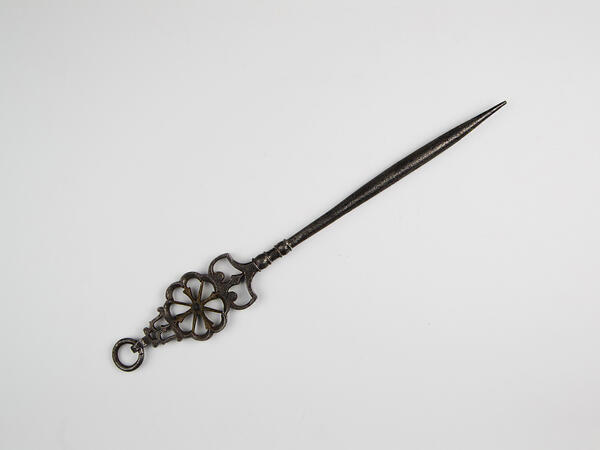
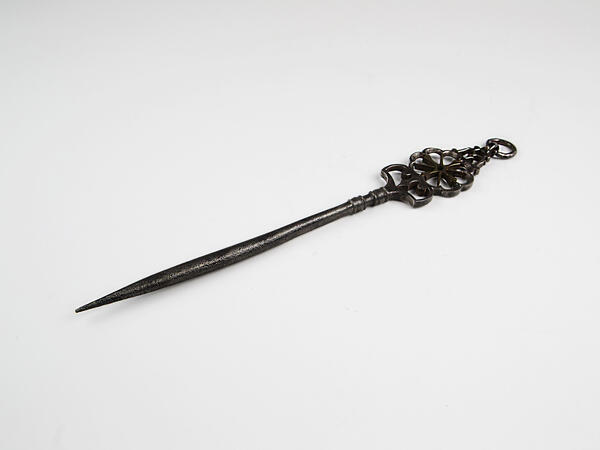
The Historical and Memorial Museum of the Demidovs presents a curious exhibit — a probe designed to take samples of dry goods from a cloth bag.
Grain was always valuable. It was important to preserve crops for as long as possible, so that there was enough high-quality grain for use and for sale. To do this, people used all kinds of methods. Merchants took probes, like the one seen on display, with them to the fair and checked the grain before buying it. With such a device one no longer needed to go through the laborious process of pouring the grains out of the bag or risk being fooled when only visually examining the top layer of the bag. A probe allowed one to obtain grain samples from the middle or even the bottom of the bag without damaging it. The probe was carefully inserted into the burlap bag from the side towards the middle with the grooves pointing down, then rotated 180 degrees and carefully removed. The resulting hole in the bag’s fabric was sealed by shifting the threads of the burlap with the tip of the probe, after which the grain was examined to reveal possible flaws.
Such devices are still actively used to this day, although their size and design are quite different. Grains stored in warehouses without a cellar, especially with asphalt and concrete floors, have shown that grain usually begins to spoil from the bottom layer, that is directly on the floor of the granary. Many devices are not designed to take samples from grains that lay at the very bottom, therefore, in order to evaluate the freshness of the grain from that level, one would need to remove part of the grain mound, which would take a lot of work, time and money. The compartments of such probes open only when the cone-shaped tip touches the floor, thus sending a spring mechanism into motion. An additional spring is installed between the compartments and the rod to ensure that the compartments open only when the probe tip touches the floor. The upper cone of the movable cone tip, in the process of opening the compartments, acts as a wedge, ensuring the compartments open even in a heavily-packed grain layer.