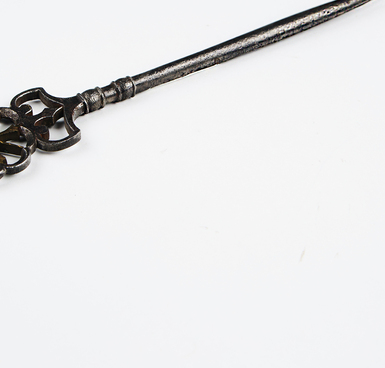
The Historical and Memorial Museum of the Demidovs presents the Sirin bird padlock for jewelry boxes, which encompasses all the charm of the elegant art of the second half of the 18th century.
Decorative boxes for storing “little things dear to the heart”, trinkets, presents, numerous boxes for letters, securities and jewelry kept under lock and key were hallmarks of this time with its reverent attitude to secrets. Padlocks were assigned the role of guardians of these boxes. Executed with inexhaustible imagination, these locks did not only guard the box’s contents, but also served as decoration, completing the intricate designs of small chests and jewelry boxes of the Catherine era.
In the 18th century, the village of Pavlovo near the Oka River became famous for its padlocks for jewelry boxes, they were also made in Tula. In Pavlovo, they were mostly made of brass supplied by the Demidov factories in the Urals. Traditions of processing copper for making arms and padlocks were preserved in technical fundamentals and methods of the craft: forging, cutting, embossing, engraving. Tiny locks of the 18th century are among the rarest items in museum collections.
Such meticulously crafted items with a locking mechanism were more often used as decoration than for their intended purpose. Each preserved lock is an original piece of work. The exhibit on display is decorated with the fabulous Sirin bird (the Old Russian word “sirin” came from the Greek “Σειρῆνες”, meaning “sirens”). In Old Russian art and legends this bird is a bird of paradise with the head of a beautiful maiden. It is believed that the Sirin are Slavic versions of Greek sirens. It is often depicted together with another bird of paradise, the Alkonost. Unlike the Alkonost, the Sirin is sometimes shown with its head uncovered and encircled by a halo.
Miniature padlocks from Tula made in the form of flat silhouette figurines and decorated in detail with engraving-like carved strokes are original works of Russian applied arts.